
Zollinger-Ellison syndrome (ZES) is a rare gastrointestinal disorder caused by a gastrin-secreting neuroendocrine tumor called a gastrinoma. Excess gastrin stimulates gastric acid production, leading to recurrent peptic ulcers, gastroesophageal reflux, and sometimes chronic diarrhea. Understanding this condition connects endocrine signaling, digestive physiology, and gastrointestinal pathology—important concepts for MCAT biology and medical education.
🧬 What Is Zollinger-Ellison Syndrome?
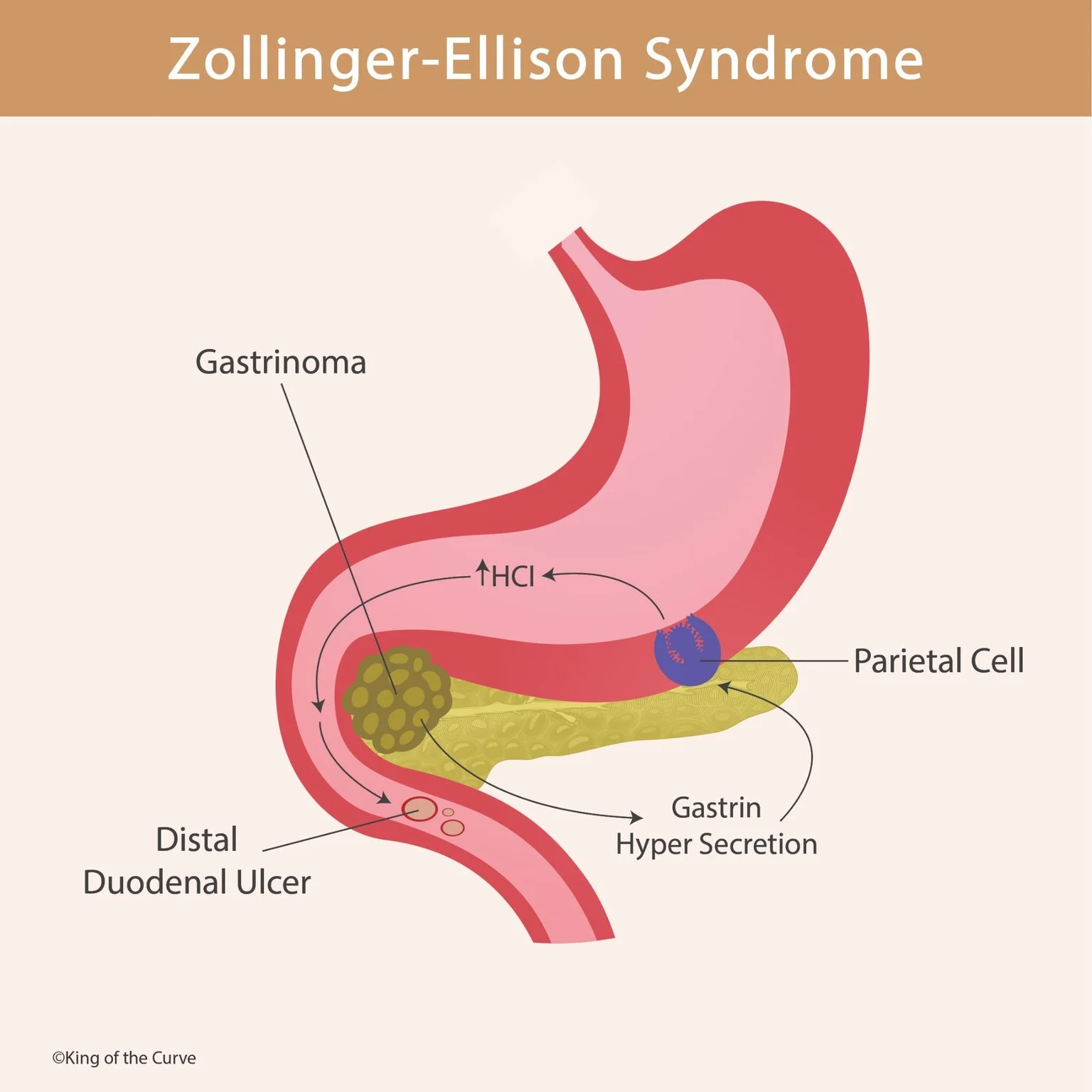
Zollinger-Ellison syndrome occurs when a gastrinoma releases excessive amounts of gastrin independently of normal physiological regulation. Gastrinomas most commonly arise in the duodenum or pancreas. The resulting hypergastrinemia causes excessive gastric hydrochloric acid (HCl) secretion, which can overwhelm the protective mechanisms of the gastrointestinal tract.
Unlike ordinary peptic ulcer disease, ZES may produce multiple, recurrent, or treatment-resistant ulcers, sometimes in unusual locations beyond the duodenal bulb.
🫀 Where Do Gastrinomas Develop?
Most gastrinomas occur within the gastrinoma triangle, an anatomical region encompassing portions of the duodenum and pancreatic head. Although gastrinomas were historically associated primarily with the pancreas, the duodenum is a particularly common primary site.
These tumors may occur sporadically or in association with multiple endocrine neoplasia type 1 (MEN1), an inherited tumor-predisposition syndrome.
⚗️ How Gastrin Stimulates Gastric Acid Production
Gastrin normally originates from G cells in the gastric antrum and helps regulate digestion. It stimulates acid secretion primarily by activating enterochromaffin-like (ECL) cells, which release histamine. Histamine then binds H₂ receptors on gastric parietal cells, increasing acid production. Gastrin can also stimulate parietal cells directly.
The simplified pathway is:
In Zollinger-Ellison syndrome, uncontrolled gastrin secretion keeps this pathway excessively active.
🔥 Why Does Zollinger-Ellison Syndrome Cause Ulcers?
Excessive gastric acid enters the duodenum and can overwhelm mucosal defenses, causing inflammation and ulceration. Patients may develop recurrent duodenal ulcers, including ulcers distal to the duodenal bulb, which should raise suspicion for ZES.
High acid levels can also impair pancreatic enzyme activity, particularly pancreatic lipase, contributing to fat malabsorption and diarrhea. These findings help distinguish ZES from uncomplicated peptic ulcer disease.
🩺 Common Signs and Symptoms
The most common manifestations include persistent or recurrent abdominal pain, severe gastroesophageal reflux, chronic diarrhea, and peptic ulcers that recur despite treatment. Some patients also experience nausea, gastrointestinal bleeding, or weight loss.
A particularly important clinical clue is the combination of recurrent peptic ulcers and chronic diarrhea, especially when ulcers are multiple or occur in unusual locations.
🧪 How Is Zollinger-Ellison Syndrome Diagnosed?
Diagnosis generally begins with measuring fasting serum gastrin alongside gastric acidity. A markedly elevated fasting gastrin level, greater than ten times the upper limit of normal, combined with a gastric pH of 2 or lower strongly supports the diagnosis.
Moderate gastrin elevations are less specific because proton pump inhibitors, atrophic gastritis, and other conditions can also increase gastrin levels. A secretin stimulation test may help in selected cases: gastrin levels paradoxically rise after secretin administration in patients with gastrinomas.
Tumor localization may involve endoscopic ultrasound, cross-sectional imaging, or somatostatin receptor imaging. Proton pump inhibitors should not be discontinued without specialist supervision, because stopping acid suppression in suspected ZES can be dangerous.
📊 Zollinger-Ellison Syndrome vs. Typical Peptic Ulcer Disease
| Feature | Zollinger-Ellison Syndrome | Typical Peptic Ulcer Disease |
|---|---|---|
| Primary Mechanism | Excess gastrin from a gastrinoma | Commonly H. pylori infection or NSAID use |
| Gastric Acid Secretion | Markedly increased | Variable |
| Ulcer Location | Often duodenal; may be multiple or distal | Usually stomach or proximal duodenum |
| Diarrhea | Relatively common | Less characteristic |
| Fasting Gastrin | Often elevated | Usually not markedly elevated |
| Treatment | Acid suppression and tumor-directed management | Cause-directed therapy and acid suppression |
💊 Treatment and Management
High-dose proton pump inhibitors are central to controlling excessive gastric acid secretion and preventing ulcer complications. Depending on tumor location, extent, and clinical circumstances, surgical resection may be considered.
Patients with metastatic or unresectable gastrinomas may require additional treatments, including somatostatin analogs or other neuroendocrine tumor-directed therapies. Individuals with suspected MEN1 may also need genetic evaluation and assessment for associated endocrine tumors.
🧠 High-Yield MCAT Takeaways
For MCAT preparation, remember that gastrin increases gastric acid secretion, histamine acts through H₂ receptors, and parietal cells secrete HCl through the H⁺/K⁺-ATPase. Gastrinomas disrupt the normal feedback regulation of gastric acid secretion.
The key relationship is:
Also remember the association between gastrinomas and MEN1, which classically involves the parathyroid glands, pancreatic or duodenal neuroendocrine tumors, and pituitary gland.
🎯 Master Gastrointestinal Physiology for the MCAT
Zollinger-Ellison syndrome illustrates how abnormal hormone secretion can disrupt normal digestive physiology. By understanding the relationship between gastrin, histamine, parietal cells, and acid secretion, students can connect endocrine signaling to gastrointestinal disease.

Frequently Asked Questions (FAQs)
-
Aim for 4-6 focused hours, ensuring you incorporate breaks to avoid burnout.
-
Practice mindfulness techniques, take practice exams under realistic conditions, and maintain a balanced lifestyle.
-
Set short-term goals, seek support from mentors, and reward yourself for small achievements.
-
Regular exercise improves focus, reduces stress, and enhances overall mental clarity.
-
KOTC offers personalized learning tools, gamification features, and adaptive question banks to help students stay on track without burnout.