
Understanding how people learn is an important part of the MCAT Psychology and Sociology section. One of the most influential concepts in developmental psychology is the Zone of Proximal Development (ZPD), introduced by psychologist Lev Vygotsky. This theory explains how learners develop new skills through guidance, social interaction, and appropriate challenges.
🧠 What Is the Zone of Proximal Development?
The Zone of Proximal Development (ZPD) is the difference between what a learner can accomplish independently and what they can accomplish with guidance from a more knowledgeable person. Vygotsky believed learning is strongly influenced by social interactions and that appropriate assistance helps learners develop skills they cannot yet perform alone.
🎯 The Three Learning Zones
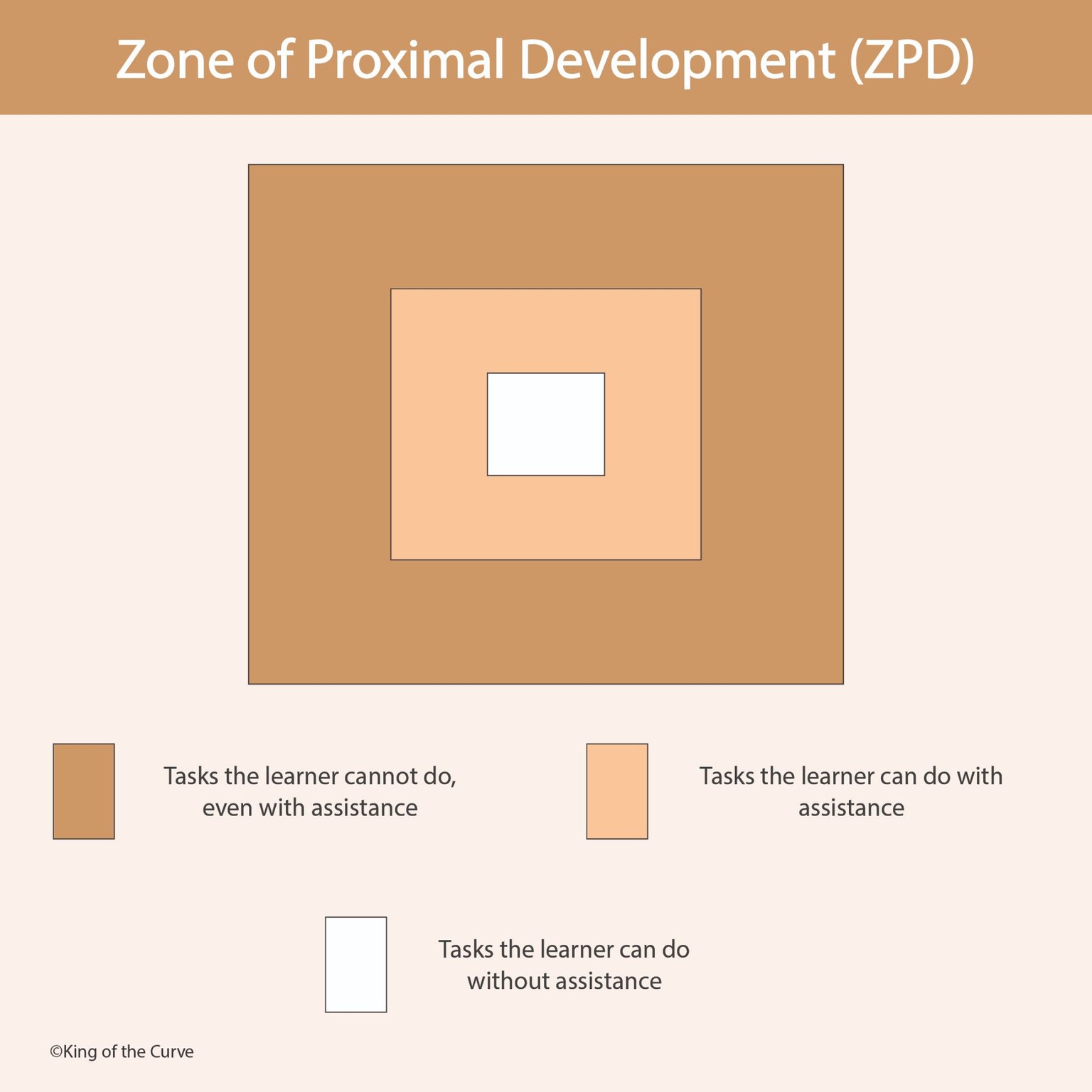
The ZPD model can be understood through three levels of learning. Each represents a different relationship between the learner's current abilities and the difficulty of a task.
| Learning Zone | Description | Example |
|---|---|---|
| Independent Performance | Tasks the learner can complete without assistance. | Solving basic arithmetic problems alone. |
| Zone of Proximal Development (ZPD) | Tasks the learner can complete with appropriate guidance. | Solving algebra problems with a teacher's hints. |
| Beyond Current Capability | Tasks the learner cannot complete even with available assistance. | Solving advanced calculus before learning foundational mathematics. |
The middle zone is the ZPD, where appropriate guidance can help the learner develop new abilities.
👨🏫 What Is Scaffolding in Learning?
Scaffolding is temporary instructional support that helps learners complete tasks they cannot yet perform independently. This support may include demonstrations, hints, feedback, or step-by-step explanations. As competence improves, assistance is gradually reduced.
Although scaffolding is closely associated with Vygotsky's theory, the instructional term was developed later by researchers including Wood, Bruner, and Ross.
🤝 The Role of the More Knowledgeable Other (MKO)
A More Knowledgeable Other (MKO) is someone who possesses greater knowledge or skill in a particular area. This individual might be a teacher, parent, tutor, or experienced peer. Through guided interaction, the learner can acquire strategies and knowledge that eventually become part of their independent abilities.
📚 How Social Interaction Supports Cognitive Development
Vygotsky emphasized that learning is fundamentally social. Children often develop cognitive skills through conversations, shared activities, and collaboration. Over time, strategies initially supported by others can become internalized, allowing the learner to perform tasks independently.
Language plays a particularly important role because it supports communication, reasoning, and self-regulation.
🔬 Vygotsky vs. Piaget: Important MCAT Differences
Vygotsky and Jean Piaget both studied cognitive development, but their theories emphasize different mechanisms.
Piaget focused on how children construct knowledge through interactions with their environment and progress through broad developmental stages. Vygotsky emphasized the influence of social interaction, culture, language, and guided learning.
For the MCAT, remember that Piaget is associated with developmental stages, while Vygotsky is strongly associated with the ZPD and socially supported learning.
🩺 Real-Life Example: Learning a Clinical Skill
Imagine a medical student learning to interpret an electrocardiogram (ECG). Initially, the student can identify basic heart rhythms independently but struggles with complex arrhythmias.
An instructor demonstrates a systematic interpretation method and provides feedback during practice. With this guidance, the student correctly identifies rhythms that were previously too difficult. As the student becomes more proficient, the instructor reduces assistance.
This is an example of learning within the Zone of Proximal Development, supported by scaffolding.
📝 How the ZPD Appears on the MCAT
MCAT questions may describe a student completing a difficult task with help from a teacher or experienced peer. The correct concept is likely the Zone of Proximal Development when the task is beyond the student's independent ability but achievable with assistance.
A related question may ask what happens when an instructor gradually removes support as the learner becomes more capable. That process is called scaffolding.
Remember the distinction: ZPD describes the range of tasks achievable with assistance; scaffolding describes the support provided during learning.
⭐ High-Yield MCAT Takeaways
Vygotsky's Zone of Proximal Development highlights how appropriate guidance can promote cognitive development. The learner's current independent abilities form one boundary, while tasks achievable with assistance define the upper boundary of the ZPD. Tasks that remain too difficult even with support fall beyond that range.

Frequently Asked Questions (FAQs)
-
Aim for 4-6 focused hours, ensuring you incorporate breaks to avoid burnout.
-
Practice mindfulness techniques, take practice exams under realistic conditions, and maintain a balanced lifestyle.
-
Set short-term goals, seek support from mentors, and reward yourself for small achievements.
-
Regular exercise improves focus, reduces stress, and enhances overall mental clarity.
-
KOTC offers personalized learning tools, gamification features, and adaptive question banks to help students stay on track without burnout.