
⚛️ What Is Half-Life in Chemical Reactions?
Half-life is the amount of time required for the concentration of a reactant to decrease to half of its initial value. It is one of the most important concepts in chemical kinetics because it helps scientists predict how quickly reactions proceed. On the MCAT, understanding half-life allows students to interpret reaction rates, compare different reaction orders, and solve kinetics problems with confidence.
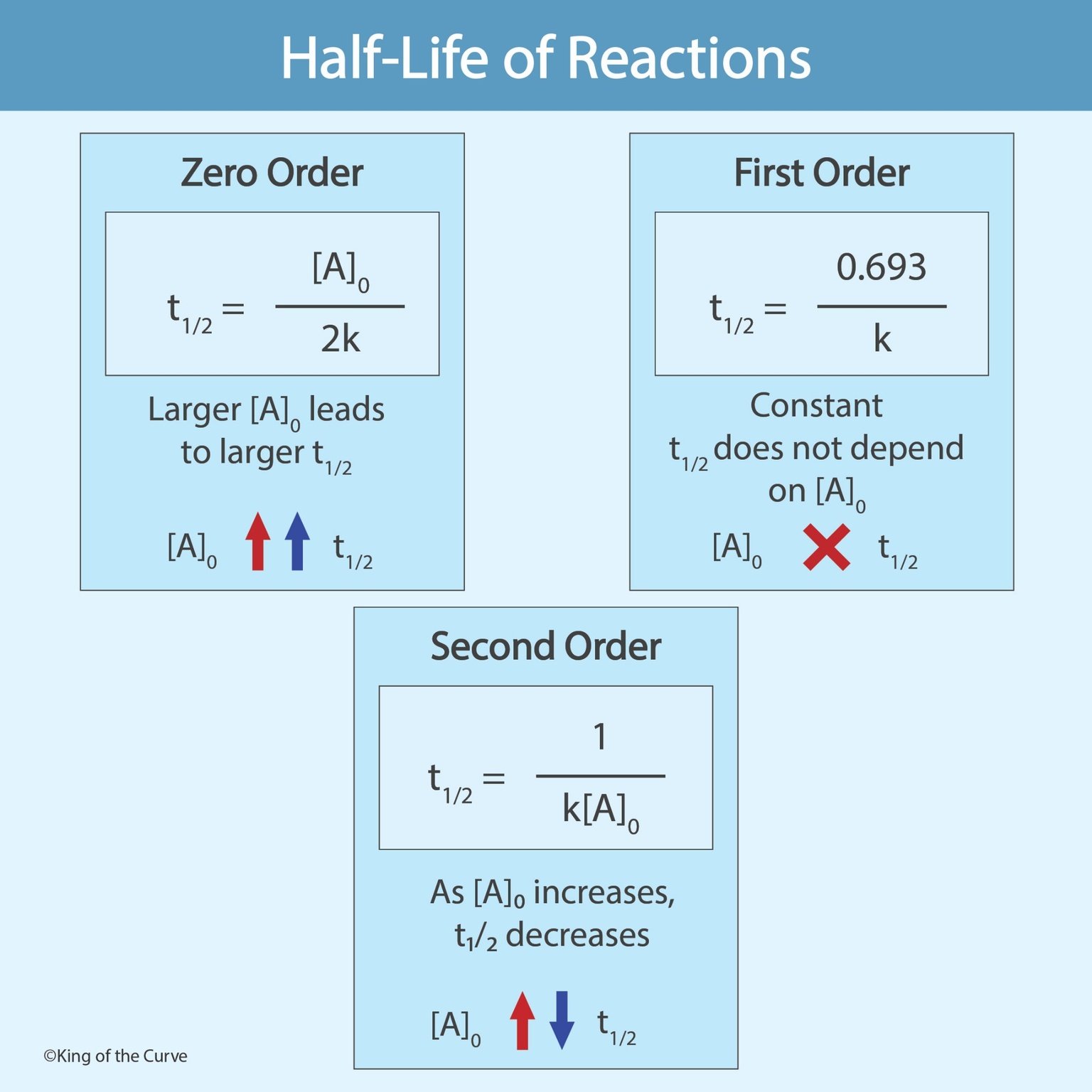
🧪 Why Half-Life Depends on Reaction Order
Not all chemical reactions lose half of their reactants at the same rate. The relationship between half-life and reactant concentration depends entirely on the order of the reaction. Zero-order, first-order, and second-order reactions each have unique half-life equations, making it important to recognize which formula applies before solving a problem. Identifying the reaction order is often the first step in MCAT kinetics questions.
📐 Zero-Order Reactions
For a zero-order reaction, the half-life is given by:
t₁/₂ = [A]₀ / 2k
This equation shows that the half-life is directly proportional to the initial concentration of the reactant. As the initial concentration increases, the half-life also increases. In other words, zero-order reactions take longer to reach half of their original concentration when more reactant is present at the start.
⏱️ First-Order Reactions
The half-life of a first-order reaction is calculated using:
t₁/₂ = 0.693 / k
Unlike zero-order reactions, the half-life of a first-order reaction is constant and does not depend on the initial concentration of the reactant. This property makes first-order kinetics especially important in radioactive decay, drug metabolism, and many biological processes frequently discussed on the MCAT.
⚡ Second-Order Reactions
For second-order reactions, the half-life is expressed as:
t₁/₂ = 1 / (k[A]₀)
In this case, the half-life is inversely proportional to the initial concentration. As the initial concentration increases, the half-life becomes shorter. This means highly concentrated second-order reactions consume half of their reactants more quickly than dilute solutions.
📋 Comparison of Half-Life Equations
| Reaction Order | Half-Life Formula | Effect of Increasing [A]0 |
|---|---|---|
| Zero Order | t1/2 = [A]0 / 2k | Half-life increases |
| First Order | t1/2 = 0.693 / k | No change (constant) |
| Second Order | t1/2 = 1 / (k[A]0) | Half-life decreases |
🎯 How the MCAT Tests Half-Life
The MCAT frequently presents graphs, laboratory data, or reaction tables and asks students to determine the reaction order based on half-life behavior. Instead of memorizing formulas alone, focus on recognizing how changing the initial concentration affects half-life. Knowing these relationships allows you to identify reaction order quickly during passage-based questions and avoid unnecessary calculations.
❌ Common Mistakes to Avoid
Many students mistakenly assume that all reactions have a constant half-life. In reality, only first-order reactions exhibit a concentration-independent half-life. Another common mistake is using the wrong half-life equation after identifying the reaction order. Always determine whether the reaction is zero, first, or second order before selecting the appropriate formula.
🚀 Master Chemical Kinetics with King of the Curve
Chemical kinetics becomes much easier when formulas are paired with visual learning. King of the Curve's exclusive science illustrations simplify reaction orders, half-life equations, and other high-yield chemistry concepts into memorable diagrams that improve long-term retention. Explore this illustration and 1,000+ additional science visuals at mcat.kingofthecurve.org, and strengthen your preparation with adaptive question banks, daily challenges, gamified learning, and comprehensive MCAT study resources designed to help you succeed.

Frequently Asked Questions (FAQs)
-
Aim for 4-6 focused hours, ensuring you incorporate breaks to avoid burnout.
-
Practice mindfulness techniques, take practice exams under realistic conditions, and maintain a balanced lifestyle.
-
Set short-term goals, seek support from mentors, and reward yourself for small achievements.
-
Regular exercise improves focus, reduces stress, and enhances overall mental clarity.
-
KOTC offers personalized learning tools, gamification features, and adaptive question banks to help students stay on track without burnout.