
⚖️ What Is an Inclined Plane Free Body Diagram?
An inclined plane free body diagram is a visual representation of all the forces acting on an object placed on a sloped surface. Instead of analyzing motion using only vertical and horizontal directions, physicists resolve forces into components that are parallel and perpendicular to the incline. This technique simplifies calculations involving acceleration, friction, and equilibrium, making it one of the most frequently tested topics in MCAT Physics.
📐 Why Resolve Forces on an Incline?
Gravity always acts straight downward, but an object on an inclined plane does not move straight down—it moves along the surface. To make calculations easier, the weight of the object is divided into two components: one acting parallel to the incline and another acting perpendicular to it. These components allow students to apply Newton's Laws directly along the object's direction of motion.
🧲 Understanding the Forces
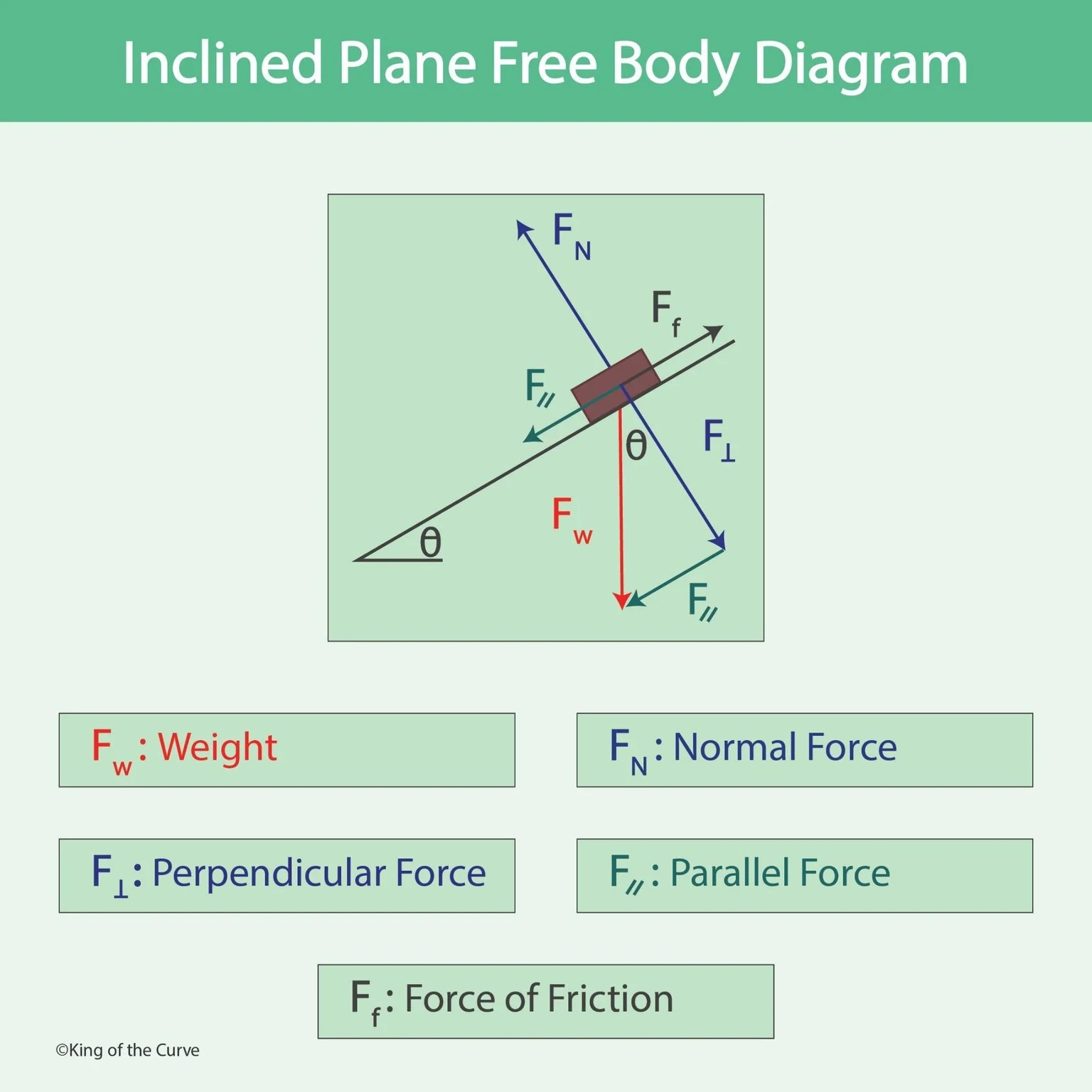
Several forces appear in an inclined plane free body diagram. The weight (F<sub>w</sub>) acts vertically downward due to gravity. The normal force (F<sub>N</sub>) acts perpendicular to the surface and supports the object. The parallel force (F<sub>∥</sub>) is the component of gravity pulling the object down the slope, while the perpendicular force (F<sub>⊥</sub>) presses the object into the surface. If friction is present, the force of friction (F<sub>f</sub>) opposes the direction of motion along the incline.
📊 Breaking Down the KOTC Illustration
The King of the Curve illustration clearly labels every force acting on a block resting on an inclined plane. It shows the weight vector pointing downward, the normal force extending outward from the surface, and the weight resolved into parallel and perpendicular components. The diagram also highlights the frictional force acting opposite the object's motion. By separating these forces visually, students can quickly identify which forces contribute to acceleration and which balance one another.
🚗 Real-World Applications
Inclined planes appear everywhere in everyday life. Cars driving up hills, boxes sliding down ramps, roller coasters climbing tracks, and wheelchair access ramps all involve the same principles shown in a free body diagram. Engineers use these force calculations when designing roads, conveyor systems, and transportation equipment to ensure both efficiency and safety.
📋 Key Forces on an Inclined Plane
| Force | Symbol | Direction & Purpose |
|---|---|---|
| Weight | Fw | Acts vertically downward due to gravity. |
| Normal Force | FN | Acts perpendicular to the inclined surface. |
| Parallel Force | F∥ | Pulls the object down the incline. |
| Perpendicular Force | F⊥ | Pushes the object into the surface. |
| Friction | Ff | Opposes motion along the incline. |
🎯 How the MCAT Tests Inclined Planes
The MCAT commonly presents inclined plane problems involving Newton's Laws, friction, and force decomposition. Students may be asked to calculate acceleration, determine the normal force, or predict how changing the angle of the incline affects motion. Remember that increasing the angle increases the parallel component of gravity while decreasing the perpendicular component, making objects more likely to slide.
❌ Common Mistakes to Avoid
A frequent mistake is drawing the normal force vertically instead of perpendicular to the surface. Another common error is forgetting to resolve the weight into parallel and perpendicular components before applying Newton's Second Law. Students should also pay close attention to the direction of friction, which always acts opposite the object's actual or impending motion—not necessarily uphill or downhill.
🚀 Master Physics with King of the Curve
Free body diagrams become much easier to understand through visual learning. King of the Curve's exclusive science illustrations simplify topics like inclined planes, force decomposition, and Newtonian mechanics into memorable diagrams that improve long-term retention. Explore this illustration along with 1,000+ visual study resources at mcat.kingofthecurve.org, and strengthen your preparation with adaptive question banks, daily challenges, gamified learning, and comprehensive MCAT study tools designed to help you succeed.

Frequently Asked Questions (FAQs)
-
Aim for 4-6 focused hours, ensuring you incorporate breaks to avoid burnout.
-
Practice mindfulness techniques, take practice exams under realistic conditions, and maintain a balanced lifestyle.
-
Set short-term goals, seek support from mentors, and reward yourself for small achievements.
-
Regular exercise improves focus, reduces stress, and enhances overall mental clarity.
-
KOTC offers personalized learning tools, gamification features, and adaptive question banks to help students stay on track without burnout.