
⚛️ What Is Formal Charge?
Formal charge is a bookkeeping tool used in chemistry to determine how electrons are distributed among atoms within a molecule. It helps predict the most stable Lewis structure, identify likely reaction sites, and understand molecular behavior. For students preparing for the MCAT, mastering formal charge is essential because it frequently appears in questions involving resonance structures, molecular geometry, and chemical bonding.
🧪 Why Is Formal Charge Important?
Formal charge allows chemists to compare different Lewis structures and determine which one best represents a molecule. The preferred structure generally minimizes formal charges and places any negative charges on the more electronegative atoms. While formal charge does not represent the actual charge on an atom, it provides a useful approximation that helps explain molecular stability and chemical reactivity.
📐 Understanding the Formal Charge Formula
The formal charge of an atom is calculated using the equation:
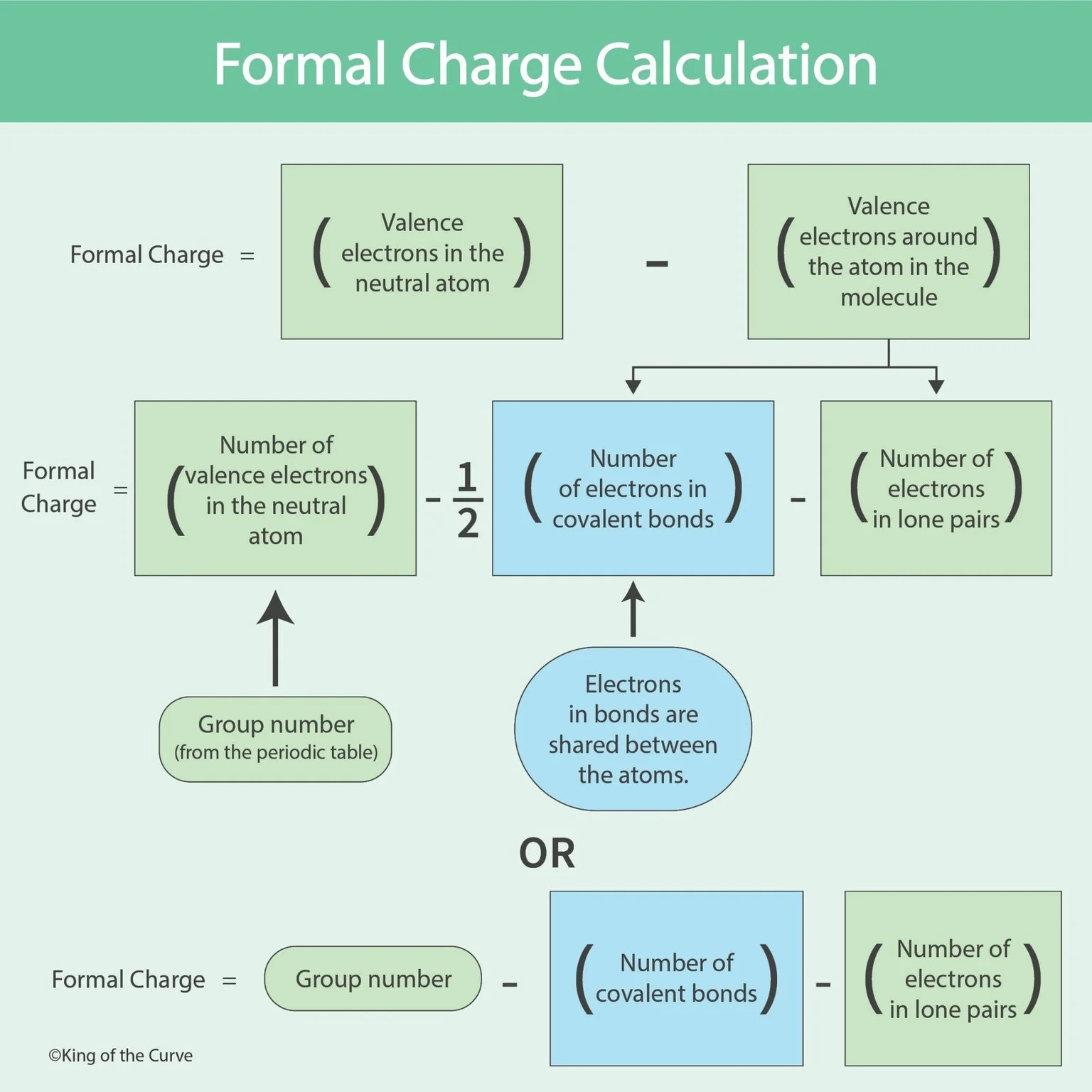
Formal Charge = Valence Electrons − (Nonbonding Electrons + ½ × Bonding Electrons)
This formula compares the number of valence electrons in a neutral atom with the electrons assigned to that atom within a molecule. Because bonding electrons are shared equally between two atoms, only half of the bonding electrons are counted toward each atom's formal charge.
📝 Breaking Down the KOTC Illustration
The King of the Curve illustration simplifies the formal charge calculation into easy-to-follow steps. It first introduces the general formula, then breaks the calculation into three essential components: the number of valence electrons, the electrons involved in covalent bonds, and the electrons found in lone pairs. The diagram also highlights a convenient shortcut that uses the atom's group number, making formal charge calculations much faster during timed exams.
🧬 Real-World Applications
Formal charge plays a major role in predicting molecular structure and reaction mechanisms. Organic chemists use it to determine the most likely resonance contributors, while biochemists rely on formal charges to understand enzyme function, amino acid ionization, and molecular interactions. Whether analyzing DNA, proteins, or pharmaceutical compounds, formal charge provides valuable insight into how molecules behave.
📋 Components of the Formal Charge Formula
| Component | Description | Role in the Calculation |
|---|---|---|
| Valence Electrons | Electrons in the neutral atom, based on group number. | Starting value for the calculation. |
| Bonding Electrons | Electrons shared in covalent bonds. | Count only half because they are shared equally. |
| Lone Pair Electrons | Nonbonding electrons assigned to the atom. | Subtract all lone pair electrons. |
🎯 How the MCAT Tests Formal Charge
The MCAT often presents Lewis structures and asks students to identify the atom with the lowest or highest formal charge, determine the most stable resonance structure, or predict reaction products. Instead of memorizing structures, focus on understanding how electrons are assigned during formal charge calculations. Being able to calculate formal charge quickly can save valuable time during the Chemistry and Biochemistry section.
❌ Common Mistakes to Avoid
A common mistake is counting all bonding electrons instead of assigning only half to each bonded atom. Another frequent error is confusing formal charge with oxidation state, even though they represent different concepts. Students should also remember that formal charge is based on electron ownership in Lewis structures, not on actual electron density measured experimentally.
🚀 Master Chemistry with King of the Curve
Complex chemistry concepts become much easier when paired with visual learning. King of the Curve's exclusive science illustrations simplify topics like formal charge into memorable diagrams that improve long-term retention. Explore this illustration along with 1,000+ visual study resources at mcat.kingofthecurve.org, and strengthen your preparation with adaptive question banks, daily challenges, gamified learning, and comprehensive MCAT study tools designed to help you succeed.

Frequently Asked Questions (FAQs)
-
Aim for 4-6 focused hours, ensuring you incorporate breaks to avoid burnout.
-
Practice mindfulness techniques, take practice exams under realistic conditions, and maintain a balanced lifestyle.
-
Set short-term goals, seek support from mentors, and reward yourself for small achievements.
-
Regular exercise improves focus, reduces stress, and enhances overall mental clarity.
-
KOTC offers personalized learning tools, gamification features, and adaptive question banks to help students stay on track without burnout.