
🫁 Embryological Development of the Lungs (Copy)
The development of the lungs is one of the most fascinating processes in human embryology, transforming a simple foregut outgrowth into a highly specialized organ capable of gas exchange. Understanding the stages of lung development is essential for MCAT, medical school, nursing, and physiology courses because it connects anatomy, embryology, and neonatal health.
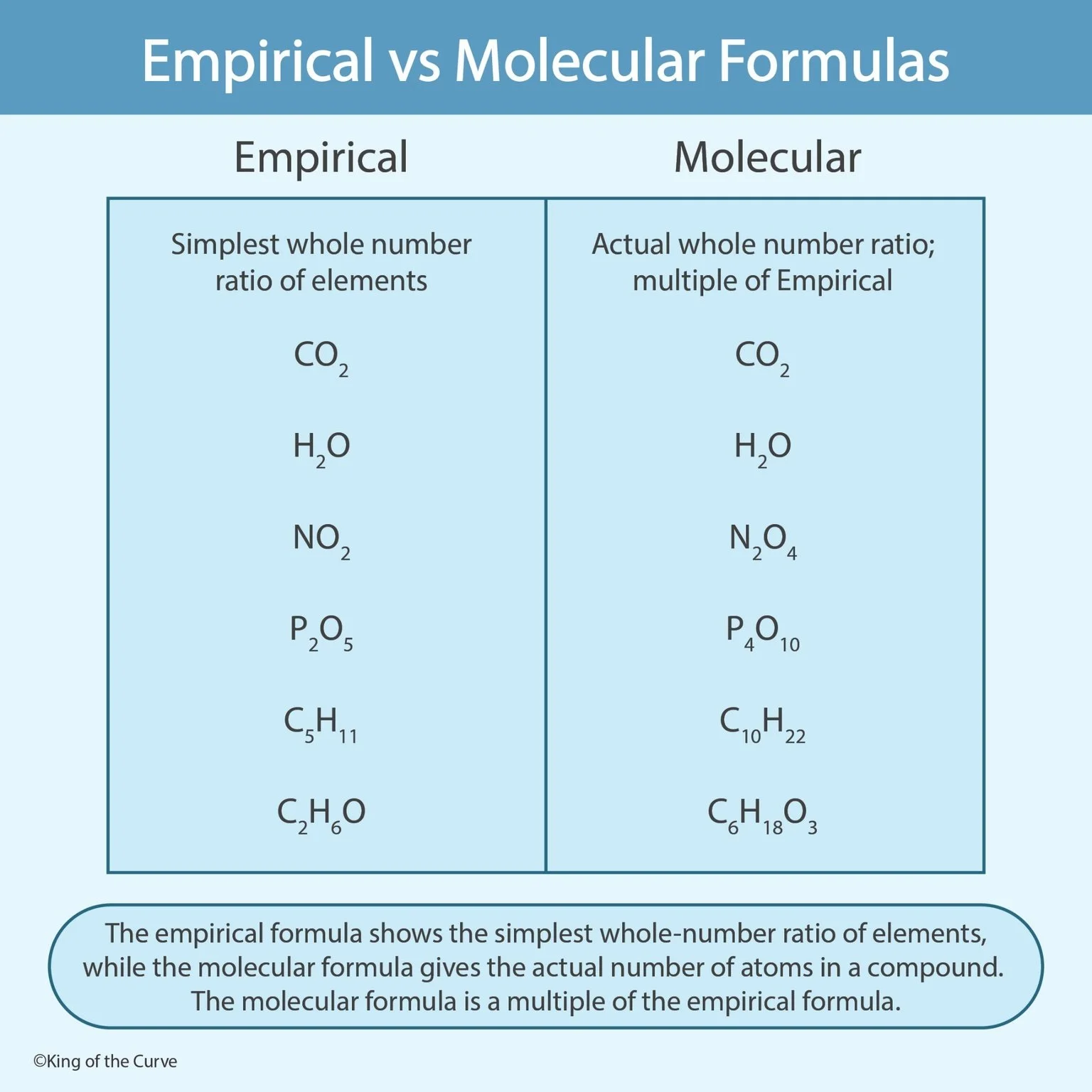
🔬 What Is an Empirical Formula?
An empirical formula shows the simplest whole-number ratio of elements in a compound. It does not necessarily indicate the actual number of atoms present but instead reduces the ratio to its lowest terms. For example, NO₂ and P₂O₅ are already in their simplest forms, making them valid empirical formulas. Chemists often determine empirical formulas from percent composition data or experimental elemental analysis.
⚖️ What Is a Molecular Formula?
A molecular formula represents the actual number of atoms of each element present in a molecule. Unlike empirical formulas, molecular formulas provide the exact composition of a compound. For example, glucose has the molecular formula C₆H₁₂O₆, while its empirical formula is CH₂O. Molecular formulas are especially important when determining molecular structure, molecular mass, and chemical properties.
📊 Empirical vs Molecular Formula Examples
| Empirical Formula | Molecular Formula | Relationship |
|---|---|---|
| CO₂ | CO₂ | Same formula |
| H₂O | H₂O | Same formula |
| NO₂ | N₂O₄ | Molecular = 2 × Empirical |
| P₂O₅ | P₄O₁₀ | Molecular = 2 × Empirical |
| C₅H₁₁ | C₁₀H₂₂ | Molecular = 2 × Empirical |
| C₂H₆O | C₆H₁₈O₃ | Molecular = 3 × Empirical |
🧮 How to Convert an Empirical Formula to a Molecular Formula
To determine a molecular formula, chemists first calculate the empirical formula and then compare its mass to the compound’s molar mass. Dividing the molecular molar mass by the empirical formula mass reveals a multiplier. This multiplier is then applied to all subscripts in the empirical formula. The result is the actual molecular formula of the compound.
📈 Why Some Compounds Have the Same Formula
Certain compounds already exist in their simplest ratio, meaning their empirical and molecular formulas are identical. Carbon dioxide (CO₂) and water (H₂O) are common examples. Since their subscripts cannot be reduced further, both formulas accurately represent the simplest ratio and the actual number of atoms. Recognizing these cases can save valuable time on chemistry exams.
🧬 Real-World Applications in Chemistry
Empirical and molecular formulas play a critical role in analytical chemistry, pharmaceutical research, and biochemical studies. Scientists often use combustion analysis to determine the empirical formula of unknown compounds. Once the molecular mass is known, the molecular formula can be calculated and used to identify substances. This process is essential in drug development, environmental testing, and materials science.
🎯 MCAT and Exam Applications
Empirical and molecular formula questions frequently appear on the MCAT and other science exams. Students may be asked to calculate an empirical formula from percentage composition data or determine a molecular formula using molar mass information. These problems test both mathematical reasoning and conceptual understanding. Mastering this topic can provide easy points on chemistry sections of standardized exams.

Frequently Asked Questions (FAQs)
-
Aim for 4-6 focused hours, ensuring you incorporate breaks to avoid burnout.
-
Practice mindfulness techniques, take practice exams under realistic conditions, and maintain a balanced lifestyle.
-
Set short-term goals, seek support from mentors, and reward yourself for small achievements.
-
Regular exercise improves focus, reduces stress, and enhances overall mental clarity.
-
KOTC offers personalized learning tools, gamification features, and adaptive question banks to help students stay on track without burnout.