
🧠 Structure of the Gastrointestinal Tract: An Overview
The gastrointestinal (GI) tract is a continuous muscular tube responsible for digestion, absorption, and movement of food through the body. Despite differences in function along its length, the GI tract follows a consistent layered structural organization, which allows it to efficiently process nutrients while maintaining protection and control.
🔬 The Mucosa: Innermost Functional Layer
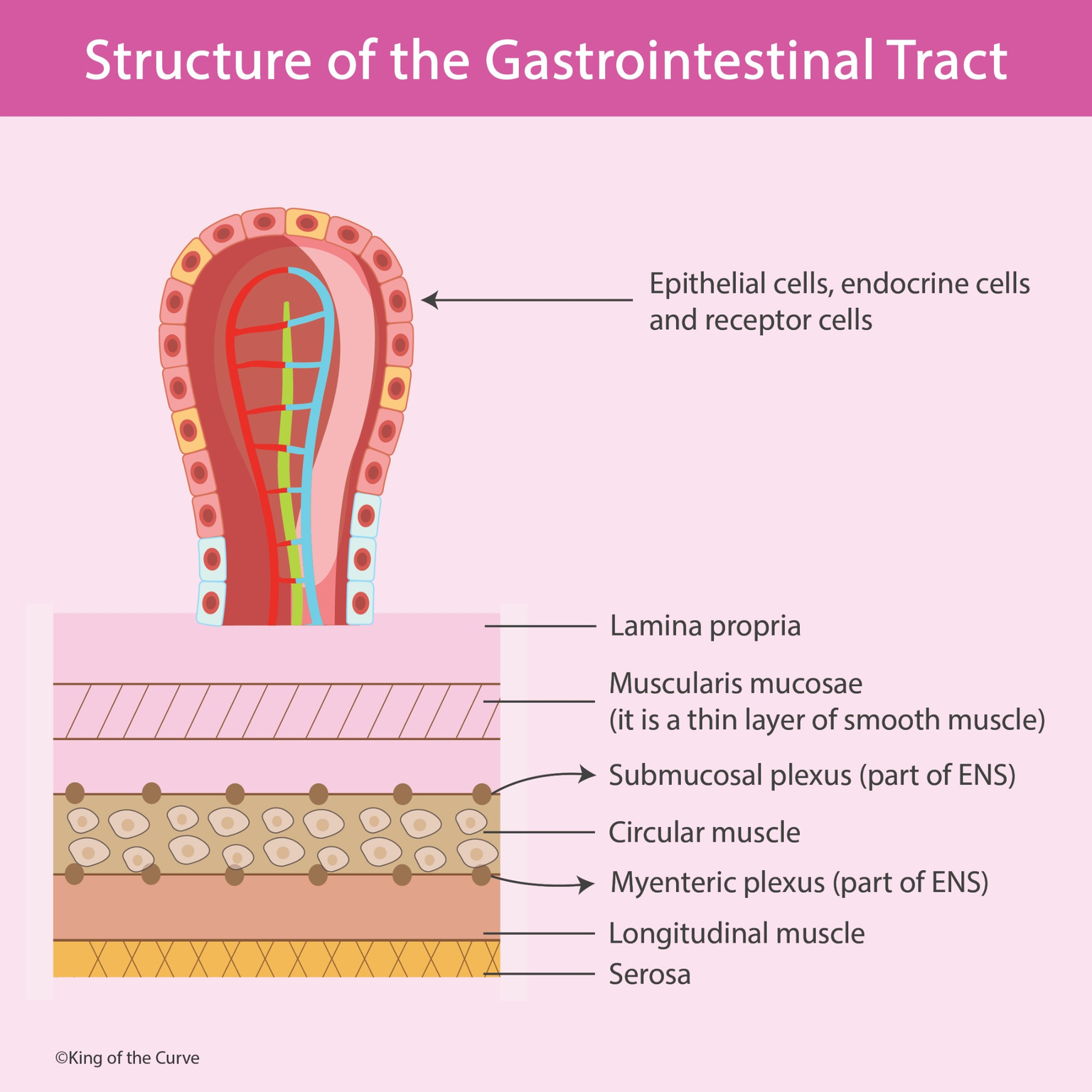
The mucosa is the innermost layer lining the lumen of the GI tract and is directly involved in digestion and absorption. It contains epithelial cells, endocrine cells, and receptor cells, which work together to absorb nutrients, secrete hormones, and sense luminal contents. This layer forms the first line of interaction between food and the body.
🩸 Lamina Propria: Support and Defense
Beneath the epithelium lies the lamina propria, a connective tissue layer rich in blood vessels, lymphatics, and immune cells. It supports the epithelium structurally and plays a crucial role in immune defense by identifying and responding to pathogens entering through the gut.
💪 Muscularis Mucosae: Local Movement Control
The muscularis mucosae is a thin layer of smooth muscle within the mucosa. Its gentle contractions help move the mucosal surface, enhancing contact between nutrients and absorptive cells. This localized movement improves digestion and absorption efficiency without contributing to large-scale peristalsis.
🔌 Submucosa and Submucosal Plexus
The submucosa is a dense connective tissue layer containing glands, blood vessels, and nerves. Embedded within it is the submucosal (Meissner’s) plexus, part of the enteric nervous system (ENS), which regulates glandular secretion and local blood flow essential for digestion.
🚶 Muscularis Externa and Myenteric Plexus
Outside the submucosa lies the muscularis externa, composed of an inner circular muscle layer and an outer longitudinal muscle layer. Between these layers is the myenteric (Auerbach’s) plexus, another component of the ENS. This plexus controls peristalsis, the coordinated contractions that propel food along the GI tract.
🛡️ Serosa: Outer Protective Layer
The serosa is the outermost layer of the GI tract. It is a thin, smooth membrane that reduces friction between the digestive organs and surrounding structures, allowing the intestines to move freely during digestion.
📊 Layers of the Gastrointestinal Tract
| Layer | Key Components | Primary Function |
|---|---|---|
| Mucosa | Epithelium, lamina propria, muscularis mucosae | Absorption, secretion, protection |
| Submucosa | Connective tissue, glands, submucosal plexus | Secretion control, blood flow regulation |
| Muscularis externa | Circular & longitudinal muscles, myenteric plexus | Peristalsis and movement |
| Serosa | Thin outer membrane | Protection and friction reduction |
✅ Key Takeaway
The gastrointestinal tract is built from four organized layers, each with specialized structures and functions. Together, these layers ensure efficient digestion, absorption, movement, and protection making the GI tract a highly coordinated and essential system for human survival.

Frequently Asked Questions (FAQs)
-
Aim for 4-6 focused hours, ensuring you incorporate breaks to avoid burnout.
-
Practice mindfulness techniques, take practice exams under realistic conditions, and maintain a balanced lifestyle.
-
Set short-term goals, seek support from mentors, and reward yourself for small achievements.
-
Regular exercise improves focus, reduces stress, and enhances overall mental clarity.
-
KOTC offers personalized learning tools, gamification features, and adaptive question banks to help students stay on track without burnout.