
🫀 Structure of the Stomach: Anatomy and Functional Significance
The stomach is a vital muscular organ of the gastrointestinal tract that plays a central role in digestion by storing food, mixing it with gastric secretions, and regulating its passage into the small intestine. Its unique shape and regional specialization allow both mechanical and chemical digestion to occur efficiently. Understanding the structure of the stomach helps explain how it performs these complex functions and why disorders affecting specific regions produce characteristic symptoms.
🔬 Major Anatomical Regions of the Stomach
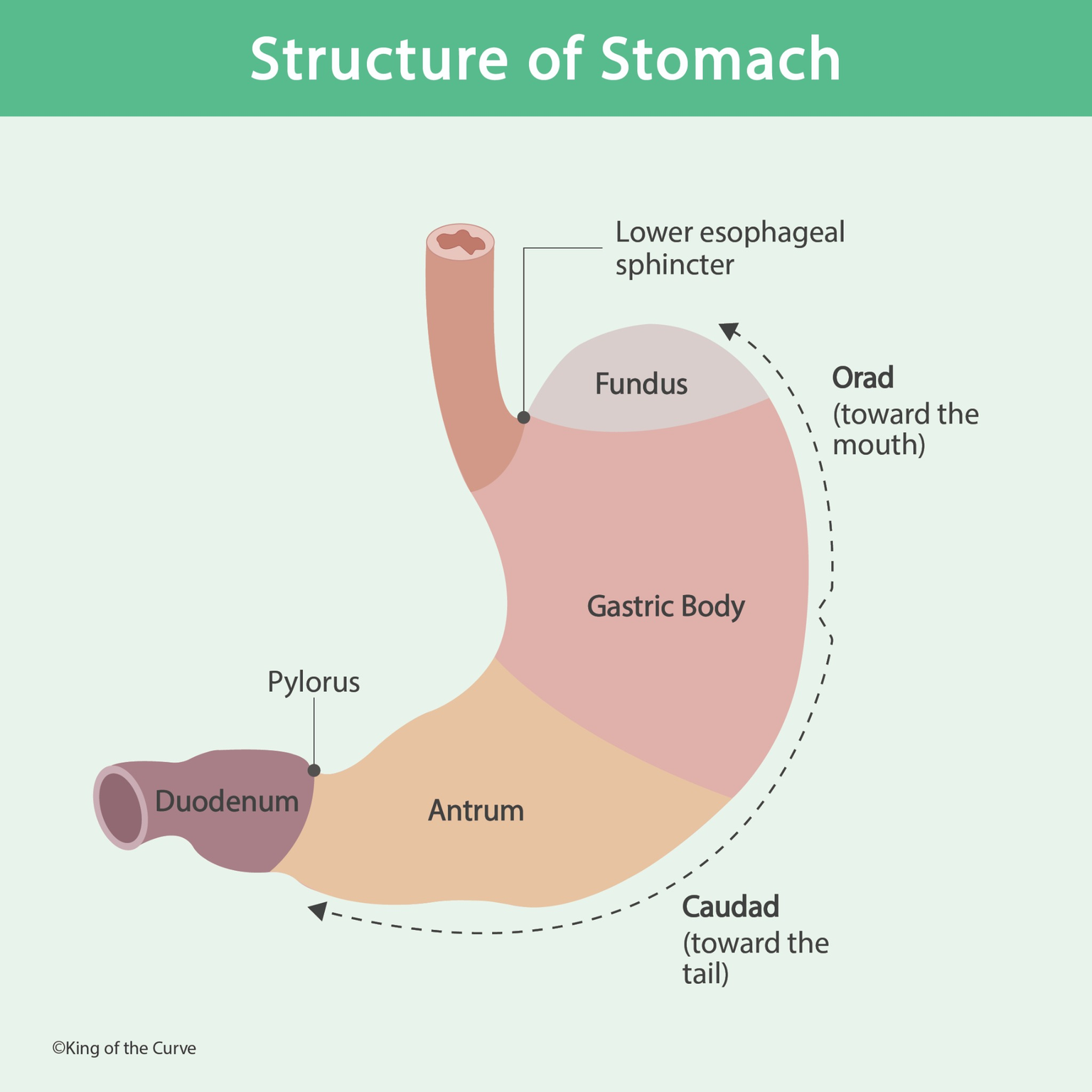
Anatomically, the stomach is divided into four main regions: the fundus, gastric body, antrum, and pylorus. The fundus is the dome-shaped superior portion located just below the diaphragm. It acts primarily as a reservoir, allowing the stomach to accommodate food and gas without a significant rise in pressure. This property is essential for comfortable food intake.
The gastric body forms the largest central portion of the stomach. It is the principal site of secretion, containing parietal cells that produce hydrochloric acid and intrinsic factor, and chief cells that secrete pepsinogen. Together, these secretions initiate protein digestion and create an acidic environment that aids enzyme activation and microbial defense.
⚙️ Distal Stomach and Gastric Emptying
The antrum, located distal to the gastric body, is thick-walled and highly muscular. Its primary role is mechanical digestion, where food is churned and ground into smaller particles to form chyme. The antrum also plays a key role in regulating gastric emptying by coordinating contractions toward the pylorus.
The pylorus consists of the pyloric canal and the pyloric sphincter. This muscular sphincter controls the release of chyme into the duodenum, preventing premature emptying and reflux of intestinal contents back into the stomach. Proper pyloric function is essential for efficient digestion and nutrient absorption.
🔄 Directional Terms: Orad and Caudad
Functional movement within the stomach follows an orad-to-caudad direction. Orad refers to movement toward the mouth, while caudad indicates movement toward the tail or distal end of the gastrointestinal tract. Gastric peristalsis propels contents caudally, ensuring effective mixing and controlled delivery of chyme into the small intestine.
📊 Summary of Stomach Regions and Functions
| Stomach Region | Structural Feature | Primary Function |
|---|---|---|
| Fundus | Dome-shaped proximal region | Storage of food and gas |
| Gastric Body | Largest central portion | Secretion of acid and digestive enzymes |
| Antrum | Thick muscular distal region | Grinding and mixing of food |
| Pylorus | Muscular sphincter | Regulation of gastric emptying |
| Duodenum | First part of small intestine | Receives chyme for further digestion |
🧠 Clinical Relevance
Each region of the stomach is associated with specific clinical conditions. For example, fundic relaxation defects can cause early satiety, gastric body inflammation may impair acid secretion, and pyloric stenosis can obstruct gastric emptying, especially in infants. Understanding the structural organization of the stomach is therefore essential for interpreting gastrointestinal symptoms and managing digestive disorders.
🧩 Key Takeaway
The stomach’s structure is closely linked to its function. From storage and secretion to mixing and controlled emptying, each anatomical region contributes to efficient digestion. A clear understanding of stomach anatomy provides a strong foundation for studying gastrointestinal physiology, pathology, and clinical medicine.

Frequently Asked Questions (FAQs)
-
Aim for 4-6 focused hours, ensuring you incorporate breaks to avoid burnout.
-
Practice mindfulness techniques, take practice exams under realistic conditions, and maintain a balanced lifestyle.
-
Set short-term goals, seek support from mentors, and reward yourself for small achievements.
-
Regular exercise improves focus, reduces stress, and enhances overall mental clarity.
-
KOTC offers personalized learning tools, gamification features, and adaptive question banks to help students stay on track without burnout.