
The stomach is a muscular organ that connects the esophagus to the duodenum, the first part of the small intestine. It temporarily stores food, mixes it with gastric secretions, and begins substantial protein digestion. This mixing produces a semifluid material called chyme, which gradually passes into the small intestine.
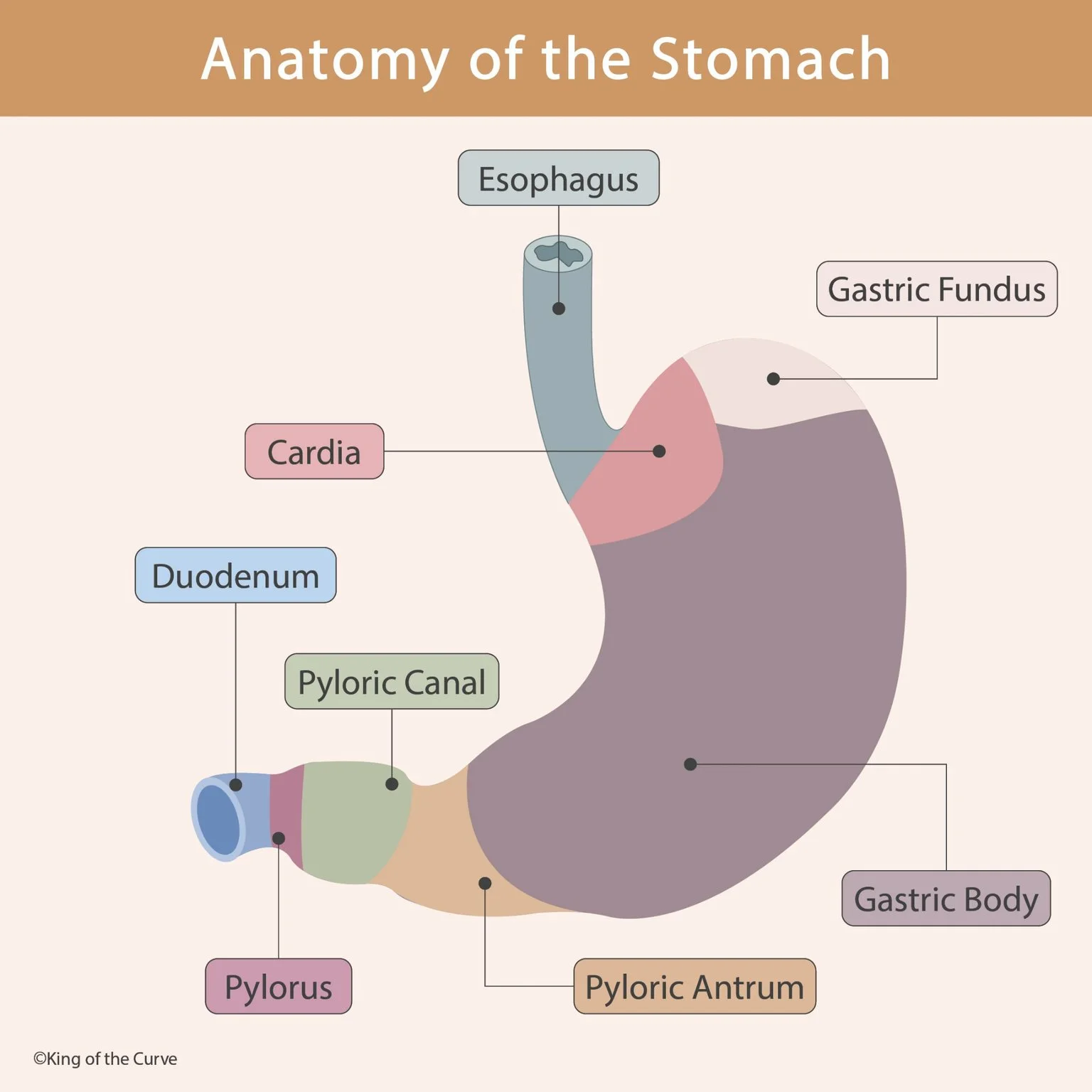
📍 Cardia: Where Food Enters
The cardia is the small region surrounding the opening where the esophagus enters the stomach. Its glands produce mucus that helps protect the nearby lining. The cardia is distinct from the lower esophageal sphincter, a functional pressure zone that helps prevent stomach contents from flowing backward into the esophagus.
🎈 Gastric Fundus: Accommodation and Storage
The fundus is the dome-shaped upper portion of the stomach, positioned above the level of the gastroesophageal junction. Along with the upper gastric body, it relaxes to accommodate an incoming meal without a large increase in pressure. Swallowed air commonly collects here, and its gastric glands also contribute digestive secretions.
🧪 Gastric Body: A Major Secretory Region
The body forms the largest central region of the stomach and contains glands with several specialized cell types. Parietal cells secrete hydrochloric acid and intrinsic factor, while chief cells release pepsinogen, the inactive precursor of pepsin. Acid helps unfold proteins and supports pepsin activation; intrinsic factor is needed for vitamin B12 absorption later in the terminal ileum.
📊 Main Stomach Regions and Their Functions
The stomach’s regions work together to receive, store, mix, and release food. Their boundaries reflect differences in anatomy and gland distribution, although their functions overlap. The pyloric region includes the wider antrum and narrower canal, ending at the outlet controlled by the pyloric sphincter.
| Region or Structure | Location | Main Function |
|---|---|---|
| Cardia | Around the esophageal opening | Receives food and contributes protective mucus |
| Gastric fundus | Dome-shaped upper stomach | Accommodates food and gas; contributes gastric secretions |
| Gastric body | Large central portion | Stores and mixes food; produces acid, pepsinogen, and intrinsic factor |
| Pyloric antrum | Wider distal region before the canal | Grinds food and contributes hormonal regulation |
| Pyloric canal | Narrow passage beyond the antrum | Directs chyme toward the gastric outlet |
| Pyloric sphincter | Junction between stomach and duodenum | Regulates the passage of gastric contents into the duodenum |
⚙️ Pyloric Antrum: Grinding and Hormonal Control
The pyloric antrum helps grind food through strong contractions that push contents toward the outlet and back into the stomach. This backward mixing, called retropulsion, helps reduce particle size. The antrum also contains G cells that release gastrin, a hormone that promotes gastric acid secretion and supports gastric activity.
🚪 Pyloric Canal and Sphincter: Controlling the Exit
The pyloric canal is the narrow passage leading from the antrum toward the duodenum. At its distal end, the pyloric sphincter is formed by thickened circular smooth muscle. Coordinated contractions and changes in sphincter resistance regulate how much chyme leaves the stomach at a time.
🛡️ How the Stomach Protects Its Lining
The stomach must protect itself from the acid and digestive enzymes within its lumen. Surface mucus and bicarbonate create a protective environment near the epithelial lining, while tight junctions help limit acid penetration. Adequate blood flow and ongoing epithelial repair also support this barrier and help maintain tissue integrity.
🔄 How the Stomach Coordinates With the Duodenum
The duodenum receives chyme and coordinates further digestion with pancreatic secretions and bile. Signals triggered by acidity, fat, and distension in the small intestine help slow gastric emptying when necessary. This feedback matches the delivery of stomach contents to the intestine’s ability to neutralize acid, digest nutrients, and prepare them for absorption.

Frequently Asked Questions (FAQs)
-
Aim for 4-6 focused hours, ensuring you incorporate breaks to avoid burnout.
-
Practice mindfulness techniques, take practice exams under realistic conditions, and maintain a balanced lifestyle.
-
Set short-term goals, seek support from mentors, and reward yourself for small achievements.
-
Regular exercise improves focus, reduces stress, and enhances overall mental clarity.
-
KOTC offers personalized learning tools, gamification features, and adaptive question banks to help students stay on track without burnout.