
🌊 Standing Waves Explained: Nodes, Antinodes, Wavelength, and Harmonics
A standing wave is a wave pattern produced when two waves with the same frequency and wavelength travel in opposite directions and interfere with each other. Instead of appearing to move continuously through space, the resulting pattern contains fixed points called nodes and regions of maximum oscillation called antinodes. Standing waves are a high-yield physics concept for the MCAT because they connect wave behavior with frequency, wavelength, resonance, and sound.
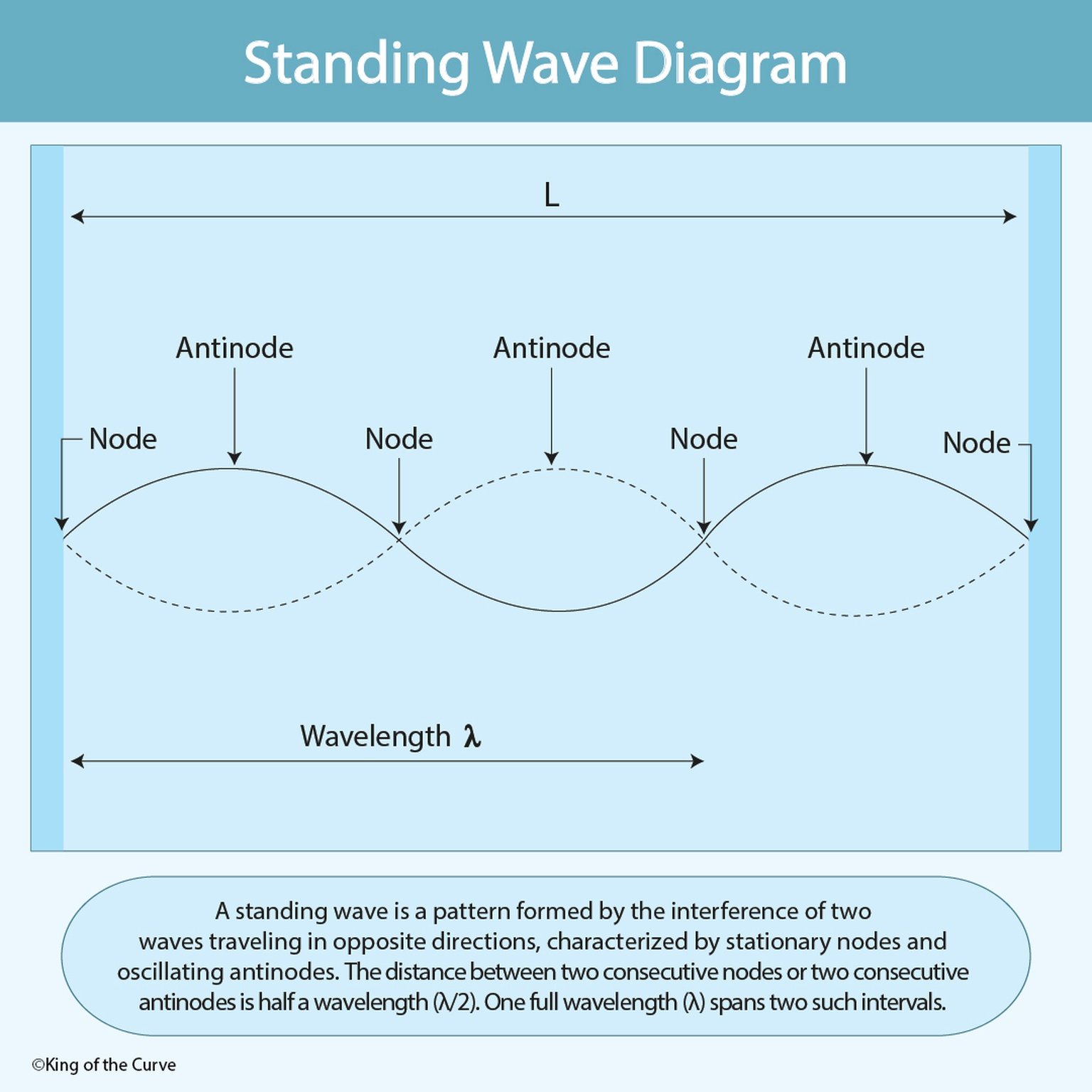
🔄 How Are Standing Waves Formed?
Standing waves commonly form when a traveling wave reflects from a boundary and interferes with the incoming wave. Through constructive and destructive interference, certain locations consistently experience large oscillations while others remain stationary. When the system is driven at one of its natural frequencies, resonance can produce a stable standing-wave pattern.
📍 What Is a Node?
A node is a point in a standing wave where the displacement remains zero. At these locations, the two component waves undergo persistent destructive interference. In a string fixed at both ends, each fixed endpoint must be a node because the string cannot move there. Additional nodes can appear between the endpoints as higher harmonics are produced.
📈 What Is an Antinode?
An antinode is a location where the oscillation has maximum amplitude. Antinodes occur between neighboring nodes and represent regions where constructive interference produces the greatest displacement. A useful MCAT relationship is that the distance from a node to the nearest antinode is λ/4.
📏 Wavelength in a Standing Wave
The wavelength λ is the spatial length of one complete wave cycle. In a standing-wave pattern, the distance between two consecutive nodes is λ/2, and the distance between two consecutive antinodes is also λ/2. Therefore, two node-to-node intervals together correspond to one complete wavelength.
| 🌊 Relationship | 📏 Distance |
|---|---|
| Node → adjacent node | λ/2 |
| Antinode → adjacent antinode | λ/2 |
| Node → nearest antinode | λ/4 |
| One complete wavelength | λ |
🎸 Standing Waves on a String Fixed at Both Ends
For a string of length L fixed at both ends, only specific wavelengths can form stable standing waves. The allowed wavelengths satisfy L = nλ/2, where n is a positive integer representing the harmonic number. Rearranging gives λₙ = 2L/n. The first harmonic has the longest wavelength, while higher harmonics contain additional nodes and antinodes.
🎵 Frequency and Harmonics
Wave speed, frequency, and wavelength are related by v = fλ. Combining this equation with the allowed wavelengths of a fixed string gives fₙ = nv/(2L). The first harmonic is the fundamental frequency, while the second, third, and subsequent harmonics occur at integer multiples of that fundamental frequency for an ideal string fixed at both ends.
🔊 Standing Waves in Sound
Standing waves also occur in air columns, making them important for understanding pipes and musical instruments. A pipe open at both ends has displacement antinodes at its open ends and supports all integer harmonics. A pipe closed at one end has a displacement node at the closed end and an antinode at the open end; in the idealized model, it supports the fundamental and odd harmonics.
🎯 MCAT High-Yield Takeaway
For the MCAT, remember: nodes have zero displacement, antinodes have maximum displacement, adjacent nodes are λ/2 apart, and a node and its nearest antinode are λ/4 apart. For a string fixed at both ends, use L = nλ/2, v = fλ, and fₙ = nv/(2L). These relationships make it much easier to solve questions involving standing waves, resonance, strings, and air columns.

Frequently Asked Questions (FAQs)
-
Aim for 4-6 focused hours, ensuring you incorporate breaks to avoid burnout.
-
Practice mindfulness techniques, take practice exams under realistic conditions, and maintain a balanced lifestyle.
-
Set short-term goals, seek support from mentors, and reward yourself for small achievements.
-
Regular exercise improves focus, reduces stress, and enhances overall mental clarity.
-
KOTC offers personalized learning tools, gamification features, and adaptive question banks to help students stay on track without burnout.