
✈️ Relative Motion Diagram: Understanding Airspeed, Wind, and Ground Velocity
Relative motion describes how the velocity of an object changes depending on the observer’s frame of reference. In physics, motion is always measured relative to something else. For an airplane, its motion can be described relative to the air (airspeed) or relative to the ground (ground velocity). Understanding this distinction is essential in aviation, physics problems, and vector analysis.
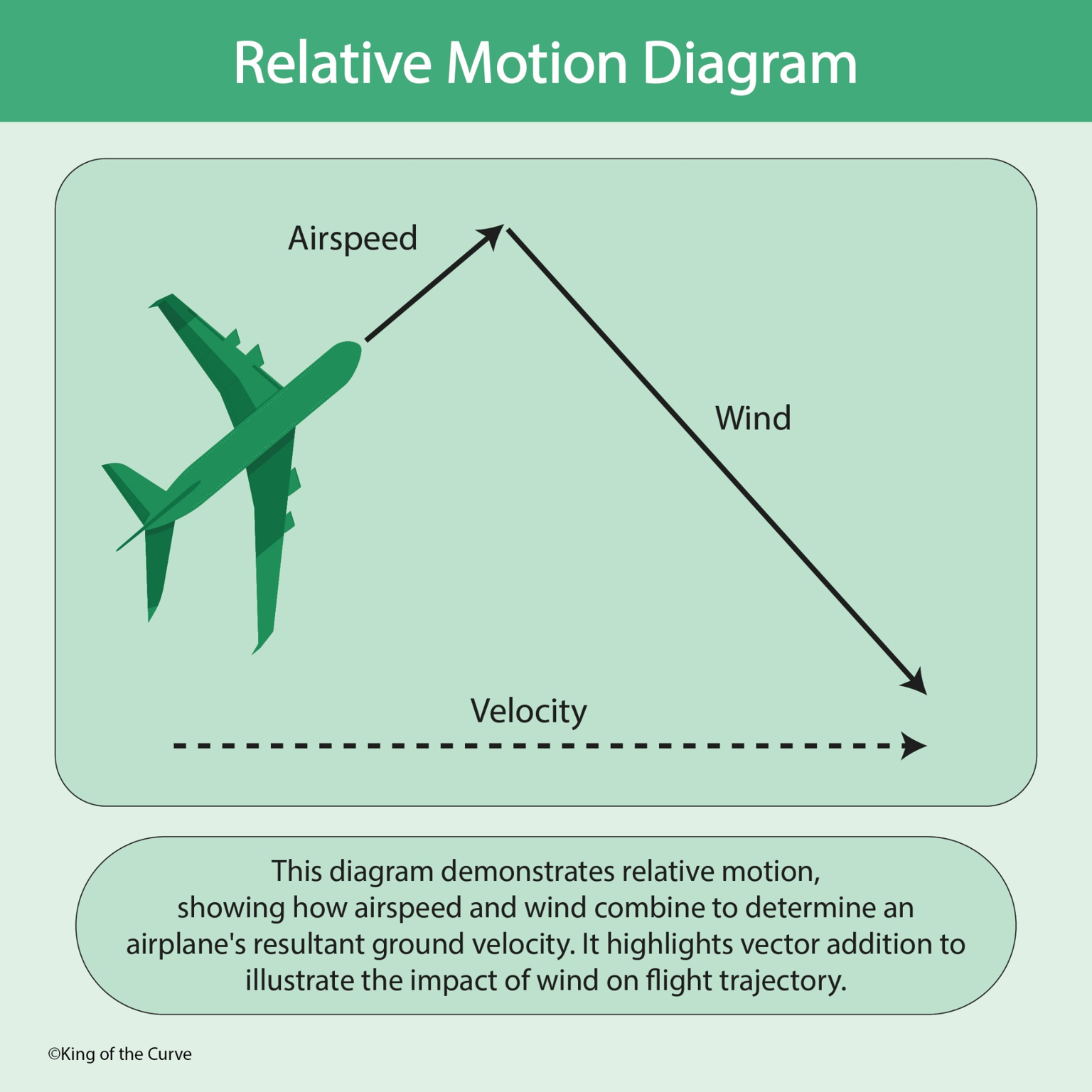
🌬️ Airspeed: Motion Relative to the Air
Airspeed is the velocity of the airplane relative to the surrounding air mass. It represents how fast the aircraft is moving through the air, independent of wind. Pilots rely on airspeed to maintain lift, control, and aerodynamic stability. In vector terms, airspeed is one component of the overall motion.
🌪️ Wind: Motion of the Air Itself
Wind is the movement of air relative to the ground. It has both magnitude (speed) and direction, meaning it is also a vector. Wind can act as:
A tailwind, increasing ground speed
A headwind, decreasing ground speed
A crosswind, altering direction
Because wind itself is moving, it affects the airplane’s final motion relative to the Earth.
➕ Vector Addition: Combining Airspeed and Wind
The airplane’s actual ground velocity is found using vector addition:
Ground Velocity = Airspeed + Wind Velocity
In the diagram, the airspeed vector and wind vector are drawn tip-to-tail. The resulting vector represents the airplane’s true velocity over the ground. This graphical method visually demonstrates how direction and magnitude combine.
📍 Ground Velocity: The Resultant Vector
Ground velocity describes how fast and in what direction the airplane moves relative to the Earth. Even if the airplane maintains a constant airspeed, changing wind conditions will alter the ground velocity. This explains why flight times vary depending on wind direction.
🎯 Directional Effects on Flight Path
If the wind blows at an angle, the airplane must adjust its heading to maintain a straight ground path. This is known as crab angle correction in aviation. Without correction, the plane would drift off course due to the wind’s horizontal component.
🧠 Why This Concept Matters in Physics
Relative motion is not limited to aviation. It applies to:
Boats crossing rivers
Swimmers in flowing water
Cars on moving platforms
Projectile motion in wind
Understanding relative motion strengthens problem-solving skills in mechanics and vector analysis.
📊 Mathematical Perspective
In component form:
| Component | Equation | Meaning |
|---|---|---|
| Ground x-component | Vgx = Vax + Vwx | Ground velocity in the x-direction equals the airplane’s x-component through the air plus the wind’s x-component. |
| Ground y-component | Vgy = Vay + Vwy | Ground velocity in the y-direction equals the airplane’s y-component through the air plus the wind’s y-component. |
Where:
Vg = Ground velocity
Va = Airspeed
Vw = Wind velocity
Magnitude of ground velocity:
| Ground Speed Magnitude | What it means |
|---|---|
| Vg = √(Vgx2 + Vgy2) | The airplane’s ground speed is the magnitude of the ground-velocity vector, found using the Pythagorean theorem from its x- and y-components. |
This quantitative approach is commonly tested in high school physics, AP Physics, and introductory university mechanics.
🚀 Real-World Application
Airlines carefully plan routes considering prevailing winds (like jet streams). Tailwinds reduce fuel consumption and travel time, while headwinds increase both. Pilots and navigation systems continuously calculate vector sums to ensure accurate positioning.
📌 Final Takeaway
The relative motion diagram clearly illustrates that motion depends on the frame of reference. Airspeed alone does not determine where an airplane goes — wind must also be considered. By applying vector addition, we can accurately predict ground velocity and trajectory.

Frequently Asked Questions (FAQs)
-
Aim for 4-6 focused hours, ensuring you incorporate breaks to avoid burnout.
-
Practice mindfulness techniques, take practice exams under realistic conditions, and maintain a balanced lifestyle.
-
Set short-term goals, seek support from mentors, and reward yourself for small achievements.
-
Regular exercise improves focus, reduces stress, and enhances overall mental clarity.
-
KOTC offers personalized learning tools, gamification features, and adaptive question banks to help students stay on track without burnout.