
🩺 Renal Tubular Disorders: Understanding Proximal Tubule Dysfunction
The kidneys maintain homeostasis by filtering blood and selectively reabsorbing essential substances. The proximal tubule is responsible for reabsorbing the majority of filtered solutes and water. When this segment malfunctions, it leads to a group of conditions known as renal tubular disorders.
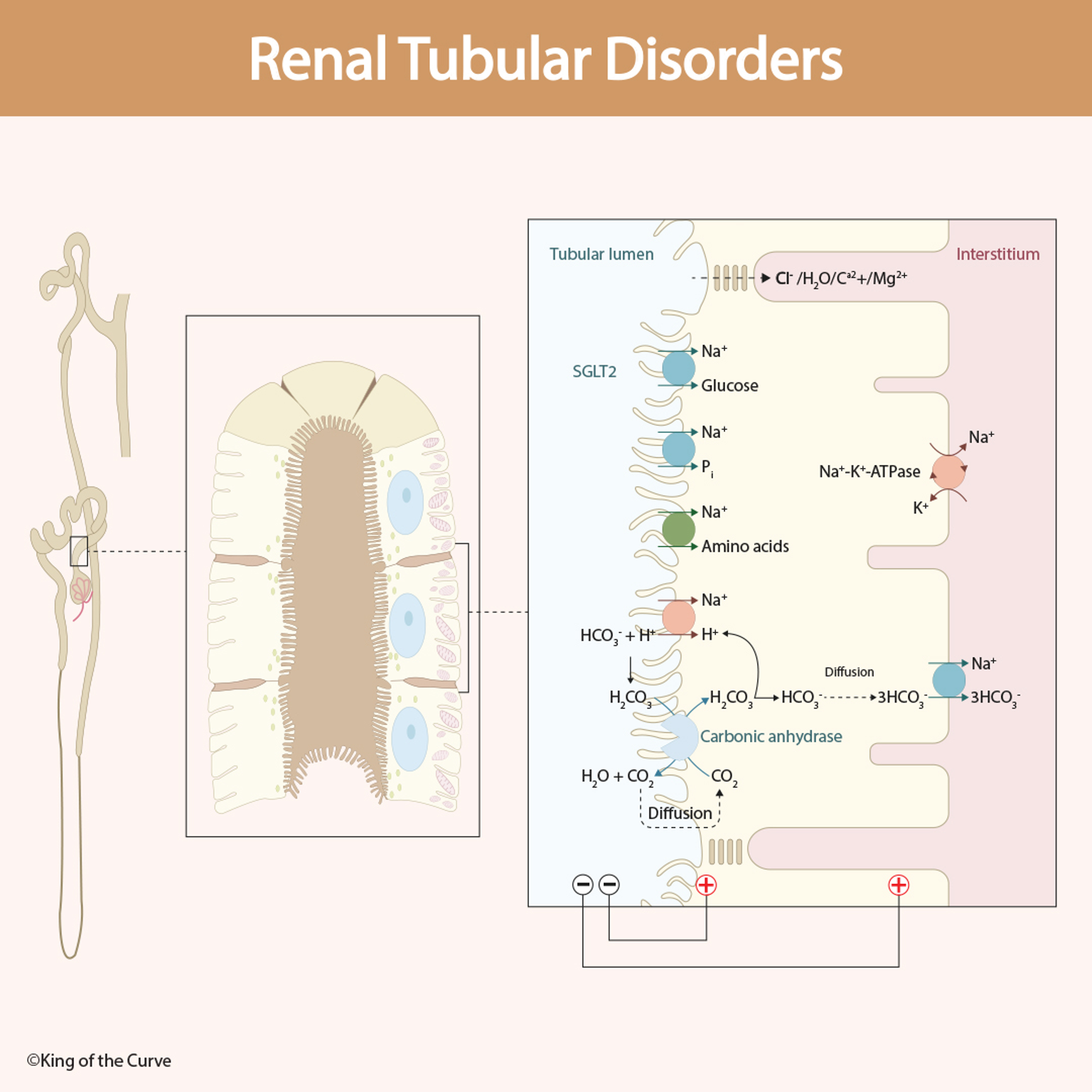
🧪 The Central Role of the Proximal Tubule
The proximal tubule reabsorbs:
~65–70% of filtered sodium and water
Nearly all glucose and amino acids
Most bicarbonate (HCO₃⁻)
Phosphate (Pᵢ)
Chloride and other electrolytes
Transport is driven by the Na⁺/K⁺-ATPase pump on the basolateral membrane, which creates a sodium gradient that powers secondary active transport.
🔄 Key Transport Mechanisms
1️⃣ Sodium-Dependent Cotransport
Sodium enters the tubular cell along its gradient, bringing other solutes with it:
SGLT2 → Glucose reabsorption
Na⁺–amino acid transporters
Na⁺–phosphate cotransporter
If these transporters fail, glucose, amino acids, and phosphate appear in the urine.
2️⃣ Bicarbonate Reabsorption
Bicarbonate reabsorption involves:
Na⁺/H⁺ exchanger secreting H⁺ into lumen
Carbonic anhydrase converting H₂CO₃ → CO₂ + H₂O
CO₂ diffusing into cell
Reformation of HCO₃⁻ inside cell
HCO₃⁻ transported into interstitium
Disruption leads to proximal (Type 2) renal tubular acidosis (RTA).
3️⃣ Na⁺/K⁺-ATPase Pump
Located on the basolateral membrane, this pump:
Moves Na⁺ out of the cell
Brings K⁺ into the cell
Maintains electrochemical gradient
Nearly all proximal reabsorption depends on this pump.
⚠️ Major Renal Tubular Disorders
🧬 Fanconi Syndrome
A generalized defect of the proximal tubule causing:
Glucosuria (with normal blood glucose)
Aminoaciduria
Phosphaturia
Bicarbonate loss
Metabolic acidosis
Causes include genetic disorders, multiple myeloma, heavy metals, and certain medications.
🧪 Proximal Renal Tubular Acidosis (Type 2 RTA)
Impaired bicarbonate reabsorption
Normal anion gap metabolic acidosis
Often associated with Fanconi syndrome
Urine initially alkaline, then becomes acidic once plasma bicarbonate falls.
💊 SGLT2 Inhibitors (Drug-Induced Effect)
Medications like empagliflozin:
Block glucose reabsorption
Cause therapeutic glucosuria
Used in diabetes and heart failure
This mimics part of proximal tubular dysfunction.
🧂 Phosphate Wasting Disorders
Defective Na⁺–phosphate transport leads to:
Hypophosphatemia
Bone demineralization
Rickets or osteomalacia
🧠 Why These Disorders Matter
Proximal tubule dysfunction affects multiple systems because it handles so many solutes. Patients may present with:
Polyuria
Electrolyte abnormalities
Metabolic acidosis
Bone disease
Growth delays (in children)
Understanding the underlying transport mechanisms makes diagnosis much easier.
📊 Clinical Pattern Recognition
If you see:
Glucosuria + normal blood glucose → think proximal tubule defect
Metabolic acidosis + bicarbonate wasting → think Type 2 RTA
Multiple electrolyte losses → think Fanconi syndrome
🏥 Big Picture Takeaway
The proximal tubule is a powerhouse of reabsorption. When its transport systems fail, the result is a constellation of metabolic disturbances. By understanding sodium gradients, cotransport systems, and bicarbonate handling, we can connect physiology directly to pathology.

Frequently Asked Questions (FAQs)
-
Aim for 4-6 focused hours, ensuring you incorporate breaks to avoid burnout.
-
Practice mindfulness techniques, take practice exams under realistic conditions, and maintain a balanced lifestyle.
-
Set short-term goals, seek support from mentors, and reward yourself for small achievements.
-
Regular exercise improves focus, reduces stress, and enhances overall mental clarity.
-
KOTC offers personalized learning tools, gamification features, and adaptive question banks to help students stay on track without burnout.