
🧭 Understanding Reference Frames for the MCAT
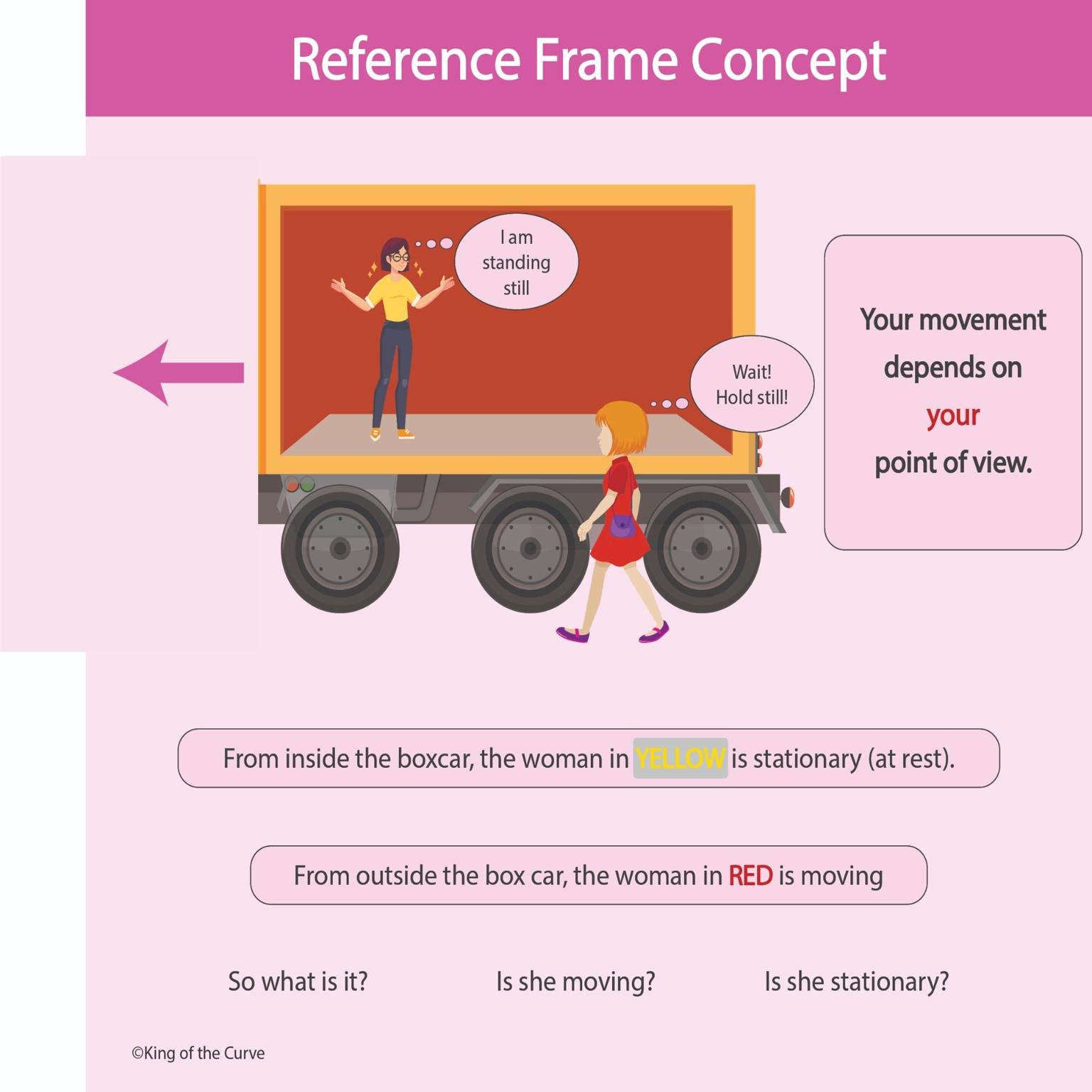
One of the most fundamental and misunderstood concepts in physics is the reference frame. Whether an object is moving or stationary depends entirely on the observer’s point of view. This idea shows up repeatedly in MCAT physics questions, especially those involving relative velocity, motion diagrams, and kinematics. King of the Curve’s visual illustrates this perfectly using a woman standing inside a moving boxcar while another person observes from outside.
👀 What Each Observer Sees
Inside the boxcar, the woman in yellow perceives herself as standing still. Everything around her the walls, floor, and interior of the boxcar is stationary relative to her. But to an observer on the ground, shown here as the woman in red, the yellow-shirted woman is clearly moving to the left along with the truck. Both perspectives are correct they simply rely on different reference frames.
🚚 Movement Depends on Your Frame of Reference
A reference frame is just a point of view from which motion is measured. In physics, one observer may report an object as stationary while another measures it in motion. MCAT questions often test this idea by giving velocities relative to different objects like cars, trains, rivers, or airplanes. Recognizing the frame being used is key to solving relative motion problems without confusion.
🧩 Why Motion Is Relative, Not Absolute
The woman in yellow appears stationary relative to the truck but is moving relative to the ground. This illustrates an essential principle: there is no universal reference point for motion. Even the Earth is rotating and orbiting the Sun, but we usually treat it as a stationary frame for convenience. The MCAT expects you to make this same assumption when solving problems unless stated otherwise.
📊 High-Yield Table: Reference Frames in MCAT Physics
| Scenario | Reference Frame | What You Observe | MCAT Connection |
|---|---|---|---|
| Woman in yellow inside truck | Truck | She is stationary | Defines motion relative to moving systems |
| Woman in red standing outside | Ground | Woman in yellow is moving | Ground frame = standard MCAT reference |
| Two cars moving side-by-side | Either car | Other car appears still | Relative velocity problems |
| Swimmer in a river | Water vs. land | Different velocities | Vector addition, frame selection |
✏️ How the MCAT Tests This Concept
You’ll often see phrasing like “velocity relative to the ground,” “speed measured by an observer in the train,” or “boat velocity with respect to the water.” These are clues that the test is manipulating reference frames. Students who skip over this detail frequently miscalculate velocity vectors or directions. Identifying the frame first makes these questions significantly easier.
📚 Mastering Physics Concepts With KOTC
KOTC visuals like this one turn abstract concepts into intuitive stories. When you pair these diagrams with the Adaptive Q-Bank, daily physics drills, and guided explanations at kingofthecurve.org/studyscience, reference frames become second nature. Understanding perspective isn’t just about physics it’s about being able to interpret motion the way the MCAT expects: clearly, systematically, and with confidence.

Frequently Asked Questions (FAQs)
-
Aim for 4-6 focused hours, ensuring you incorporate breaks to avoid burnout.
-
Practice mindfulness techniques, take practice exams under realistic conditions, and maintain a balanced lifestyle.
-
Set short-term goals, seek support from mentors, and reward yourself for small achievements.
-
Regular exercise improves focus, reduces stress, and enhances overall mental clarity.
-
KOTC offers personalized learning tools, gamification features, and adaptive question banks to help students stay on track without burnout.