
🎯 Components of Projectile Motion Explained
Projectile motion is a fundamental concept in physics that describes the motion of an object launched into the air under the influence of gravity. Once projected, the object follows a curved path called a parabola, assuming air resistance is negligible. This motion can be broken down into two independent components: horizontal motion (X-axis) and vertical motion (Y-axis).
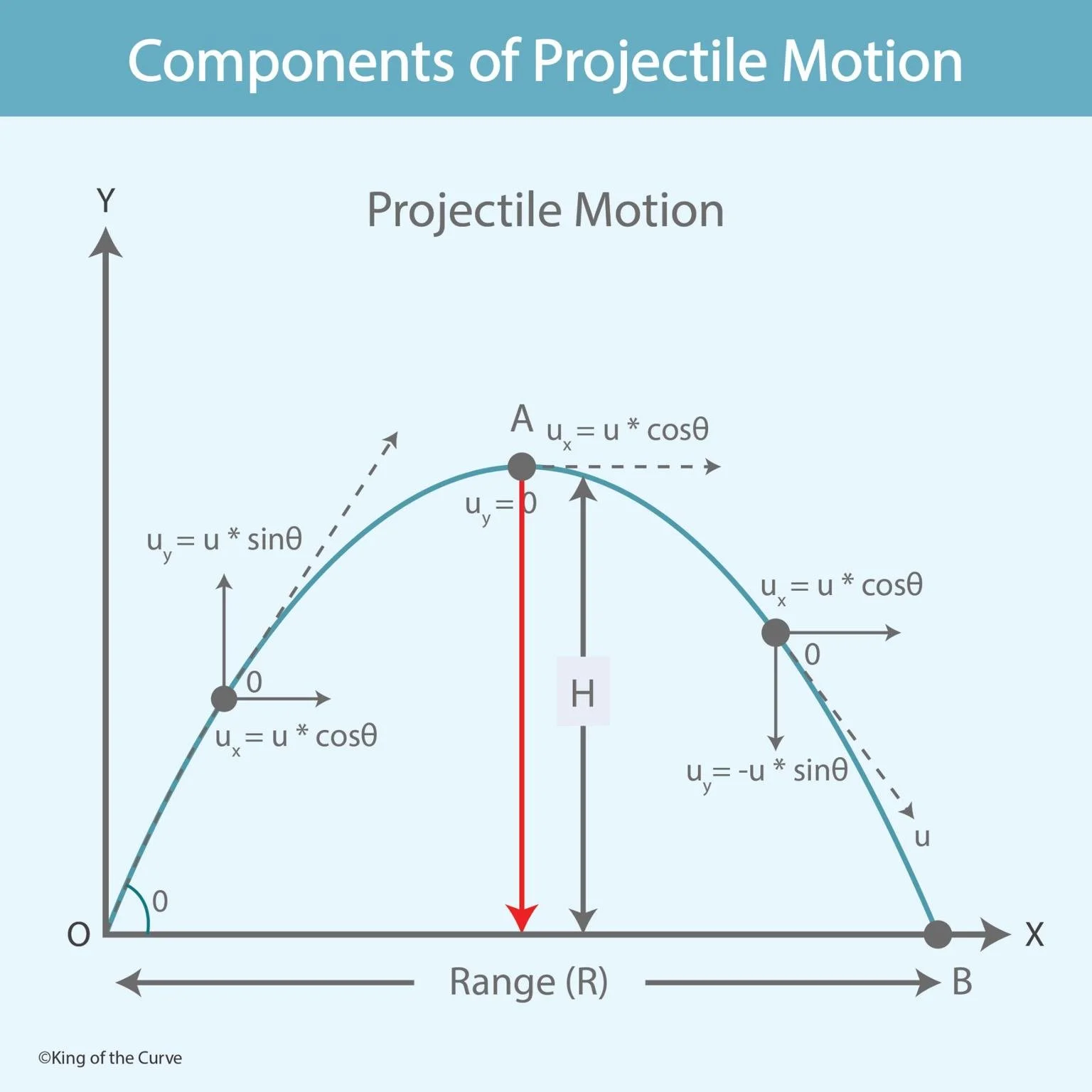
🔍 Horizontal and Vertical Components
At the moment of projection, the initial velocity (u) is resolved into two components:
Horizontal component (uₓ = u cosθ):
Remains constant throughout motion
No acceleration in the horizontal direction (ignoring air resistance)
Vertical component (uᵧ = u sinθ):
Changes due to gravity
Decreases as the object rises
Becomes zero at the highest point (A)
Increases in magnitude (negative direction) during descent
This separation allows us to analyze projectile motion using simple equations of motion independently in each direction.
⛰️ Maximum Height (H)
At the highest point of the trajectory (point A):
Vertical velocity (uᵧ = 0)
Only horizontal velocity (uₓ) remains
The object momentarily stops rising before descending
The maximum height (H) depends on the vertical component of the initial velocity. A greater launch angle or speed results in a higher peak.
📏 Range (R)
The range (R) is the horizontal distance traveled from the point of projection (O) to the landing point (B).
Key points:
Horizontal velocity remains constant → determines range
Symmetry: Time of ascent = time of descent
The projectile lands at the same vertical level it was launched from (in this case)
⚖️ Motion Symmetry
Projectile motion is perfectly symmetrical (without air resistance):
Velocity at equal heights is the same in magnitude but opposite in direction
Time taken to rise equals time taken to fall
The path on ascent mirrors the descent
For example:
Upward motion: uᵧ = +u sinθ
Downward motion: uᵧ = −u sinθ
🧠 Key Formulas
Horizontal velocity: uₓ = u cosθ
Vertical velocity: uᵧ = u sinθ
Maximum height: H = (u² sin²θ) / (2g)
Range: R = (u² sin2θ) / g
📊 Summary Table
| Component | Direction | Behavior | Key Feature |
|---|---|---|---|
| Horizontal (ux) | X-axis | Constant velocity | No acceleration |
| Vertical (uy) | Y-axis | Accelerated motion | Affected by gravity |
| Max Height (H) | — | Peak of trajectory | uy = 0 |
| Range (R) | X-axis | Total horizontal distance | Depends on angle & speed |
🩺 Real-Life Applications
Projectile motion is widely seen in everyday life and scientific fields:
Sports (football, basketball, cricket shots)
Engineering (trajectory of missiles and rockets)
Astronomy (motion of celestial bodies in simplified models)
Understanding these principles helps improve accuracy, efficiency, and prediction in various disciplines.
✅ Key Takeaway
Projectile motion becomes simple when broken into independent horizontal and vertical components. While horizontal motion remains uniform, vertical motion is influenced by gravity—together creating the characteristic parabolic path.

Frequently Asked Questions (FAQs)
-
Aim for 4-6 focused hours, ensuring you incorporate breaks to avoid burnout.
-
Practice mindfulness techniques, take practice exams under realistic conditions, and maintain a balanced lifestyle.
-
Set short-term goals, seek support from mentors, and reward yourself for small achievements.
-
Regular exercise improves focus, reduces stress, and enhances overall mental clarity.
-
KOTC offers personalized learning tools, gamification features, and adaptive question banks to help students stay on track without burnout.