
🧪 Polyprotic Acids: Understanding Multiple Proton Donation in Chemistry
Polyprotic acids are acids capable of donating more than one hydrogen ion (H⁺) during acid-base reactions. Unlike monoprotic acids, which release only a single proton, polyprotic acids dissociate in multiple steps, with each successive dissociation producing a different conjugate base. Understanding these acids is essential in general chemistry, biochemistry, and MCAT preparation because they play important roles in biological buffering systems and chemical equilibria.
🔬 What Are Polyprotic Acids?
A polyprotic acid is an acid that can donate two or more protons (H⁺ ions). The number of ionizable hydrogen atoms determines whether an acid is:
Monoprotic: Donates 1 H⁺ (e.g., HCl)
Diprotic: Donates 2 H⁺ (e.g., H₂SO₄)
Triprotic: Donates 3 H⁺ (e.g., H₃PO₄)
Each proton is released in a separate equilibrium reaction with its own acid dissociation constant (Ka).
⚛️ Phosphoric Acid: A Classic Triprotic Acid
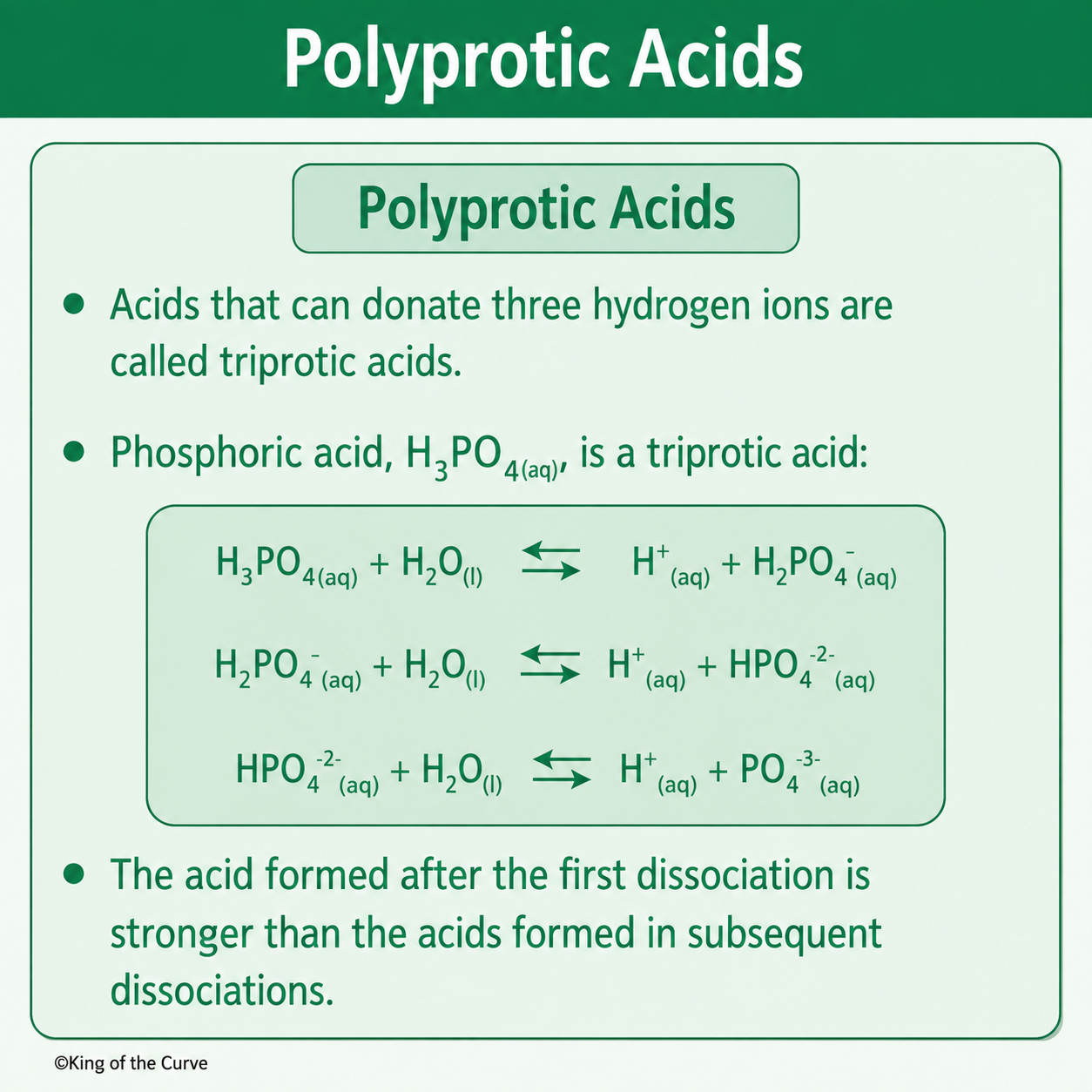
Phosphoric acid (H₃PO₄) is one of the most common examples of a triprotic acid. It dissociates in three distinct steps:
H₃PO₄ ⇌ H⁺ + H₂PO₄⁻
H₂PO₄⁻ ⇌ H⁺ + HPO₄²⁻
HPO₄²⁻ ⇌ H⁺ + PO₄³⁻
Each reaction removes one hydrogen ion, forming a new conjugate base that can further dissociate under suitable conditions.
📉 Why Does Acid Strength Decrease After Each Dissociation?
The first proton is always the easiest to remove, making the first dissociation the strongest. After losing one proton, the remaining species becomes increasingly negatively charged, which holds onto the remaining hydrogen ions more tightly.
As a result:
Ka₁ > Ka₂ > Ka₃
pKa₁ < pKa₂ < pKa₃
This means every successive dissociation is weaker than the previous one.
⚖️ Ka and pKa in Polyprotic Acids
Each dissociation step has its own equilibrium constant:
Ka₁ measures the strength of the first proton donation.
Ka₂ measures the second.
Ka₃ measures the third.
Because the acid becomes progressively weaker after each proton is removed, the Ka values decrease while the pKa values increase.
This trend is commonly tested in chemistry exams and is essential for understanding buffer systems.
🧬 Biological Importance of Polyprotic Acids
Polyprotic acids are critical in biological systems because they help maintain stable pH levels.
Examples include:
Phosphoric acid/phosphate buffer in cells
Carbonic acid/bicarbonate buffer in blood
Amino acids with multiple ionizable groups
DNA and RNA phosphate backbone
These systems resist sudden changes in pH, allowing enzymes and metabolic reactions to function properly.
📚 Common Examples of Polyprotic Acids
| Acid | Type | Number of Ionizable H+ | Common Use |
|---|---|---|---|
| H2SO4 (Sulfuric acid) | Diprotic | 2 | Industrial acid |
| H2CO3 (Carbonic acid) | Diprotic | 2 | Blood buffering |
| H3PO4 (Phosphoric acid) | Triprotic | 3 | Biological phosphate buffer |
| H2C2O4 (Oxalic acid) | Diprotic | 2 | Organic chemistry |
| H4EDTA | Polyprotic | 4 | Metal ion chelation |
🎯 MCAT & Exam Tips
When solving problems involving polyprotic acids:
Identify how many ionizable hydrogens are present.
Remember that Ka₁ is always the largest.
Each dissociation occurs independently.
Successive conjugate bases become weaker acids.
Buffer questions often involve intermediate species such as H₂PO₄⁻ and HPO₄²⁻.
These concepts frequently appear in MCAT, general chemistry, and biochemistry examinations.
✅ Key Takeaways
Polyprotic acids donate multiple hydrogen ions through sequential dissociation reactions. Phosphoric acid is a classic triprotic acid, releasing three protons one at a time. Each successive dissociation is weaker because the remaining molecule becomes more negatively charged, making additional proton loss less favorable. Understanding polyprotic acids, their Ka values, and their biological significance is essential for mastering acid-base chemistry and excelling on the MCAT.

Frequently Asked Questions (FAQs)
-
Aim for 4-6 focused hours, ensuring you incorporate breaks to avoid burnout.
-
Practice mindfulness techniques, take practice exams under realistic conditions, and maintain a balanced lifestyle.
-
Set short-term goals, seek support from mentors, and reward yourself for small achievements.
-
Regular exercise improves focus, reduces stress, and enhances overall mental clarity.
-
KOTC offers personalized learning tools, gamification features, and adaptive question banks to help students stay on track without burnout.