
🧪 Understanding pKa: A Complete MCAT Guide to Acid Strength
The pKa value is one of the most important concepts in acid-base chemistry and is frequently tested on the MCAT. It provides a simple way to compare the strength of acids by describing how readily they donate protons (H⁺). Rather than memorizing individual acid strengths, understanding pKa allows students to predict reaction direction, buffer behavior, and equilibrium in biological and chemical systems.
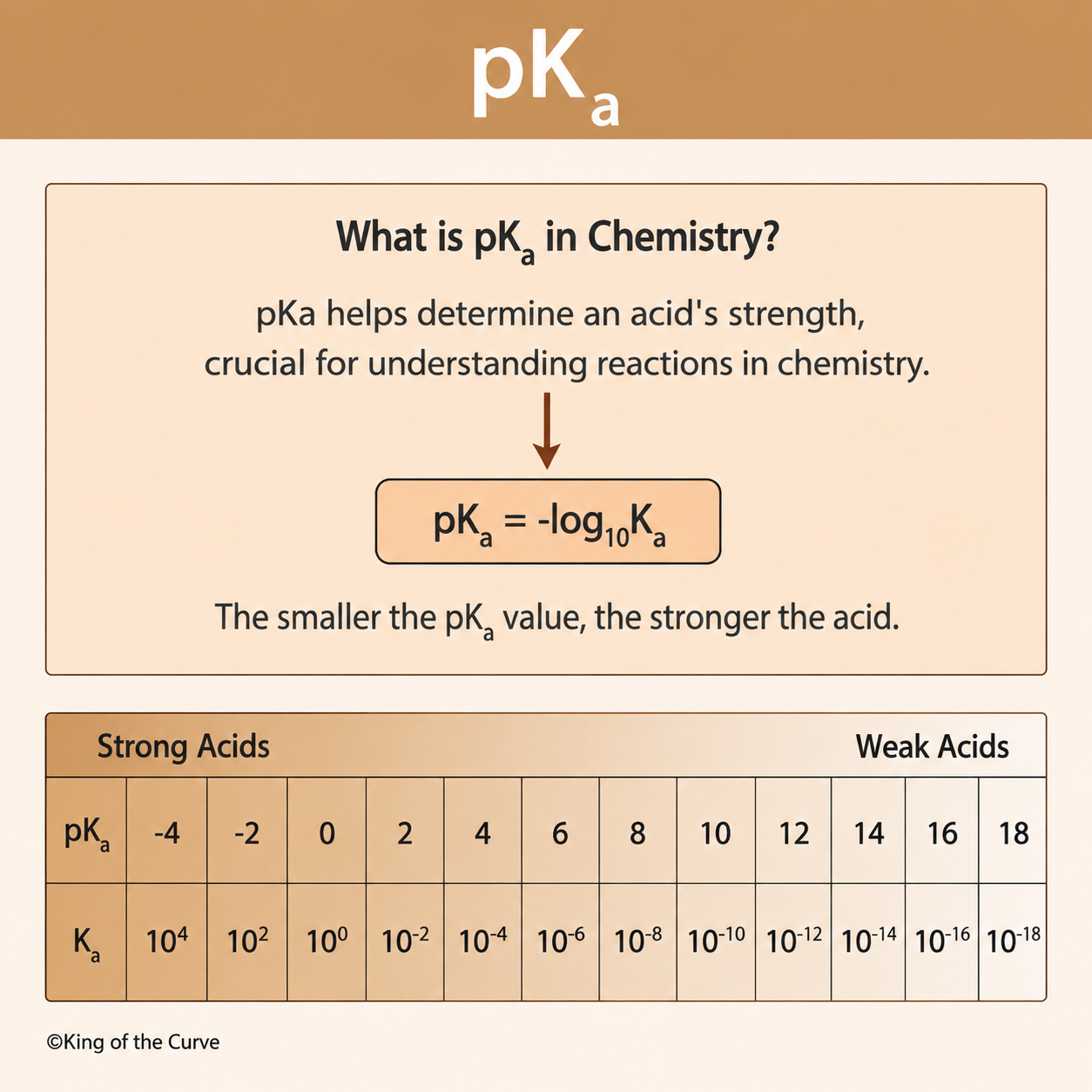
📚 1. What Is pKa?
The pKa is the negative logarithm of an acid's dissociation constant (Ka). It measures how easily an acid donates a proton in solution. A lower pKa indicates a larger Ka value, meaning the acid dissociates more completely and is therefore stronger. Conversely, a higher pKa represents a weaker acid that ionizes less readily.
The mathematical relationship is:
pKa = −log₁₀(Ka)
⚖️ 2. Relationship Between pKa and Acid Strength
The relationship between pKa and acid strength is inverse. As Ka increases, the acid becomes stronger because it dissociates more readily. Since pKa is calculated using a negative logarithm, stronger acids have smaller (or even negative) pKa values, while weaker acids have progressively larger pKa values.
A simple rule to remember is:
Low pKa = Strong acid
High pKa = Weak acid
🔬 3. Why Is pKa Important?
The pKa value helps chemists predict how molecules behave under different pH conditions. It determines whether an acid will remain protonated or lose a proton and is essential for understanding buffer systems, enzyme activity, pharmaceutical drug absorption, and biochemical pathways. In medicine and biology, pKa influences how drugs cross cell membranes and how proteins function within specific pH ranges.
⚗️ 4. The Relationship Between Ka and pKa
The acid dissociation constant (Ka) directly measures the extent to which an acid ionizes in water. Strong acids have very large Ka values, while weak acids have very small Ka values. Because pKa is calculated using a logarithmic scale, each change of one pKa unit corresponds to a tenfold change in Ka. This logarithmic relationship makes pKa much easier to compare than extremely large or small Ka values.
🧠 5. MCAT High-Yield Concept
One of the highest-yield MCAT concepts is comparing the pH of a solution with the pKa of an acid. When pH equals pKa, the concentrations of the protonated acid (HA) and its conjugate base (A⁻) are equal. This relationship forms the basis of the Henderson–Hasselbalch equation and explains why buffers work most effectively when the solution pH is close to the acid's pKa.
💊 6. Clinical and Biological Significance
The pKa concept extends far beyond chemistry laboratories. Drug absorption, protein folding, enzyme catalysis, and blood buffering all depend on acid-base equilibria governed by pKa values. For example, weak acids are more easily absorbed in acidic environments such as the stomach, while weak bases are better absorbed in the more alkaline environment of the small intestine. Understanding pKa therefore helps explain many physiological and pharmacological processes.
📊 7. pKa and Ka Comparison Table
| pKa Value | Ka Value | Acid Strength |
|---|---|---|
| −4 | 104 | Very Strong Acid |
| −2 | 102 | Very Strong Acid |
| 0 | 100 | Strong Acid |
| 2 | 10−2 | Moderately Strong Acid |
| 4 | 10−4 | Weak Acid |
| 6 | 10−6 | Weak Acid |
| 8 | 10−8 | Very Weak Acid |
| 10 | 10−10 | Very Weak Acid |
| 12 | 10−12 | Extremely Weak Acid |
| 14 | 10−14 | Extremely Weak Acid |
| 16 | 10−16 | Nearly Non-Ionizing |
| 18 | 10−18 | Extremely Weak / Negligible Dissociation |
🎯 8. MCAT Takeaway
For MCAT success, remember that pKa and acid strength move in opposite directions. Strong acids have large Ka values and low pKa values, while weak acids have small Ka values and high pKa values. Also remember the key relationship that each one-unit change in pKa corresponds to a tenfold change in acid strength. Mastering this concept will make acid-base chemistry, buffers, biological systems, and equilibrium questions significantly easier on exam day.

Frequently Asked Questions (FAQs)
-
Aim for 4-6 focused hours, ensuring you incorporate breaks to avoid burnout.
-
Practice mindfulness techniques, take practice exams under realistic conditions, and maintain a balanced lifestyle.
-
Set short-term goals, seek support from mentors, and reward yourself for small achievements.
-
Regular exercise improves focus, reduces stress, and enhances overall mental clarity.
-
KOTC offers personalized learning tools, gamification features, and adaptive question banks to help students stay on track without burnout.