
Percent Yield: Formula, Calculation, and Importance in Chemistry
Percent yield is one of the most important concepts in chemistry because it measures how efficiently a chemical reaction produces the desired product. In laboratory experiments and industrial manufacturing, the amount of product obtained is rarely equal to the theoretical prediction due to side reactions, impurities, incomplete reactions, or product loss during handling.
📊 What Is Percent Yield?
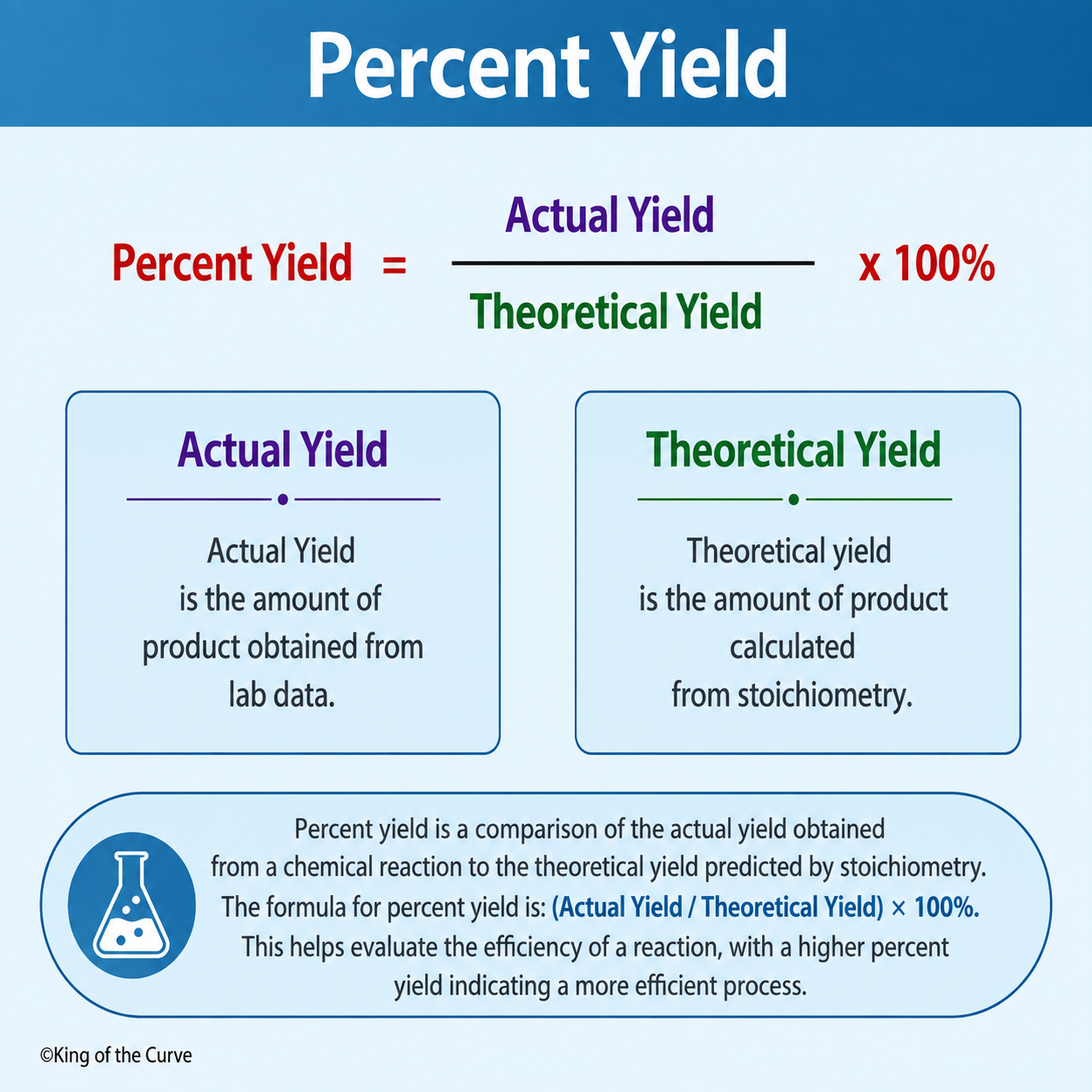
Percent yield compares the actual amount of product produced to the maximum amount that could theoretically be produced.
Formula
Percent Yield = Actual Yield / Theoretical Yield × 100%
A higher percent yield indicates a more efficient reaction.
🧪 Actual Yield
Actual yield is the amount of product that is actually collected during the experiment.
It is measured directly from laboratory data after the reaction is complete.
Characteristics
Obtained experimentally
Measured using laboratory equipment
Usually smaller than theoretical yield
May be affected by product loss or impurities
Example
If an experiment produces 8.5 g of product, then:
Actual Yield = 8.5 g
📐 Theoretical Yield
Theoretical yield is the maximum possible amount of product predicted by stoichiometric calculations.
It assumes:
Complete reaction
No side reactions
No product loss
Pure reactants
Characteristics
Calculated mathematically
Based on balanced chemical equations
Represents the highest possible yield
Example
Stoichiometric calculations predict:
Theoretical Yield = 10.0 g
🧮 Percent Yield Calculation Example
Suppose:
Actual Yield = 8.5 g
Theoretical Yield = 10.0 g
Using the formula:
8.5 / 10.0 × 100 = 85%
Percent Yield = 85%
This means the reaction produced 85% of the maximum possible product.
⚠️ Why Is Percent Yield Less Than 100%?
Several factors reduce the amount of product obtained.
Common reasons include:
Incomplete reactions
Side reactions producing unwanted products
Product lost during filtration or purification
Measurement errors
Impure reactants
Product decomposition
✅ Can Percent Yield Be Greater Than 100%?
Yes—but only because of experimental errors.
Common causes include:
Wet product
Impurities mixed with the product
Incorrect weighing
Incomplete drying
Contamination
A percent yield greater than 100% usually indicates inaccurate measurements rather than an exceptionally efficient reaction.
📚 Importance of Percent Yield
Percent yield is widely used in:
Laboratory chemistry
Organic synthesis
Pharmaceutical manufacturing
Industrial chemical production
Quality control
Research laboratories
It helps chemists determine how efficiently a reaction converts reactants into products and identifies opportunities to improve reaction conditions.
📖 Actual Yield vs. Theoretical Yield
| Feature | Actual Yield | Theoretical Yield |
|---|---|---|
| Source | Experimental measurement | Stoichiometric calculation |
| Obtained From | Laboratory experiment | Balanced chemical equation |
| Value | Actual product collected | Maximum possible product |
| Can Exceed the Other? | Should not exceed theoretical yield under ideal conditions | Represents the upper limit |
💡 MCAT Tip
Remember this simple rule:
Actual Yield = What you obtain in the lab
Theoretical Yield = What chemistry predicts
Percent Yield = How efficient the reaction was
The MCAT frequently tests stoichiometry, limiting reactants, and percent yield calculations, so understanding the relationship between these concepts is essential.
🎯 Key Takeaways
Percent yield measures reaction efficiency.
Actual yield is obtained experimentally.
Theoretical yield is calculated using stoichiometry.
Percent yield is calculated as:
(Actual Yield ÷ Theoretical Yield) × 100%
Most laboratory reactions have a percent yield below 100% due to unavoidable losses.
Percent yield is an essential concept in chemistry, laboratory work, and the MCAT.

Frequently Asked Questions (FAQs)
-
Aim for 4-6 focused hours, ensuring you incorporate breaks to avoid burnout.
-
Practice mindfulness techniques, take practice exams under realistic conditions, and maintain a balanced lifestyle.
-
Set short-term goals, seek support from mentors, and reward yourself for small achievements.
-
Regular exercise improves focus, reduces stress, and enhances overall mental clarity.
-
KOTC offers personalized learning tools, gamification features, and adaptive question banks to help students stay on track without burnout.