
🧠 Pathways of Emotion Theories: How Do We Actually Feel Emotions?
Emotions are a central part of human life. Whether it’s fear before an exam, joy after good news, or anxiety during uncertainty, emotions shape how we think, behave, and respond to the world.
🌿 1. James–Lange Theory: Body First, Emotion Second
The James–Lange theory proposes that emotions occur after physiological arousal.
Pathway:
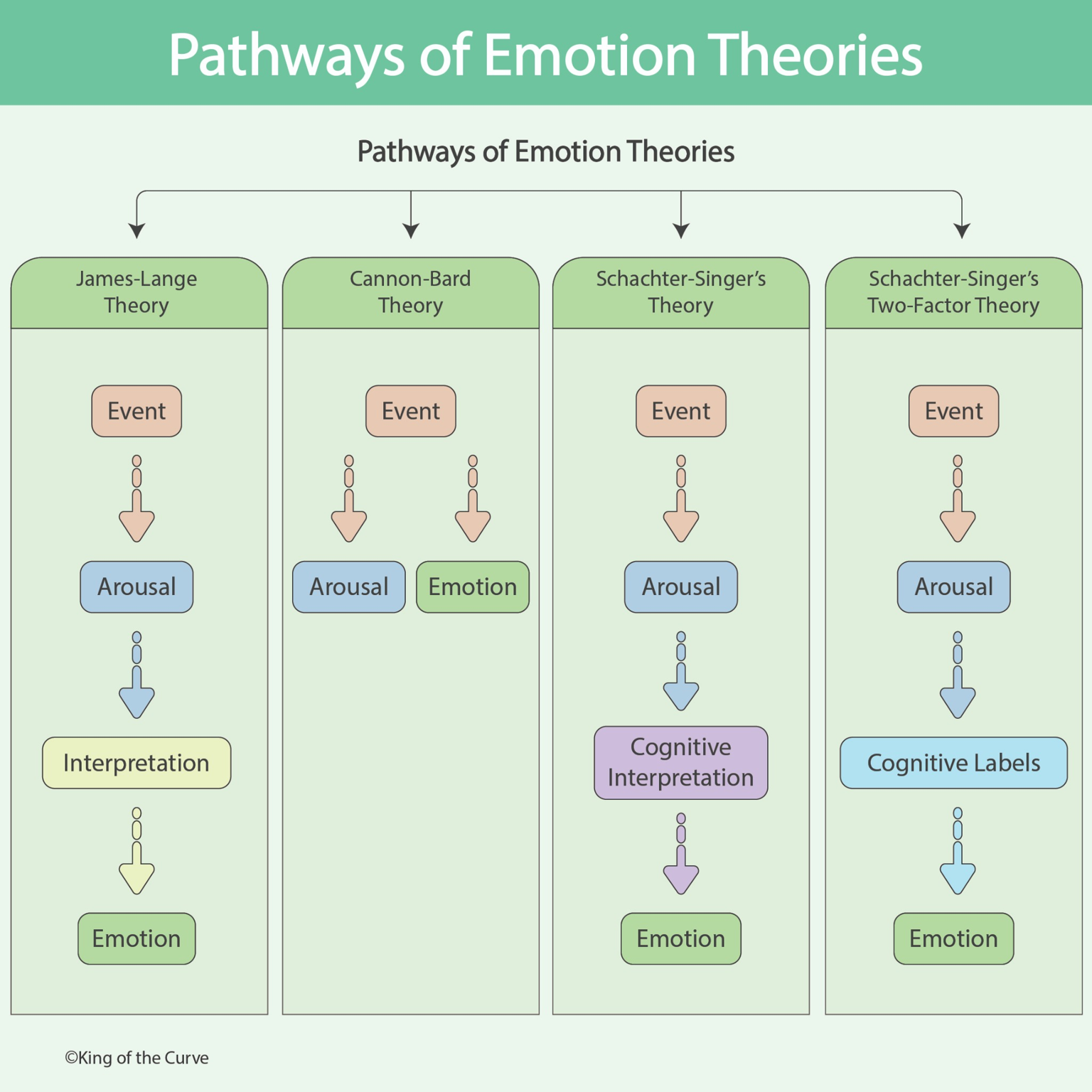
Event → Arousal → Interpretation → Emotion
Key idea:
“We feel afraid because we tremble.”
Example:
You see a snake.
Your heart races
You start sweating
Then your brain interprets those bodily changes as fear
So according to James–Lange:
✅ The body reacts first
✅ Emotion comes after interpreting the reaction
⚡ 2. Cannon–Bard Theory: Emotion and Arousal Happen Together
The Cannon–Bard theory disagrees with James–Lange.
It argues that emotions and physical reactions occur simultaneously, not sequentially.
Pathway:
Event → Emotion + Arousal (at the same time)
Key idea:
“We feel fear and our heart races at the same moment.”
Example:
You see a snake.
You feel fear immediately
Your heart races immediately
No waiting for interpretation.
So Cannon–Bard says:
✅ Emotion and arousal happen together
❌ The body does not cause emotion
🧩 3. Schachter–Singer Theory: Emotion Requires Cognitive Interpretation
The Schachter–Singer theory introduces the role of cognition.
It proposes that physiological arousal alone isn’t enough.
You must interpret the situation to label the emotion.
Pathway:
Event → Arousal → Cognitive Interpretation → Emotion
Key idea:
“Emotion depends on how we explain our arousal.”
Example:
Your heart is racing.
If you're at a concert → excitement
If you're in a dark alley → fear
Same arousal, different emotion.
So this theory emphasizes:
✅ Arousal + cognition = emotion
🏷️ 4. Schachter–Singer Two-Factor Theory: Labels Create Emotion
The Two-Factor theory is closely related but focuses more on emotional labeling.
Pathway:
Event → Arousal → Cognitive Labels → Emotion
Key idea:
“We feel emotion once we label our arousal.”
Example:
You feel shaky and your heart beats fast.
Your brain asks:
What is happening?
Why am I aroused?
Then you assign a label:
Fear
Joy
Anger
Emotion is the result of that label.
📊 Quick Comparison Table
| Theory | Emotion Happens When? | Role of Body | Role of Cognition |
|---|---|---|---|
| James–Lange | After arousal | Primary driver | Interpretation of arousal |
| Cannon–Bard | Simultaneously with arousal | Parallel response | Minimal |
| Schachter–Singer | After interpretation | Provides arousal | Essential |
| Two-Factor | After labeling arousal | Provides arousal | Cognitive labeling |
🎯 Why These Theories Matter
Understanding emotion pathways is important in many fields:
Psychology and therapy
Stress and anxiety disorders
Behavioral neuroscience
Emotional intelligence
Medical education (psychiatry, neurobiology)
These models help explain why people can experience emotions differently—even in similar situations.
✅ Final Takeaway
Emotion is not just a feeling—it’s a process involving:
An external event
A physiological reaction
Cognitive interpretation
Emotional experience
Each theory emphasizes a different step in that pathway.

Frequently Asked Questions (FAQs)
-
Aim for 4-6 focused hours, ensuring you incorporate breaks to avoid burnout.
-
Practice mindfulness techniques, take practice exams under realistic conditions, and maintain a balanced lifestyle.
-
Set short-term goals, seek support from mentors, and reward yourself for small achievements.
-
Regular exercise improves focus, reduces stress, and enhances overall mental clarity.
-
KOTC offers personalized learning tools, gamification features, and adaptive question banks to help students stay on track without burnout.