
🧪 Newman Projections: Understanding Eclipsed, Gauche, and Anti Conformations
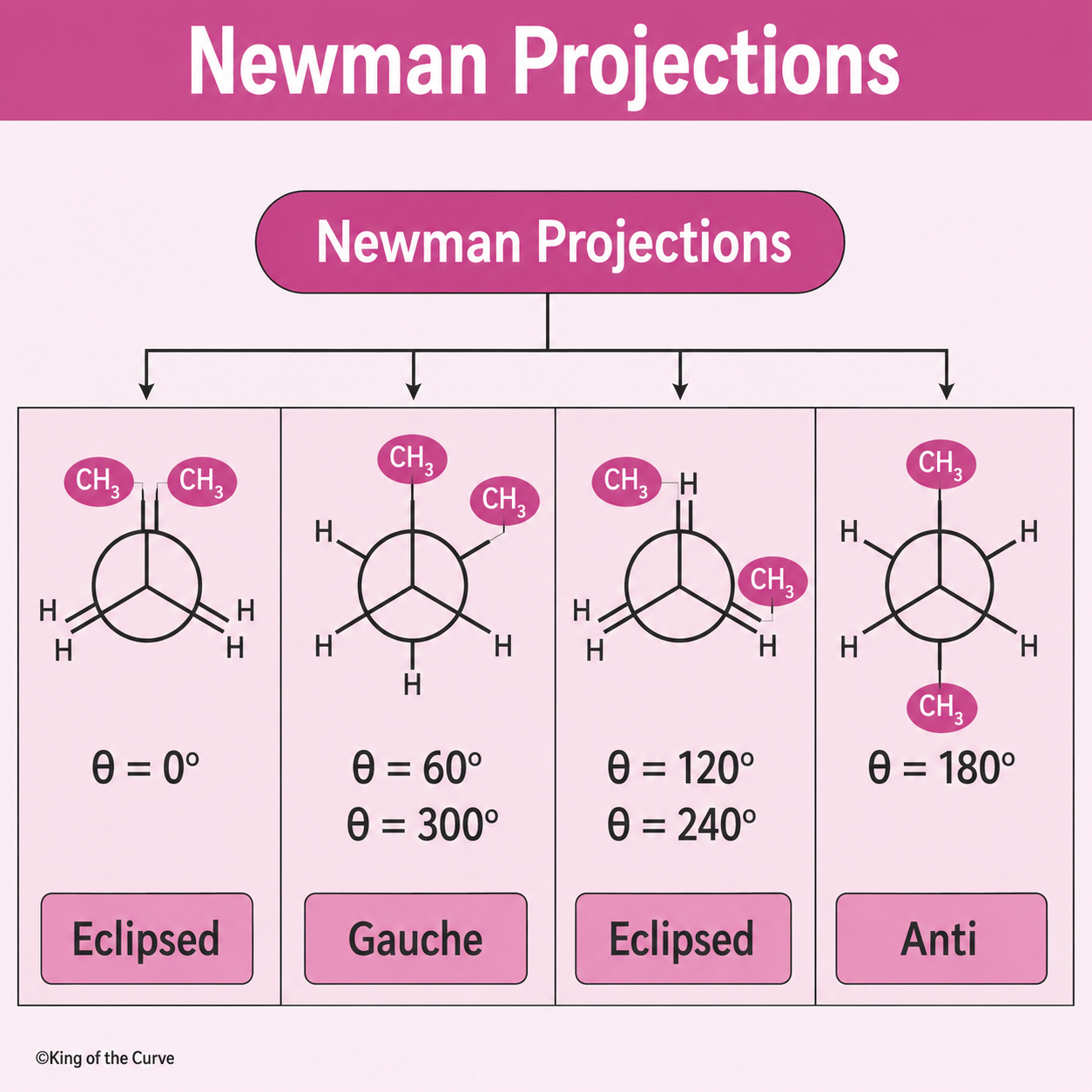
Newman projections are a convenient way to visualize the three-dimensional arrangement of atoms around a carbon–carbon single bond. By looking directly along the bond axis, chemists can compare different molecular conformations and predict which arrangements are more stable. The diagram illustrates the major conformations of butane as the bond rotates through different dihedral angles.
👁️ What Is a Newman Projection?
A Newman projection represents a molecule as viewed along a selected carbon–carbon bond. The front carbon is shown as a point or junction, while the rear carbon is represented by a circle. The three bonds attached to each carbon extend outward, making the relative positions of substituents easy to compare.
🔄 Bond Rotation and Dihedral Angle
Single bonds can rotate, producing different spatial arrangements called conformations. The angle between a bond on the front carbon and a corresponding bond on the rear carbon is the dihedral angle, represented by θ. A complete 360° rotation produces several repeating conformations.
🌑 Eclipsed Conformations
An eclipsed conformation occurs when the bonds on the rear carbon align directly behind the bonds on the front carbon. In butane, eclipsed conformations appear at 0°, 120°, and 240°. These arrangements have higher energy because the bonding electron clouds repel one another, producing torsional strain.
The 0° eclipsed conformation is the least stable because the two bulky methyl groups eclipse each other, creating both torsional and steric strain.
↗️ Gauche Conformations
Gauche conformations occur at 60° and 300°. They are staggered conformations, meaning the bonds are positioned between one another rather than directly aligned. This greatly reduces torsional strain.
However, the two methyl groups remain only 60° apart, producing some steric repulsion. For this reason, gauche conformations are stable but slightly higher in energy than the anti conformation.
↔️ Anti Conformation
The anti conformation occurs at a dihedral angle of 180°. The two methyl groups are positioned as far apart as possible, minimizing steric repulsion. It is the most stable conformation of butane and therefore has the lowest potential energy.
📊 Comparison of Butane Conformations
| 🔬 Conformation | 📐 Dihedral Angle | ⚡ Relative Stability | 🧩 Main Feature |
|---|---|---|---|
| Eclipsed, CH3–CH3 overlap | 0° | Least stable | Maximum torsional and steric strain |
| Gauche | 60° and 300° | Moderately stable | Staggered, but the methyl groups remain close together |
| Eclipsed | 120° and 240° | Unstable | Bond overlap produces torsional strain |
| Anti | 180° | Most stable | Methyl groups are positioned farthest apart |
📉 Conformational Energy Changes
As the carbon–carbon bond rotates, the potential energy rises and falls. Eclipsed conformations correspond to energy maxima, while staggered conformations correspond to energy minima. The anti conformation is the global energy minimum, and the gauche conformations are local minima.
The general stability order is:
Anti > Gauche > Eclipsed > Fully eclipsed CH₃–CH₃
Here, “greater than” indicates greater stability and therefore lower energy.
🧠 Why Newman Projections Matter
Newman projections help students analyze molecular shape, steric interactions, and conformational stability. They are especially useful in organic chemistry when studying reaction mechanisms, cyclohexane conformations, stereochemistry, and the preferred shapes of biologically important molecules.
✏️ How to Draw a Newman Projection
First, select the carbon–carbon bond you want to examine. Draw the front carbon as a central point with three bonds separated by approximately 120°. Draw the rear carbon as a circle behind it, then add its three bonds. Finally, place each substituent and determine whether the arrangement is eclipsed, staggered, gauche, or anti.
🎯 Key Takeaway
Newman projections provide a simple method for comparing molecular conformations. In butane, the anti conformation at 180° is the most stable, the gauche conformations at 60° and 300° are slightly less stable, and eclipsed conformations have higher energy because of torsional and steric strain.

Frequently Asked Questions (FAQs)
-
Aim for 4-6 focused hours, ensuring you incorporate breaks to avoid burnout.
-
Practice mindfulness techniques, take practice exams under realistic conditions, and maintain a balanced lifestyle.
-
Set short-term goals, seek support from mentors, and reward yourself for small achievements.
-
Regular exercise improves focus, reduces stress, and enhances overall mental clarity.
-
KOTC offers personalized learning tools, gamification features, and adaptive question banks to help students stay on track without burnout.