
🧠 Neuroglial Cell Types and Their Functions: A Complete Guide to CNS and PNS Glial Cells
Neuroglial cells, commonly known as glial cells, are the non-neuronal cells of the nervous system that provide essential structural, metabolic, and immune support to neurons. Although they do not transmit nerve impulses like neurons, glial cells are indispensable for maintaining a healthy and functional nervous system. They regulate the neuronal environment, produce myelin, protect against infections, and facilitate repair following injury.
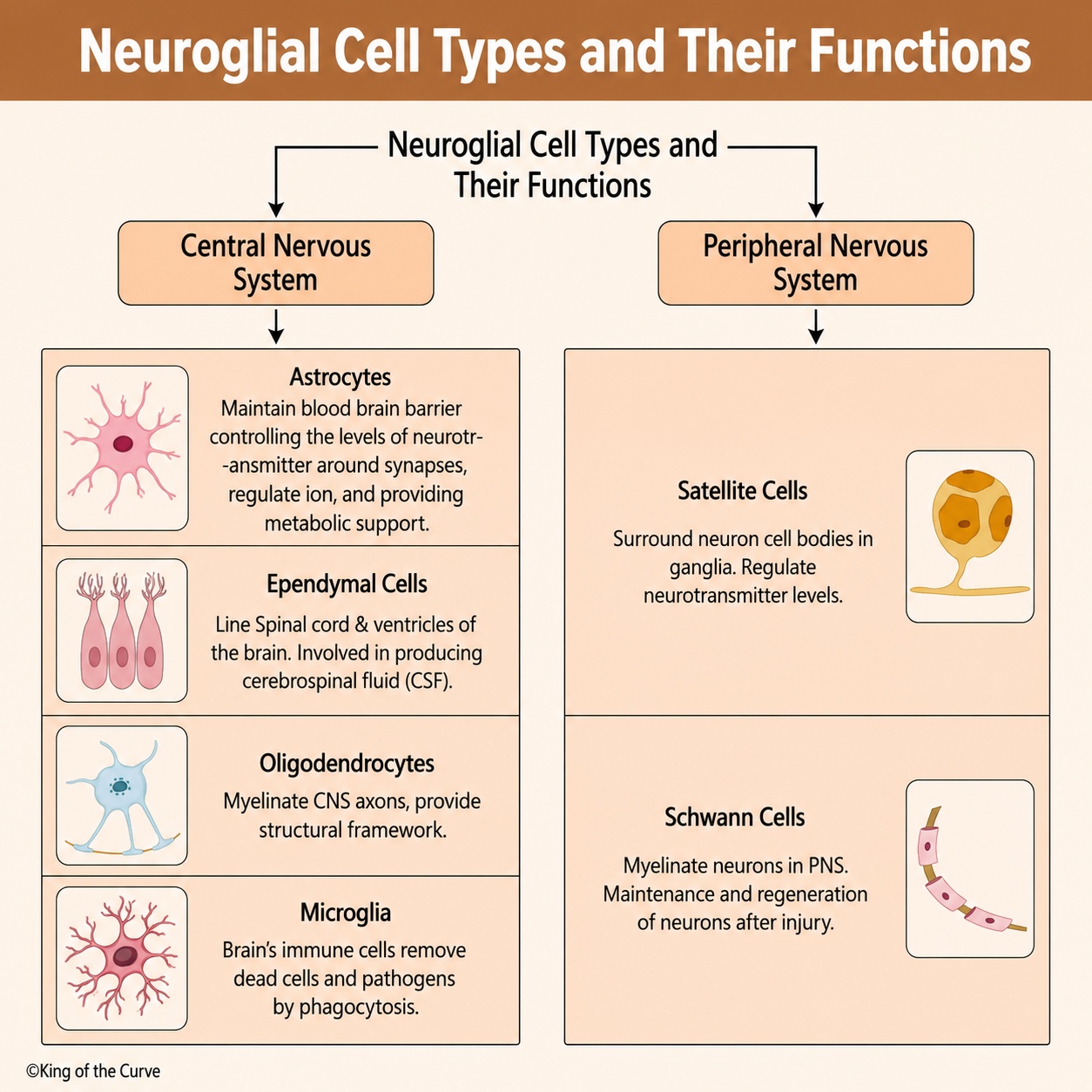
🧠 What Are Neuroglial Cells?
Neuroglial cells are specialized support cells that outnumber neurons in many parts of the nervous system. Their primary roles include maintaining homeostasis, insulating nerve fibers, supplying nutrients, removing waste, and defending against pathogens.
Unlike neurons, glial cells retain the ability to divide throughout life, allowing them to participate in tissue repair and immune responses.
🏥 Neuroglial Cells of the Central Nervous System (CNS)
The CNS includes the brain and spinal cord and contains four major types of glial cells.
⭐ Astrocytes
Astrocytes are the largest and most abundant glial cells in the CNS.
Functions:
Maintain the blood-brain barrier
Regulate extracellular potassium levels
Remove excess neurotransmitters
Provide metabolic support to neurons
Participate in tissue repair after injury
Clinical relevance: Astrocytes become reactive following CNS injury, producing glial scars that limit further damage.
🧪 Ependymal Cells
Ependymal cells line the ventricles of the brain and the central canal of the spinal cord.
Functions:
Produce cerebrospinal fluid (CSF)
Help circulate CSF through ciliary movement
Form part of the choroid plexus
Maintain the internal environment of the CNS
Clinical relevance: Dysfunction can contribute to hydrocephalus due to impaired CSF circulation.
⚡ Oligodendrocytes
Oligodendrocytes are responsible for forming the myelin sheath around CNS axons.
Functions:
Produce CNS myelin
Increase nerve impulse conduction speed
Provide structural support to axons
One oligodendrocyte can myelinate multiple axons simultaneously.
Clinical relevance: They are damaged in multiple sclerosis (MS), leading to CNS demyelination.
🛡️ Microglia
Microglia serve as the resident immune cells of the CNS.
Functions:
Phagocytose pathogens
Remove damaged neurons
Eliminate cellular debris
Initiate inflammatory responses
Assist in tissue remodeling
Clinical relevance: Overactivation of microglia has been associated with neurodegenerative diseases such as Alzheimer's disease.
🌐 Neuroglial Cells of the Peripheral Nervous System (PNS)
The PNS consists of nerves and ganglia outside the brain and spinal cord. It contains two primary glial cell types.
🟡 Satellite Cells
Satellite cells surround neuronal cell bodies within peripheral ganglia.
Functions:
Regulate the chemical environment around neurons
Control nutrient exchange
Maintain neurotransmitter balance
Provide structural support
Clinical relevance: Satellite cell dysfunction has been linked to chronic pain syndromes.
⚙️ Schwann Cells
Schwann cells form the myelin sheath around peripheral nerve fibers.
Functions:
Myelinate peripheral axons
Support axonal regeneration
Remove debris after nerve injury
Promote peripheral nerve repair
Unlike oligodendrocytes, one Schwann cell myelinates only one segment of one axon.
Clinical relevance: Schwann cells enable peripheral nerves to regenerate much more effectively than CNS neurons.
📊 Comparison of Neuroglial Cell Types
| 🧠 Neuroglial Cell Type | 📍 Location | ⚙️ Primary Function | 🩺 Clinical Significance |
|---|---|---|---|
| Astrocytes | Central Nervous System (CNS) | Maintain the blood-brain barrier, regulate ion and neurotransmitter levels, and provide metabolic support to neurons. | Form glial scars after injury and help preserve blood-brain barrier integrity. |
| Ependymal Cells | Central Nervous System (CNS) | Line the ventricles of the brain and the central canal of the spinal cord; produce and circulate cerebrospinal fluid (CSF). | Dysfunction may contribute to impaired CSF flow and hydrocephalus. |
| Oligodendrocytes | Central Nervous System (CNS) | Form the myelin sheath around CNS axons, increasing the speed of nerve impulse conduction. | Damaged in multiple sclerosis (MS), leading to CNS demyelination. |
| Microglia | Central Nervous System (CNS) | Act as resident immune cells by removing pathogens, dead cells, and cellular debris through phagocytosis. | Overactivation is associated with neuroinflammatory and neurodegenerative diseases. |
| Satellite Cells | Peripheral Nervous System (PNS) | Surround neuronal cell bodies in peripheral ganglia and regulate the extracellular environment. | Help maintain neuronal health and may contribute to chronic pain conditions. |
| Schwann Cells | Peripheral Nervous System (PNS) | Form the myelin sheath around peripheral axons and promote nerve regeneration after injury. | Essential for peripheral nerve repair and affected in Guillain-Barré syndrome. |
🔍 CNS vs. PNS Neuroglia
Understanding the distinction between CNS and PNS glial cells is fundamental in neurobiology.
| ⚙️ Feature | 🧠 Central Nervous System (CNS) | 🌐 Peripheral Nervous System (PNS) |
|---|---|---|
| Myelin-Producing Cells | Oligodendrocytes | Schwann Cells |
| Immune Cells | Microglia | Macrophages (with Schwann cell support) |
| Support Cells | Astrocytes | Satellite Cells |
| CSF Production | Ependymal Cells | Not Present |
| Regenerative Ability | Limited | High |
⚕️ Clinical Importance
Knowledge of neuroglial cells helps explain numerous neurological diseases.
Multiple sclerosis: Oligodendrocyte destruction causes CNS demyelination.
Guillain-Barré syndrome: Schwann cell myelin is damaged in the PNS.
Hydrocephalus: Ependymal dysfunction affects CSF flow.
Alzheimer's disease: Chronic microglial activation contributes to neurodegeneration.
Peripheral nerve injury: Schwann cells facilitate axonal regeneration.
🎯 Key Takeaways
Neuroglial cells provide structural, metabolic, immune, and electrical support to neurons.
The CNS contains astrocytes, oligodendrocytes, ependymal cells, and microglia.
The PNS contains Schwann cells and satellite cells.
Oligodendrocytes myelinate multiple CNS axons, whereas Schwann cells myelinate a single PNS axon segment.
Microglia function as the immune cells of the CNS.
Astrocytes are essential for maintaining the blood-brain barrier.
Ependymal cells produce and circulate cerebrospinal fluid.
Understanding neuroglial cell functions is crucial for diagnosing and treating neurological disorders.

Frequently Asked Questions (FAQs)
-
Aim for 4-6 focused hours, ensuring you incorporate breaks to avoid burnout.
-
Practice mindfulness techniques, take practice exams under realistic conditions, and maintain a balanced lifestyle.
-
Set short-term goals, seek support from mentors, and reward yourself for small achievements.
-
Regular exercise improves focus, reduces stress, and enhances overall mental clarity.
-
KOTC offers personalized learning tools, gamification features, and adaptive question banks to help students stay on track without burnout.