
🫁 Negative Pressure Breathing: How Inspiration and Expiration Work
Negative pressure breathing is the mechanism humans use to move air into the lungs. Instead of actively pulling air through the airways, the respiratory system expands the thoracic cavity, lowering pressure inside the lungs below atmospheric pressure. Air then flows down this pressure gradient into the lungs.
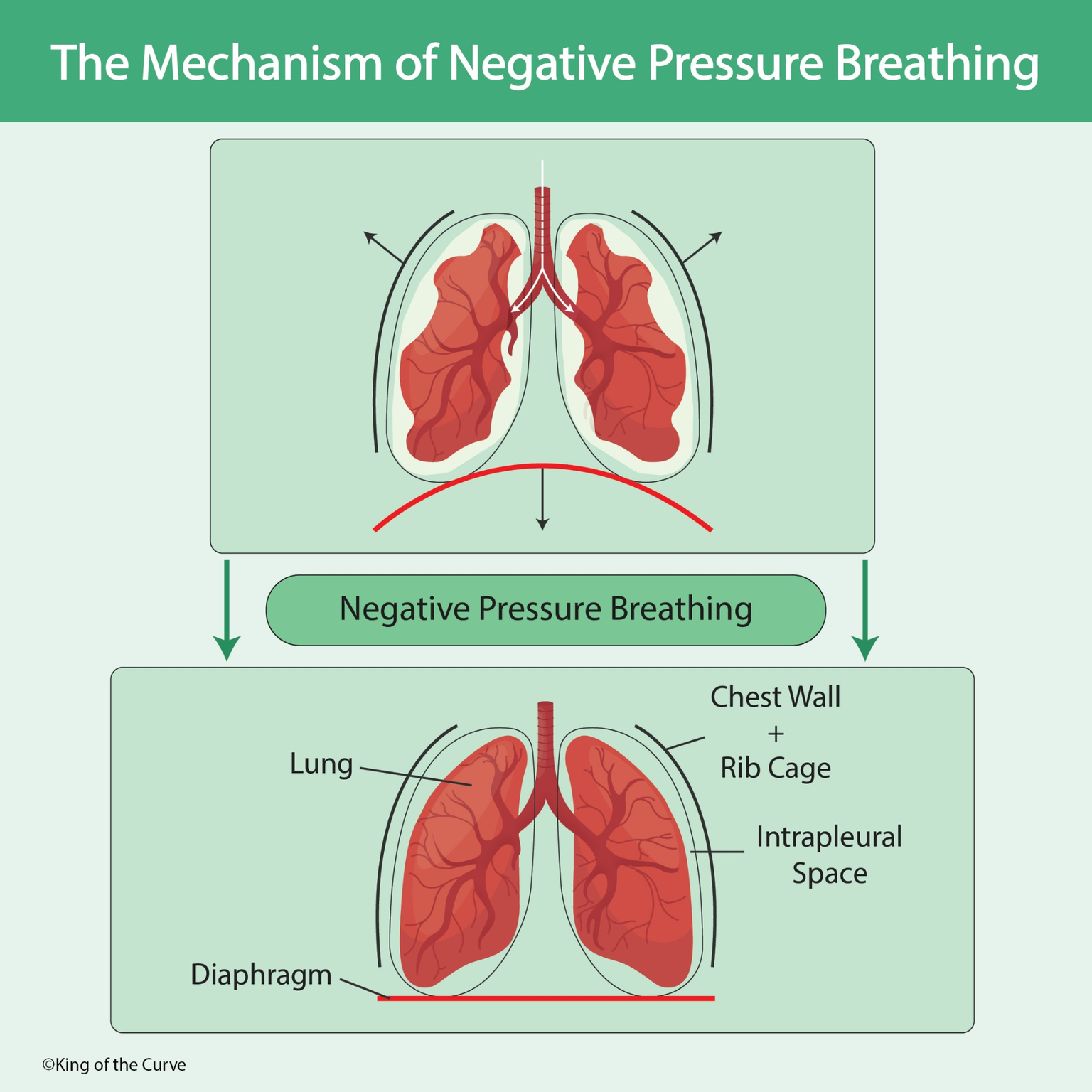
🫁 How the Lungs Follow the Chest Wall
The lungs are mechanically coupled to the chest wall through the pleural membranes and the thin fluid-filled intrapleural space. The visceral pleura covers the lungs, while the parietal pleura lines the thoracic wall. The interaction between these layers helps the lungs expand as the thoracic cavity enlarges.
💪 The Diaphragm Drives Inspiration
During quiet inspiration, the diaphragm contracts and moves downward, becoming flatter. The external intercostal muscles also help elevate the ribs. Together, these actions increase the volume of the thoracic cavity and allow the lungs to expand.
📉 Volume Increases and Pressure Decreases
The relationship between pressure and volume can be understood using Boyle’s law: at constant temperature, pressure is inversely related to volume. As thoracic and lung volume increase during inspiration, intrapulmonary pressure falls below atmospheric pressure, causing air to enter the lungs.
➡️ How Air Moves Into the Lungs
Air moves from an area of higher pressure to an area of lower pressure. When alveolar pressure drops below atmospheric pressure, air travels through the conducting airways toward the alveoli. Airflow continues until alveolar pressure again becomes equal to atmospheric pressure.
🔄 What Happens During Expiration?
During quiet expiration, the diaphragm relaxes and moves upward. The elastic recoil of the lungs and chest wall decreases thoracic volume. As lung volume decreases, alveolar pressure rises above atmospheric pressure, driving air out of the lungs. Quiet expiration is therefore largely passive.
🧪 Why Intrapleural Pressure Matters
Intrapleural pressure is normally negative relative to atmospheric pressure and generally remains below alveolar pressure during normal breathing. This pressure relationship helps maintain lung expansion. If air enters the pleural space, as in a pneumothorax, the normal pressure relationship can be disrupted and the affected lung may partially or completely collapse.
| 🫁 Phase | 📦 Thoracic Volume | 📉 Alveolar Pressure | 🌬️ Airflow |
|---|---|---|---|
| Inspiration | Increases | Below atmospheric | Into lungs |
| End inspiration | Increased | Equals atmospheric | No net airflow |
| Expiration | Decreases | Above atmospheric | Out of lungs |
🧠 Negative Pressure Breathing and the MCAT
For the MCAT, connect respiratory mechanics with pressure-volume relationships. Diaphragm contraction → thoracic volume increases → alveolar pressure decreases → air enters. During passive expiration, the sequence reverses. This is a classic application of Boyle’s law in biological systems.
🎯 High-Yield Takeaway
Remember: air moves because of pressure gradients, not because the lungs directly “suck” air in. Increasing thoracic volume lowers alveolar pressure and produces inspiration, while decreasing thoracic volume raises alveolar pressure and produces expiration. Understanding this sequence makes many MCAT respiratory physiology questions much easier to solve.

Frequently Asked Questions (FAQs)
-
Aim for 4-6 focused hours, ensuring you incorporate breaks to avoid burnout.
-
Practice mindfulness techniques, take practice exams under realistic conditions, and maintain a balanced lifestyle.
-
Set short-term goals, seek support from mentors, and reward yourself for small achievements.
-
Regular exercise improves focus, reduces stress, and enhances overall mental clarity.
-
KOTC offers personalized learning tools, gamification features, and adaptive question banks to help students stay on track without burnout.