
🧪 Mole Conversions: A Comprehensive Guide to Grams, Moles, and Particles
Understanding mole conversions is one of the most important skills in chemistry. Whether you're calculating the mass of a substance, determining the number of particles, or solving stoichiometry problems, mastering the relationship between grams, moles, and particles is essential.
⚛️ What Is a Mole?
A mole (mol) is the SI unit used to measure the amount of a substance. One mole contains exactly:
6.022 × 10²³ particles
These particles can be:
Atoms
Molecules
Formula units
Ions
This value is known as Avogadro's number.
⚖️ Converting Between Grams and Moles
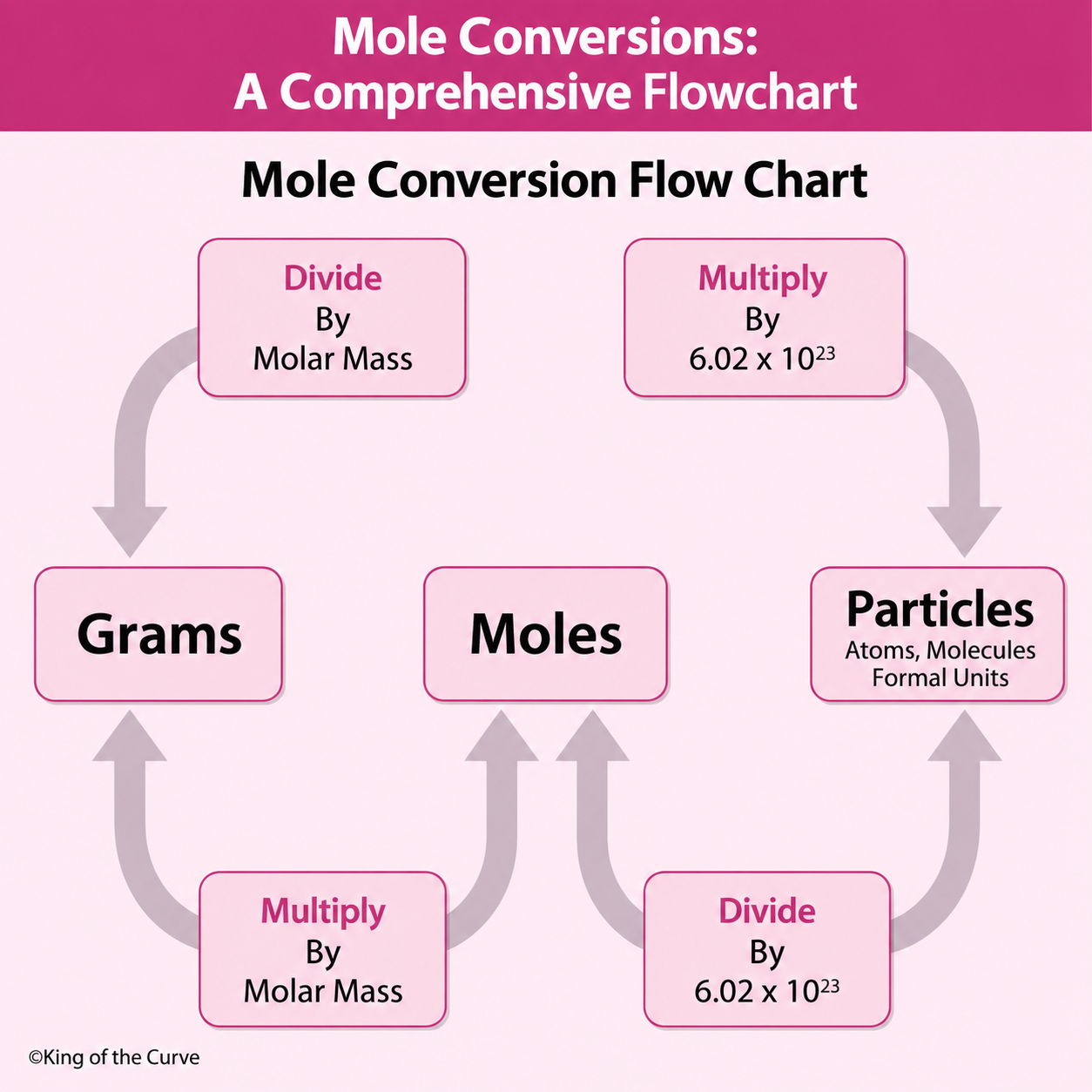
The relationship between mass and moles is determined by the molar mass, which is the mass of one mole of a substance (expressed in g/mol).
➗ Grams → Moles
To convert grams into moles:
Formula
Moles = Mass (g) ÷ Molar Mass (g/mol)
✖️ Moles → Grams
To convert moles into grams:
Formula
Mass (g) = Moles × Molar Mass (g/mol)
These conversions are commonly used in laboratory calculations and stoichiometric equations.
🔬 Converting Between Moles and Particles
A mole also relates directly to the number of particles through Avogadro's number (6.022 × 10²³).
➗ Particles → Moles
Formula
Moles = Number of Particles ÷ 6.022 × 10²³
✖️ Moles → Particles
Formula
Number of Particles = Moles × 6.022 × 10²³
These calculations are useful when determining the number of atoms or molecules present in a sample.
📊 Mole Conversion Summary
| 🔄 Conversion | 🧮 Operation | 📘 Formula |
|---|---|---|
| Grams → Moles | Divide by molar mass | Moles = Mass (g) ÷ Molar Mass (g/mol) |
| Moles → Grams | Multiply by molar mass | Mass (g) = Moles × Molar Mass (g/mol) |
| Moles → Particles | Multiply by Avogadro's number (6.022 × 10²³) | Particles = Moles × 6.022 × 10²³ |
| Particles → Moles | Divide by Avogadro's number (6.022 × 10²³) | Moles = Particles ÷ 6.022 × 10²³ |
🧾 Step-by-Step Example
Suppose you have 36 g of water (H₂O).
The molar mass of water is:
18 g/mol
Step 1: Convert grams to moles
36 g ÷ 18 g/mol = 2 moles
Step 2: Convert moles to molecules
2 × 6.022 × 10²³
= 1.204 × 10²⁴ molecules
💡 Tips for Remembering Mole Conversions
Grams ↔ Moles always use molar mass.
Moles ↔ Particles always use Avogadro's number.
Check that units cancel correctly before solving.
Keep significant figures consistent with the given data.
📚 Applications of Mole Conversions
Mole conversions are widely used in:
Chemical reaction calculations
Stoichiometry
Solution preparation
Empirical and molecular formula determination
Gas law calculations
Laboratory experiments
Pharmaceutical and industrial chemistry
🎯 Key Takeaways
Mole conversions provide the bridge between mass, amount of substance, and the number of particles. By using molar mass for mass conversions and Avogadro's number for particle conversions, you can solve a wide range of chemistry problems accurately. Mastering these relationships forms the foundation for more advanced topics such as stoichiometry, gas laws, and solution chemistry.

Frequently Asked Questions (FAQs)
-
Aim for 4-6 focused hours, ensuring you incorporate breaks to avoid burnout.
-
Practice mindfulness techniques, take practice exams under realistic conditions, and maintain a balanced lifestyle.
-
Set short-term goals, seek support from mentors, and reward yourself for small achievements.
-
Regular exercise improves focus, reduces stress, and enhances overall mental clarity.
-
KOTC offers personalized learning tools, gamification features, and adaptive question banks to help students stay on track without burnout.