
🧬 Molecular Relationships: A Step-by-Step Guide to Identifying Isomers
Understanding the relationship between two molecules is one of the most important skills in organic chemistry. Two compounds may appear similar, share the same molecular formula, or even have nearly identical structures—but they can differ significantly in their connectivity or three-dimensional arrangement.
🧪 Why Molecular Relationships Matter
Chemists compare molecular structures to determine whether compounds are identical or represent different chemical species. This classification is essential in:
Organic chemistry
Pharmaceutical drug development
Biochemistry
Materials science
Spectroscopic analysis
A structured decision-making process helps eliminate confusion and ensures accurate classification.
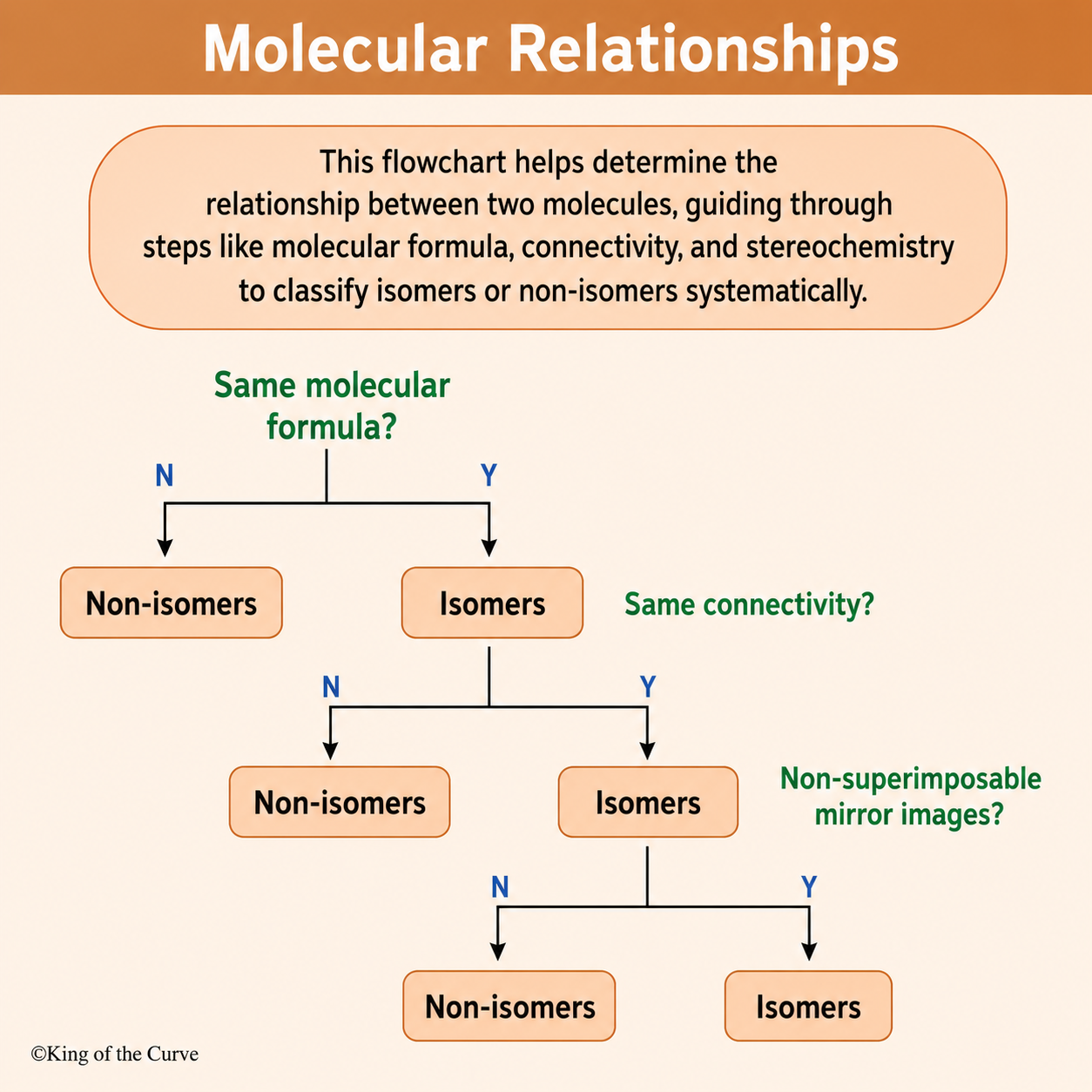
📋 Step 1: Do the Molecules Have the Same Molecular Formula?
The first and most important question is:
Do both molecules contain the same number and type of atoms?
No → Non-isomers
Yes → Continue to the next step
Molecules with different molecular formulas cannot be isomers because isomers must share the same chemical formula.
Example
Ethanol (C₂H₆O)
Propanol (C₃H₈O)
These compounds have different formulas, so they are non-isomers.
🔗 Step 2: Do They Have the Same Connectivity?
If the molecular formulas are identical, compare how the atoms are connected.
❌ No
Different bonding arrangements indicate constitutional (structural) isomers.
These compounds contain the same atoms but arranged differently.
Example
Butane
Isobutane
Both have the molecular formula C₄H₁₀, but their carbon skeletons differ.
✅ Yes
If the atoms are connected identically, proceed to stereochemistry.
🧭 Step 3: Are They Non-Superimposable Mirror Images?
Now examine the three-dimensional arrangement of atoms.
Ask:
Are the molecules mirror images that cannot be perfectly superimposed?
✅ Yes
They are enantiomers, a type of stereoisomer.
Characteristics include:
Identical physical properties (except optical rotation)
Rotate plane-polarized light in opposite directions
Often exhibit different biological activity
❌ No
If they are not mirror images but still differ spatially, they are diastereomers, another class of stereoisomers.
Examples include:
Cis/trans isomers
E/Z isomers
Molecules with multiple chiral centers
⚖️ Types of Molecular Relationships
| 🧬 Relationship | ⚗️ Molecular Formula | 🔗 Connectivity | 🧭 3D Arrangement |
|---|---|---|---|
| Non-isomers | Different | Different | Different |
| Constitutional Isomers | Same | Different | May vary |
| Enantiomers | Same | Same | Non-superimposable mirror images |
| Diastereomers | Same | Same | Not mirror images |
| Identical Molecules | Same | Same | Superimposable |
🧠 Easy Decision Process
Follow these three questions:
Same molecular formula?
No → Non-isomers
Yes → Continue
Same connectivity?
No → Constitutional isomers
Yes → Continue
Non-superimposable mirror images?
Yes → Enantiomers
No → Diastereomers (or identical molecules if fully superimposable)
⚗️ Real-World Importance
Correctly identifying molecular relationships is critical in many scientific fields.
💊 Pharmaceuticals
Many drugs exist as stereoisomers, and one form may be therapeutic while another may be inactive or harmful.
🧬 Biochemistry
Enzymes recognize specific stereochemical arrangements, making molecular orientation essential for biological function.
🏭 Chemical Manufacturing
Understanding isomerism improves reaction efficiency and product purity.
🔬 Analytical Chemistry
Techniques such as NMR spectroscopy, mass spectrometry, and chromatography are frequently used to distinguish different molecular relationships.
📚 Common Mistakes
Students often confuse:
Same molecular formula with identical compounds
Constitutional isomers with stereoisomers
Enantiomers with diastereomers
Mirror images with merely rotated structures
Using a stepwise flowchart minimizes these errors.
🎯 Key Takeaways
The Molecular Relationships Flowchart simplifies the classification of molecules by asking three essential questions:
Do they have the same molecular formula?
Do they have the same connectivity?
Are they non-superimposable mirror images?

Frequently Asked Questions (FAQs)
-
Aim for 4-6 focused hours, ensuring you incorporate breaks to avoid burnout.
-
Practice mindfulness techniques, take practice exams under realistic conditions, and maintain a balanced lifestyle.
-
Set short-term goals, seek support from mentors, and reward yourself for small achievements.
-
Regular exercise improves focus, reduces stress, and enhances overall mental clarity.
-
KOTC offers personalized learning tools, gamification features, and adaptive question banks to help students stay on track without burnout.