
⚗️ Molarity vs. Molality: Key Differences Explained
Understand the difference between molarity and molality, two important concentration units in chemistry. Learn their definitions, formulas, units, applications, and when to use each measurement.
🧪 What Is Concentration?
Concentration describes the amount of a solute dissolved in a given quantity of solvent or solution. Chemists use several concentration units, but molarity (M) and molality (m) are among the most commonly used.
Although they appear similar, they differ in what they measure and how they respond to temperature changes.
📚 What Is Molarity?
Molarity (M) is the number of moles of solute dissolved per liter of solution.
Formula
Molarity (M) = Moles of Solute ÷ Liters of Solution
Since the total solution volume is used, molarity depends on temperature because liquids expand or contract as temperature changes.
Example
If 2 moles of sodium chloride are dissolved to make 1 liter of solution:
Molarity = 2 mol ÷ 1 L = 2 M
⚖️ What Is Molality?
Molality (m) is the number of moles of solute dissolved per kilogram of solvent.
Formula
Molality (m) = Moles of Solute ÷ Kilograms of Solvent
Because it depends on mass rather than volume, molality remains constant even when temperature changes.
Example
If 2 moles of glucose are dissolved in 1 kilogram of water:
Molality = 2 mol ÷ 1 kg = 2 m
🔍 Key Differences Between Molarity and Molality
The primary distinction lies in what each unit uses as its denominator:
Molarity uses the volume of the solution.
Molality uses the mass of the solvent.
As a result, molarity changes with temperature, while molality does not.
🌡️ Effect of Temperature
Temperature affects liquids by causing them to expand or contract.
Molarity
Since volume changes with temperature, the molarity of a solution can increase or decrease.
Molality
Mass remains constant regardless of temperature, making molality independent of thermal expansion.
This makes molality particularly useful in experiments involving changing temperatures.
🧾 Comparison Table
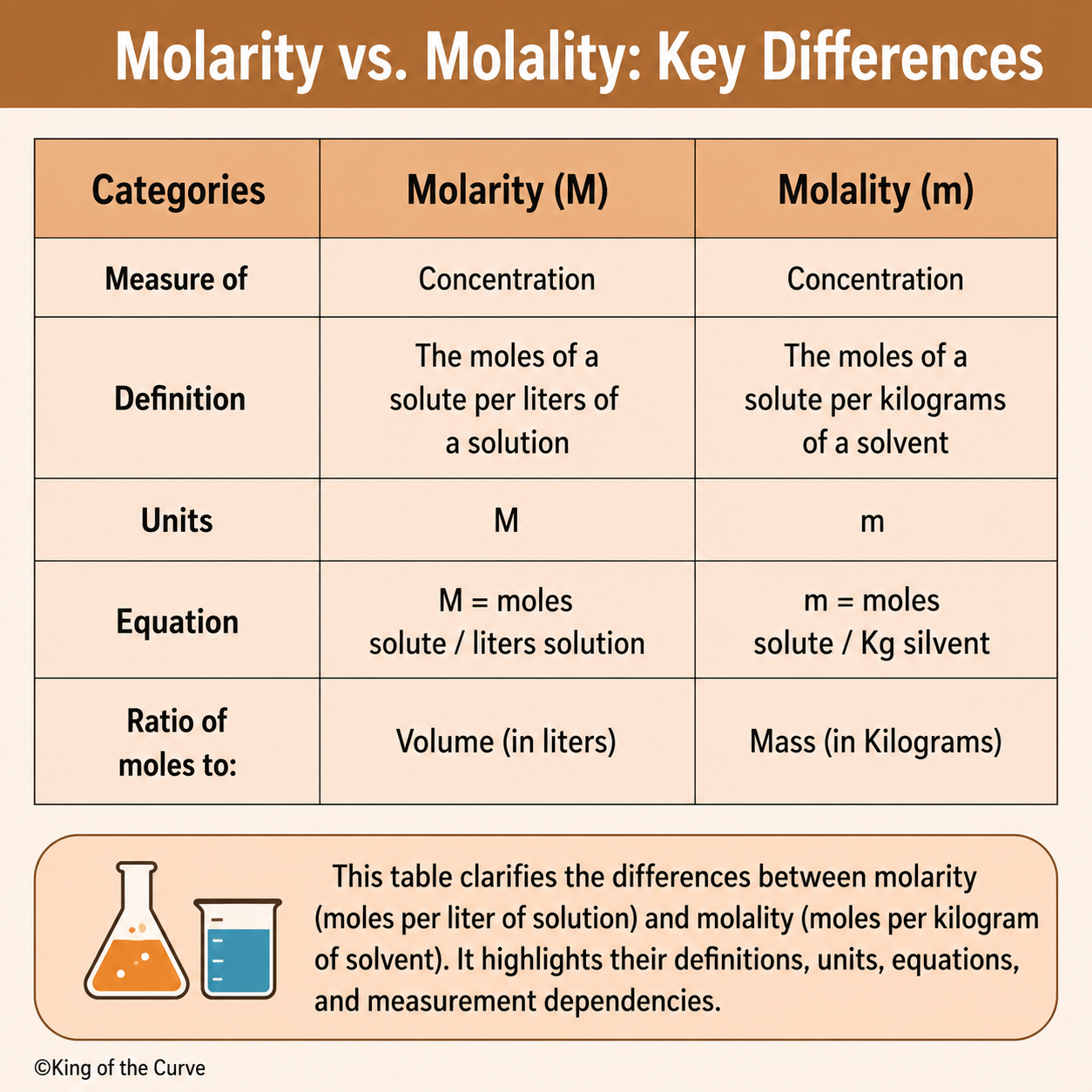
| ⚙️ Feature | 🧪 Molarity (M) | ⚖️ Molality (m) |
|---|---|---|
| Measure of | Concentration | Concentration |
| Definition | Moles of solute per liter of solution | Moles of solute per kilogram of solvent |
| Formula | M = moles of solute ÷ liters of solution | m = moles of solute ÷ kilograms of solvent |
| Unit | mol/L (M) | mol/kg (m) |
| Based on | Volume of solution | Mass of solvent |
| Temperature dependence | Changes with temperature | Independent of temperature |
| Common applications | Laboratory solution preparation | Colligative property calculations |
🏭 Applications of Molarity
Molarity is widely used in analytical and laboratory chemistry because measuring solution volume is convenient.
Common applications include:
Preparing standard laboratory solutions
Acid-base titrations
Pharmaceutical formulations
Chemical reaction calculations
Industrial solution preparation
❄️ Applications of Molality
Molality is preferred whenever temperature changes may affect experimental results.
It is commonly used for:
Freezing point depression
Boiling point elevation
Osmotic pressure studies
Antifreeze formulation
Thermodynamic calculations
💡 Tips to Remember
A simple memory trick is:
Molarity = Volume (Liters)
Molality = Mass (Kilograms)
Think of the letters:
Molarity → Volume
Molality → Mass
📌 Key Takeaways
Molarity measures moles of solute per liter of solution.
Molality measures moles of solute per kilogram of solvent.
Molarity depends on solution volume and changes with temperature.
Molality depends on solvent mass and remains constant with temperature.
Both units are essential in chemistry but are used for different purposes.

Frequently Asked Questions (FAQs)
-
Aim for 4-6 focused hours, ensuring you incorporate breaks to avoid burnout.
-
Practice mindfulness techniques, take practice exams under realistic conditions, and maintain a balanced lifestyle.
-
Set short-term goals, seek support from mentors, and reward yourself for small achievements.
-
Regular exercise improves focus, reduces stress, and enhances overall mental clarity.
-
KOTC offers personalized learning tools, gamification features, and adaptive question banks to help students stay on track without burnout.