
🧪 Differences Between Molarity and Molality
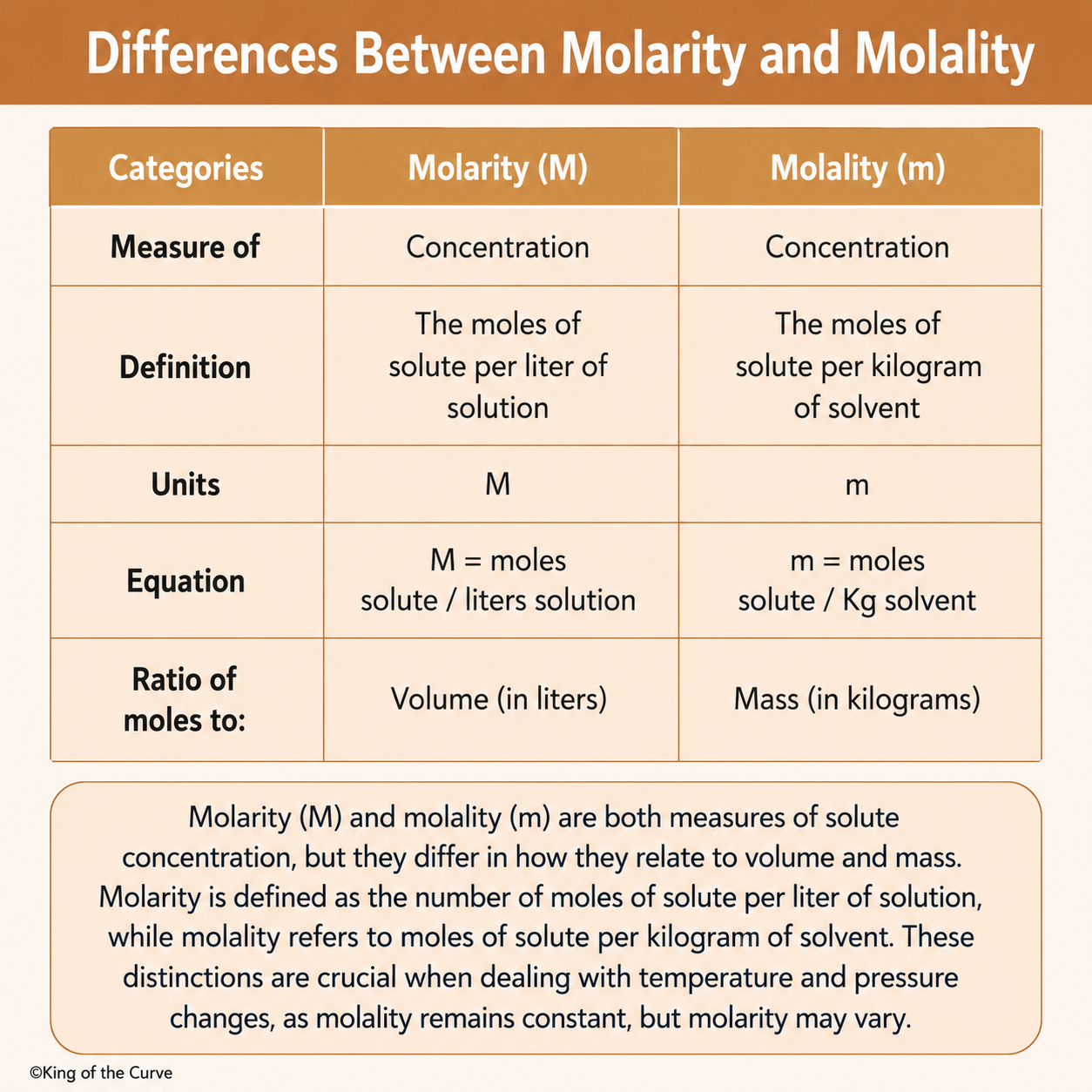
Chemists use different ways to describe the concentration of solutions, and two of the most common measurements are molarity (M) and molality (m). Although these terms sound similar, they are calculated differently and are used in different scientific situations. Understanding the distinction between them is essential in chemistry, especially in laboratory calculations and physical chemistry.
📘 What is Molarity?
Molarity refers to the number of moles of solute present in one liter of solution. It is represented by the symbol M and is one of the most frequently used concentration units in chemistry.
🔹 Formula for Molarity
| Force Type | When It Occurs | Examples |
|---|---|---|
| London Dispersion Forces | Between nonpolar molecules due to temporary induced dipoles | Ar (liquid), I₂ (solid) |
| Dipole-Dipole Forces | Between polar molecules with permanent dipoles | H₂S, CH₃Cl |
| Hydrogen Bonding | When H is bonded to N, O, or F | H₂O, NH₃, HF |
| Ion-Dipole Forces | Between ions and polar molecules | KBr dissolved in H₂O |
| Ionic Bonding | Between oppositely charged ions | NaCl, NH₄NO₃ |
For example, if 1 mole of sodium chloride is dissolved in enough water to make 1 liter of solution, the molarity is 1 M.
⚠️ Important Feature
Molarity depends on the total volume of the solution, which means it can change with temperature because liquids expand or contract when heated or cooled.
⚖️ What is Molality?
Molality measures the number of moles of solute per kilogram of solvent. It is represented by the symbol m.
🔹 Formula for Molality
If 1 mole of glucose is dissolved in 1 kilogram of water, the molality is 1 m.
⚠️ Important Feature
Molality is based on mass, not volume, so it remains constant even when temperature changes. This makes it especially useful in experiments involving temperature variations.
🔬 Key Differences Between Molarity and Molality
| Feature | Molarity (M) | Molality (m) |
|---|---|---|
| Based On | Volume of solution | Mass of solvent |
| Formula | Moles / Liter solution | Moles / Kg solvent |
| Unit | M | m |
| Temperature Dependence | Changes with temperature | Independent of temperature |
| Common Use | Laboratory solutions | Colligative properties |
🌡️ Why Temperature Matters
One major difference between molarity and molality is how they react to temperature changes. Since molarity depends on solution volume, heating a solution can slightly increase its volume and reduce the molarity. Molality, however, uses mass measurements, which remain unchanged regardless of temperature. Because of this stability, molality is commonly used in studies involving boiling point elevation, freezing point depression, and vapor pressure.
🧠 Applications in Chemistry
Molarity is widely used in everyday laboratory work because it is convenient for preparing solutions quickly using volumetric flasks and measuring cylinders. Molality, on the other hand, is preferred in physical chemistry and thermodynamics because it provides more accurate concentration values under changing environmental conditions.
Understanding both concepts helps students solve concentration problems efficiently and choose the correct unit depending on the scientific situation.
✅ Conclusion
Molarity and molality are both important concentration measurements, but they differ in the way they relate solute quantity to solution properties. Molarity uses the volume of the entire solution, while molality relies on the mass of the solvent. Knowing when to use each measurement is essential for accurate chemical calculations and experimental analysis.

Frequently Asked Questions (FAQs)
-
Aim for 4-6 focused hours, ensuring you incorporate breaks to avoid burnout.
-
Practice mindfulness techniques, take practice exams under realistic conditions, and maintain a balanced lifestyle.
-
Set short-term goals, seek support from mentors, and reward yourself for small achievements.
-
Regular exercise improves focus, reduces stress, and enhances overall mental clarity.
-
KOTC offers personalized learning tools, gamification features, and adaptive question banks to help students stay on track without burnout.