
👁️ Comparing Absolute and Difference Thresholds in Sensory Perception
Human sensory systems constantly receive information from the environment, but not every stimulus is strong enough to be noticed. Psychologists study the limits of sensation using concepts such as the absolute threshold and the difference threshold. These thresholds help explain how humans detect stimuli and perceive changes in the world around them.
🔍 What Is the Absolute Threshold?
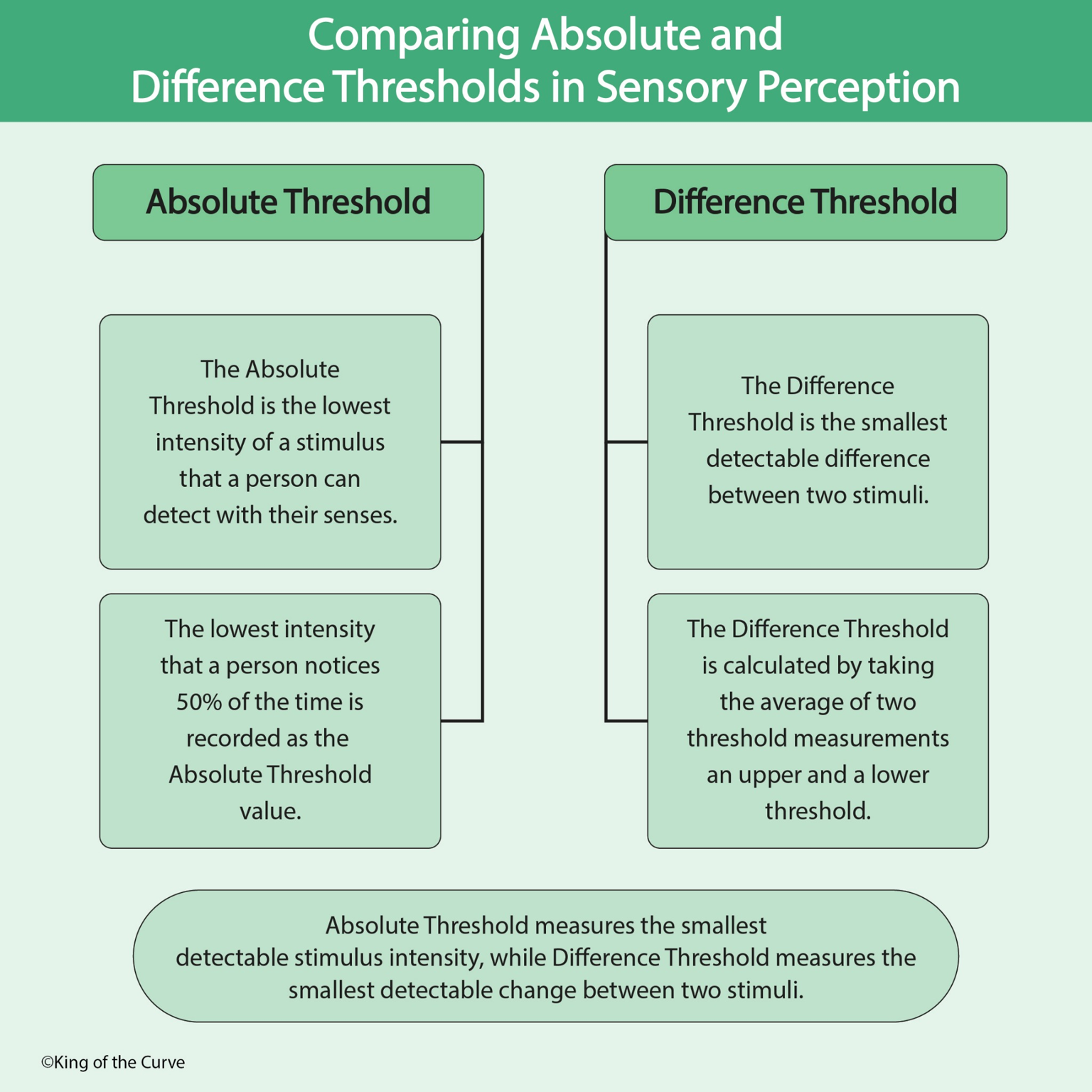
The absolute threshold refers to the lowest level of stimulus intensity that a person can detect at least 50% of the time. This concept applies to all senses, including hearing, vision, taste, touch, and smell.
For example, in a quiet room, the faintest sound a person can hear represents their auditory absolute threshold. Similarly, the dimmest light visible in darkness reflects the visual absolute threshold. Because sensory sensitivity differs among individuals, thresholds can vary from person to person.
⚖️ What Is the Difference Threshold?
The difference threshold, also called the just noticeable difference (JND), is the smallest detectable difference between two stimuli. Instead of asking whether a person can detect a stimulus, it measures whether they can notice a change in intensity.
For instance, adding one extra candle to a brightly lit room may go unnoticed, while adding the same candle to a dark room is easily detected. This principle demonstrates how perception depends on relative differences rather than absolute values alone.
🧠 Weber’s Law and Sensory Detection
The difference threshold is closely connected to Weber’s Law, which states that the just noticeable difference between two stimuli is proportional to the original intensity of the stimulus. As stimulus intensity increases, larger changes are required for detection.
This principle explains why small changes are easier to detect when stimulus levels are low. For example, adding 1 kilogram to a 5-kilogram weight is noticeable, but adding 1 kilogram to a 100-kilogram weight may not be detected as easily.
📚 Importance in Psychology and Everyday Life
Threshold concepts are important in psychology, neuroscience, marketing, and product design. Companies often use sensory thresholds to determine noticeable differences in product appearance, sound, taste, or packaging.
In medicine and neuroscience, threshold testing helps evaluate sensory disorders and nervous system function. Understanding sensory thresholds also improves our knowledge of attention, perception, and how the brain processes environmental information.
📊 Comparison Table: Absolute vs Difference Threshold
| Feature | Absolute Threshold | Difference Threshold |
|---|---|---|
| Definition | Lowest detectable stimulus intensity | Smallest detectable change between stimuli |
| Also Known As | Sensory threshold | Just Noticeable Difference (JND) |
| Main Focus | Detection of presence | Detection of change |
| Example | Hearing a faint sound | Noticing volume increase |
| Related Principle | Sensory sensitivity | Weber’s Law |
🎯 Factors Affecting Sensory Thresholds
Sensory thresholds are not fixed and can change depending on several internal and external factors. Attention, fatigue, motivation, emotions, and environmental conditions all influence how sensitive a person is to stimuli. For example, a tired individual may fail to notice faint sounds or dim lights that they would normally detect easily when fully alert.
Practice and experience can also improve sensory detection. Musicians often develop heightened auditory sensitivity, while professional chefs may become more sensitive to subtle taste differences. This adaptability demonstrates how the human nervous system can refine perception through repeated exposure and learning.
🌍 Real-World Applications of Threshold Concepts
Absolute and difference thresholds are widely applied in fields such as advertising, medicine, ergonomics, and technology design. Marketers use difference thresholds to make slight product changes without negatively affecting customer perception, while still improving cost efficiency or packaging design.
In healthcare, sensory threshold testing is used to evaluate hearing loss, nerve damage, and visual impairments. Engineers and interface designers also consider human sensory limits when creating alarms, smartphone notifications, and safety systems to ensure signals are noticeable without becoming overwhelming.

Frequently Asked Questions (FAQs)
-
Aim for 4-6 focused hours, ensuring you incorporate breaks to avoid burnout.
-
Practice mindfulness techniques, take practice exams under realistic conditions, and maintain a balanced lifestyle.
-
Set short-term goals, seek support from mentors, and reward yourself for small achievements.
-
Regular exercise improves focus, reduces stress, and enhances overall mental clarity.
-
KOTC offers personalized learning tools, gamification features, and adaptive question banks to help students stay on track without burnout.