
⚙️ Metallic Bonding: Definition, Properties, and the Sea of Electrons Explained
Learn how metallic bonding forms, why metals conduct electricity and heat so efficiently, and how the "sea of electrons" model explains the unique physical properties of metals.
🧲 What Is Metallic Bonding?
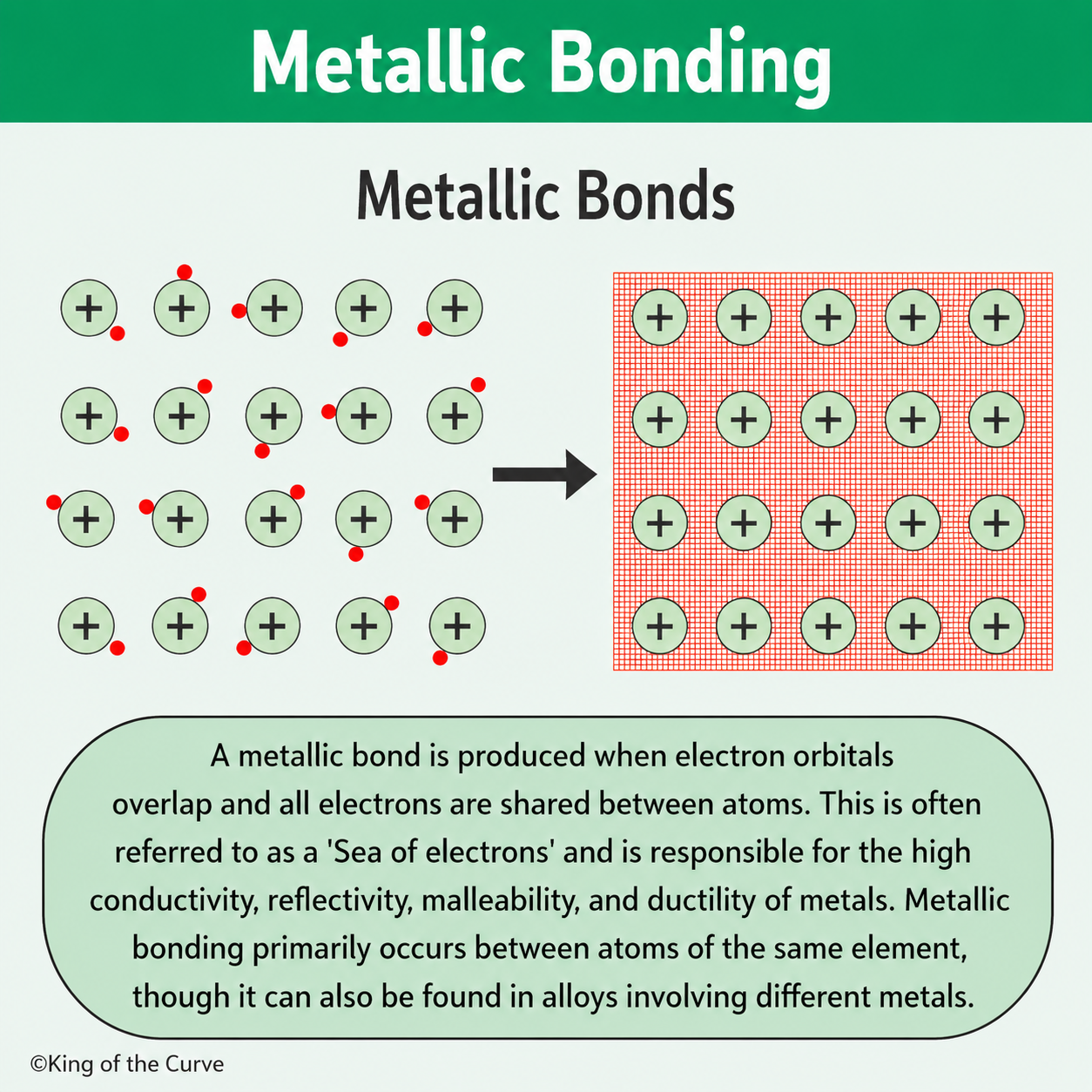
Metallic bonding is the electrostatic attraction between positively charged metal ions and a shared pool of delocalized valence electrons. Unlike ionic or covalent bonds, metallic bonds do not involve electrons being transferred or shared between specific atoms. Instead, the electrons move freely throughout the entire metal lattice.
This mobile "sea of electrons" keeps the positively charged metal ions tightly bound together while allowing metals to exhibit several unique physical properties.
🌊 The Sea of Electrons Model
The sea of electrons model is the most widely accepted explanation for metallic bonding.
In this model:
Metal atoms lose their outermost electrons.
These electrons become delocalized, meaning they are free to move throughout the crystal lattice.
The remaining metal ions form an organized lattice.
Strong electrostatic attraction between the ions and the mobile electrons creates metallic bonds.
Because the electrons are not attached to any one atom, metals remain stable even when subjected to mechanical stress.
⚡ Key Properties of Metallic Bonding
Metallic bonding gives metals their characteristic physical properties.
🔬 How Metallic Bonding Forms
Metallic bonding develops through a simple sequence:
Metal atoms contribute their valence electrons.
The electrons become delocalized throughout the crystal.
Positive metal ions arrange into a regular lattice.
Electrostatic attraction between ions and electrons creates a strong metallic bond.
This continuous attraction holds the entire metal together rather than forming individual bonds between neighboring atoms.
🏗️ Metallic Bonding in Alloys
Metallic bonding is also present in alloys, which are mixtures of two or more elements containing at least one metal.
Common examples include:
🔩 Steel (Iron + Carbon)
🟡 Brass (Copper + Zinc)
🟤 Bronze (Copper + Tin)
🛡️ Stainless Steel (Iron + Chromium + Nickel)
Alloys often possess greater strength, hardness, or corrosion resistance than pure metals because the different-sized atoms disrupt the regular lattice structure.
⚙️ Factors Affecting Metallic Bond Strength
Several factors influence the strength of metallic bonds:
🧪 Number of delocalized electrons available
➕ Positive charge on metal ions
📏 Atomic size of the metal
🧱 Crystal lattice arrangement
Generally, smaller metal ions with more delocalized electrons form stronger metallic bonds.
🏭 Everyday Applications of Metallic Bonding
The unique properties produced by metallic bonding make metals essential in everyday life.
Examples include:
⚡ Electrical wiring
🚗 Automobiles
✈️ Aircraft components
🏗️ Building materials
🍳 Cookware
💍 Jewelry
⚙️ Industrial machinery
🩺 Medical instruments
📌 Key Takeaways
Metallic bonding occurs between metal atoms through delocalized electrons.
The sea of electrons model explains the structure of metals.
Metallic bonding is responsible for conductivity, malleability, ductility, metallic luster, and high melting points.
Strong electrostatic attraction holds the metal lattice together.
Metallic bonding occurs in both pure metals and alloys.

Frequently Asked Questions (FAQs)
-
Aim for 4-6 focused hours, ensuring you incorporate breaks to avoid burnout.
-
Practice mindfulness techniques, take practice exams under realistic conditions, and maintain a balanced lifestyle.
-
Set short-term goals, seek support from mentors, and reward yourself for small achievements.
-
Regular exercise improves focus, reduces stress, and enhances overall mental clarity.
-
KOTC offers personalized learning tools, gamification features, and adaptive question banks to help students stay on track without burnout.