
🧪 Isotope Example: Understanding Lithium Isotopes
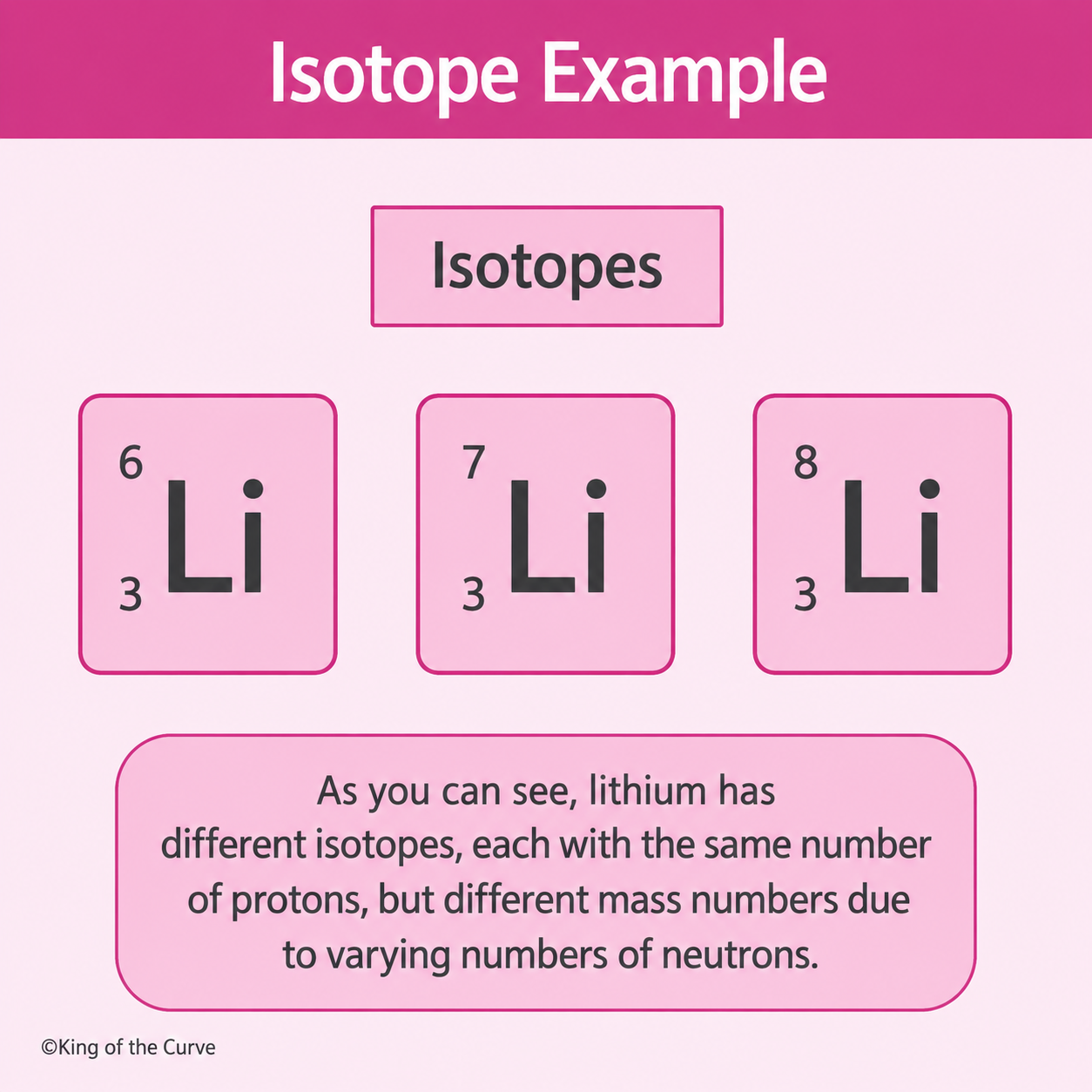
Isotopes are atoms of the same element that have the same number of protons but different numbers of neutrons. Because the number of protons determines the element’s identity, isotopes remain chemically similar while differing in mass. The diagram above uses lithium as an example to illustrate this concept.
What Are Isotopes?
An isotope is a variation of an element that contains:
The same atomic number (same number of protons)
A different mass number (different total number of protons and neutrons)
Since isotopes have identical numbers of protons and electrons, they exhibit nearly identical chemical properties. However, their physical properties may differ because of their different masses.
🔬 Lithium Isotopes
Lithium has an atomic number of 3, meaning every lithium atom contains:
3 protons
3 electrons (if neutral)
The image shows three lithium isotopes:
| Isotope | Protons | Neutrons | Mass Number |
|---|---|---|---|
| Lithium-6 (⁶Li) | 3 | 3 | 6 |
| Lithium-7 (⁷Li) | 3 | 4 | 7 |
| Lithium-8 (⁸Li) | 3 | 5 | 8 |
🧮 How to Calculate Neutrons
The number of neutrons can be found using:
Neutrons = Mass Number − Atomic Number
Examples
Lithium-6
Mass number = 6
Atomic number = 3
Neutrons = 6 − 3 = 3
Lithium-7
Mass number = 7
Atomic number = 3
Neutrons = 7 − 3 = 4
Lithium-8
Mass number = 8
Atomic number = 3
Neutrons = 8 − 3 = 5
📚 Why Are Isotopes Important?
Isotopes have many scientific and practical applications:
🏥 Medicine
Radioactive isotopes are used in medical imaging and cancer treatment.
⏳ Dating Ancient Materials
Carbon-14 helps determine the age of fossils and archaeological artifacts.
⚡ Energy Production
Certain isotopes, such as uranium-235, are used in nuclear reactors.
🔬 Scientific Research
Isotopes help scientists track chemical reactions and biological processes.
⚖️ Stable vs Radioactive Isotopes
Not all isotopes are equally stable.
Stable Isotopes
Do not undergo radioactive decay
Example: Lithium-6 and Lithium-7
Radioactive Isotopes
Unstable and emit radiation
Example: Lithium-8
Radioactive isotopes eventually transform into more stable forms over time.
🎯 Key Takeaway
Lithium isotopes demonstrate the defining feature of isotopes: the same number of protons but different numbers of neutrons. Lithium-6, Lithium-7, and Lithium-8 all have an atomic number of 3, yet their differing neutron counts give them different mass numbers. Understanding isotopes is essential in chemistry, physics, medicine, and nuclear science.

Frequently Asked Questions (FAQs)
-
Aim for 4-6 focused hours, ensuring you incorporate breaks to avoid burnout.
-
Practice mindfulness techniques, take practice exams under realistic conditions, and maintain a balanced lifestyle.
-
Set short-term goals, seek support from mentors, and reward yourself for small achievements.
-
Regular exercise improves focus, reduces stress, and enhances overall mental clarity.
-
KOTC offers personalized learning tools, gamification features, and adaptive question banks to help students stay on track without burnout.