
📘 Linear vs. Circular Motion
Motion is one of the most fundamental concepts in physics, describing how objects change position over time. Two common types of motion are linear motion and circular motion, each governed by similar principles but applied in different ways. Understanding the relationship between these two forms of motion helps students transition from basic kinematics to rotational dynamics. Although they describe different paths, many of their equations have directly corresponding forms.
🚶 What Is Linear Motion?
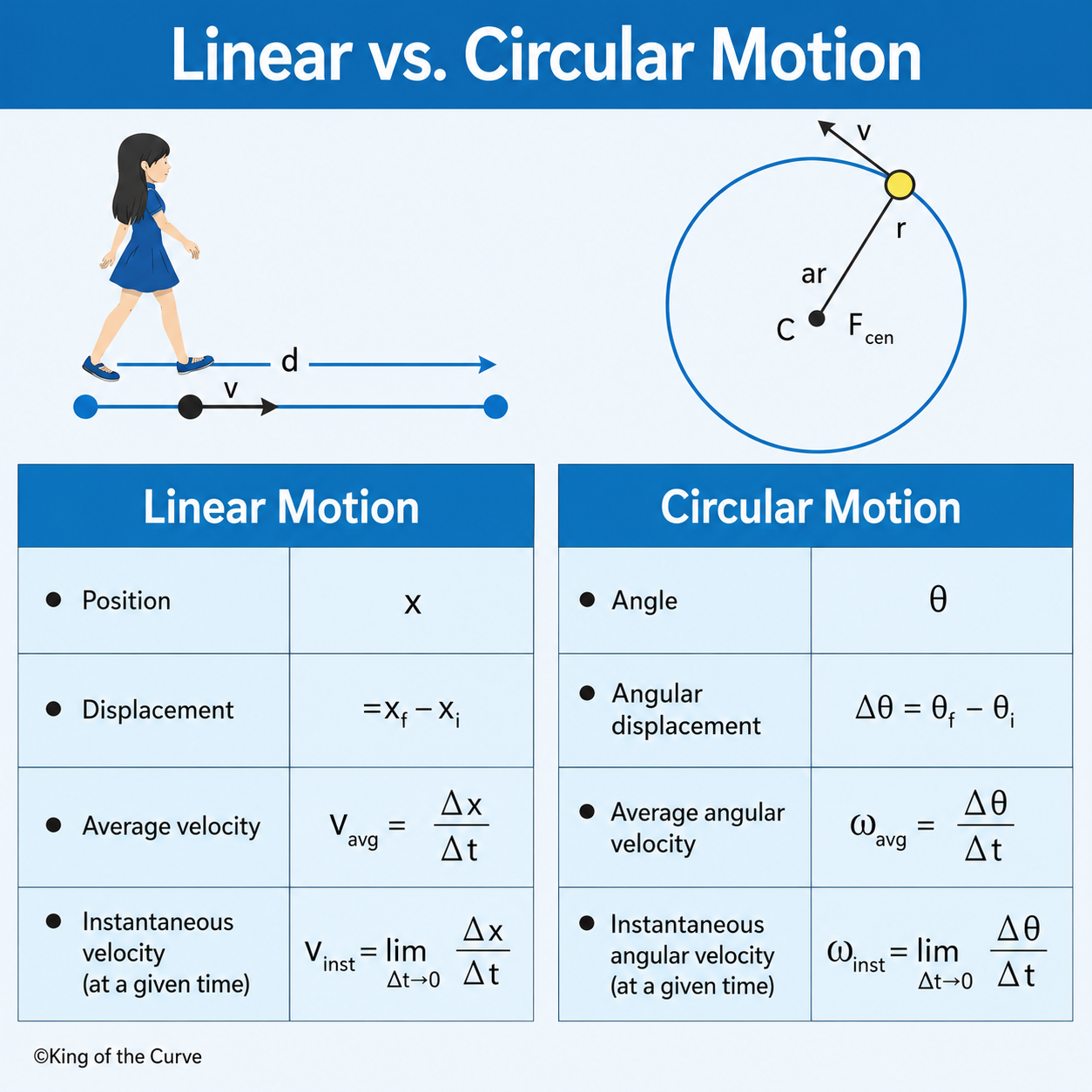
Linear motion occurs when an object moves along a straight line. Examples include a person walking on a sidewalk, a train traveling along a straight track, or an elevator moving vertically. In linear motion, quantities such as position, displacement, and velocity are measured in terms of straight-line distance. The position is represented by x, while displacement is calculated as the difference between the final and initial positions.
🔄 What Is Circular Motion?
Circular motion occurs when an object moves around a fixed center while maintaining a constant radius. Examples include the rotation of a Ferris wheel, the blades of a fan, or a satellite orbiting Earth. Instead of linear displacement, circular motion uses angular displacement (θ), and instead of linear velocity, it uses angular velocity (ω). These angular quantities describe how much and how quickly an object rotates.
⚖️ Comparing Linear and Circular Motion
Although the paths are different, linear and circular motion share many mathematical similarities. Linear quantities have rotational equivalents, making it easier to understand circular motion by relating it to familiar concepts from straight-line motion.
| Linear Motion | Circular Motion |
|---|---|
| Position (x) | Angular Position (θ) |
| Displacement (Δx) | Angular Displacement (Δθ) |
| Average Velocity (vavg) | Average Angular Velocity (ωavg) |
| Instantaneous Velocity (v) | Instantaneous Angular Velocity (ω) |
| Straight-line path | Circular path |
📐 Linear and Angular Relationships
Linear and circular quantities are connected through the radius of the circular path. The distance traveled along a circle is called the arc length, given by s = rθ, where r is the radius and θ is measured in radians. Similarly, the relationship between linear velocity and angular velocity is v = rω. These equations show how rotational motion can be converted into equivalent linear motion.
⏱️ Average and Instantaneous Velocity
Average velocity measures how fast an object moves over a period of time, while instantaneous velocity measures its speed at a specific moment. In linear motion, average velocity is calculated using displacement divided by time, whereas in circular motion, average angular velocity uses angular displacement divided by time. Instantaneous values are obtained using calculus by considering an infinitely small time interval.
🌍 Real-World Applications
Both types of motion are encountered in everyday life. Linear motion is seen in vehicles traveling on straight roads, moving walkways, elevators, and runners. Circular motion is observed in gears, bicycle wheels, washing machine drums, amusement park rides, and planetary orbits. Engineers use both concepts extensively when designing transportation systems, rotating machinery, and mechanical devices.
🎯 Importance in Physics
Studying linear motion provides the foundation for understanding rotational motion. Concepts such as velocity, acceleration, and force have direct rotational counterparts, including angular velocity, angular acceleration, and torque. Mastering these relationships helps students solve more advanced problems involving centripetal force, rotational equilibrium, and conservation of angular momentum.
✅ Conclusion
Linear and circular motion describe different ways objects move, yet they are closely connected through equivalent physical quantities and mathematical relationships. By understanding how displacement corresponds to angular displacement and velocity corresponds to angular velocity, students can confidently approach more advanced topics in mechanics. Recognizing these parallels simplifies problem-solving and deepens the understanding of motion in both everyday life and scientific applications.

Frequently Asked Questions (FAQs)
-
Aim for 4-6 focused hours, ensuring you incorporate breaks to avoid burnout.
-
Practice mindfulness techniques, take practice exams under realistic conditions, and maintain a balanced lifestyle.
-
Set short-term goals, seek support from mentors, and reward yourself for small achievements.
-
Regular exercise improves focus, reduces stress, and enhances overall mental clarity.
-
KOTC offers personalized learning tools, gamification features, and adaptive question banks to help students stay on track without burnout.