
🧪 What Is a Limiting Reagent?
The relationship between language and cognition has fascinated psychologists, linguists, and neuroscientists for decades. A central question is whether our thoughts shape the language we use or whether language itself influences the way we think. Several major theories offer different perspectives on this relationship, making this topic highly relevant for the MCAT Psychology and Sociology section.
⚖️ Why Limiting Reagents Matter
Chemical reactions occur according to fixed mole ratios defined by a balanced chemical equation. If one reactant is present in a smaller amount than required by the stoichiometric ratio, it limits the amount of product that can be produced. Identifying the limiting reagent allows chemists to predict the maximum theoretical yield and determine whether any excess reactant remains after the reaction.
🧬 When No Limiting Reagent Exists
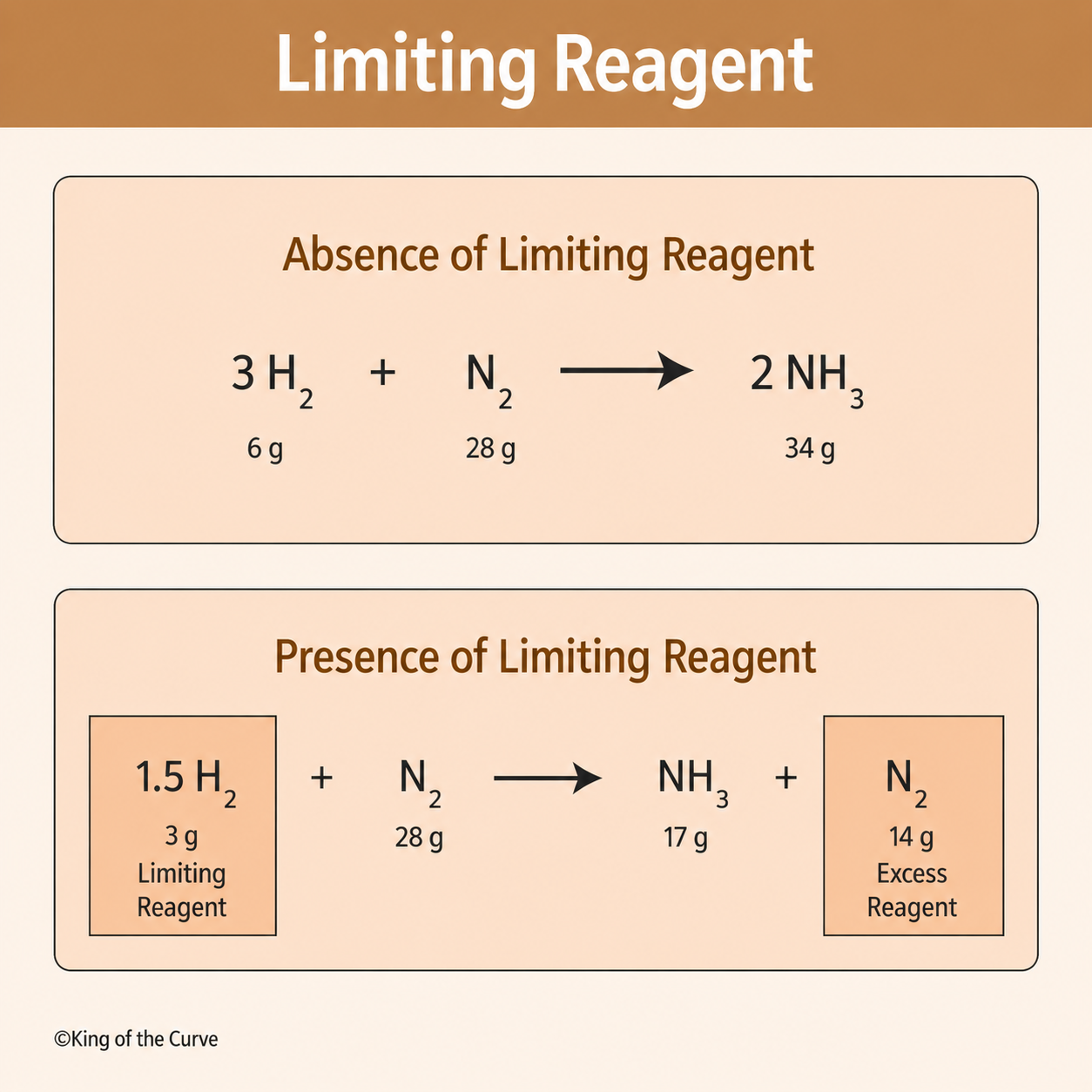
A reaction has no limiting reagent when all reactants are supplied in the exact stoichiometric ratio. In the reaction:
3 H₂ + N₂ → 2 NH₃
Six grams of hydrogen react perfectly with twenty-eight grams of nitrogen to produce thirty-four grams of ammonia. Because both reactants are completely consumed, there is no excess material remaining after the reaction finishes.
⚗️ When a Limiting Reagent Is Present
If the reactants are not mixed in the correct proportions, one reactant will run out before the other. In the illustration, only 1.5 moles (3 g) of H₂ are available with 28 g of N₂. Hydrogen becomes the limiting reagent, producing only 17 g of NH₃, while 14 g of nitrogen remains as the excess reagent after the reaction stops.
📈 Calculating the Limiting Reagent
To determine the limiting reagent, first balance the chemical equation. Next, convert each reactant into moles and calculate how much product each could theoretically produce. The reactant that forms the smaller amount of product is the limiting reagent. This systematic approach helps eliminate mistakes on stoichiometry questions and ensures accurate yield calculations.
📋 Limiting vs. Excess Reagents
| Concept | Description | Role in the Reaction |
|---|---|---|
| Limiting Reagent | Reactant consumed first | Determines the maximum amount of product formed. |
| Excess Reagent | Reactant remaining after completion | Left over once the limiting reagent is exhausted. |
| Theoretical Yield | Maximum product possible | Calculated using the limiting reagent. |
| Actual Yield | Product obtained experimentally | Often lower than the theoretical yield. |
| Percent Yield | (Actual Yield ÷ Theoretical Yield) × 100 | Measures reaction efficiency. |
How the MCAT Tests Limiting Reagents
The MCAT commonly presents balanced equations, reaction tables, or laboratory scenarios requiring students to identify the limiting reagent before calculating product yield. Many questions include extra information to test whether students correctly distinguish between limiting and excess reactants. Always compare the available moles of each reactant to the balanced equation rather than comparing masses directly.
❌ Common Mistakes to Avoid
One of the most common errors is assuming the reactant with the smaller mass is automatically the limiting reagent. Because different substances have different molar masses, students must always convert grams to moles first. Another frequent mistake is calculating theoretical yield using the excess reagent instead of the limiting reagent, which leads to incorrect answers.
🚀 Master Stoichiometry with King of the Curve
Stoichiometry becomes much easier when complex calculations are paired with visual learning. King of the Curve's exclusive science illustrations simplify limiting reagents, reaction yields, and other high-yield chemistry concepts into memorable diagrams that improve long-term retention. Explore this illustration along with 1,000+ visual study resources at mcat.kingofthecurve.org, and strengthen your preparation with adaptive question banks, daily challenges, gamified learning, and comprehensive MCAT study tools designed to help you succeed.

Frequently Asked Questions (FAQs)
-
Aim for 4-6 focused hours, ensuring you incorporate breaks to avoid burnout.
-
Practice mindfulness techniques, take practice exams under realistic conditions, and maintain a balanced lifestyle.
-
Set short-term goals, seek support from mentors, and reward yourself for small achievements.
-
Regular exercise improves focus, reduces stress, and enhances overall mental clarity.
-
KOTC offers personalized learning tools, gamification features, and adaptive question banks to help students stay on track without burnout.