
🧪 Understanding Intermolecular Forces
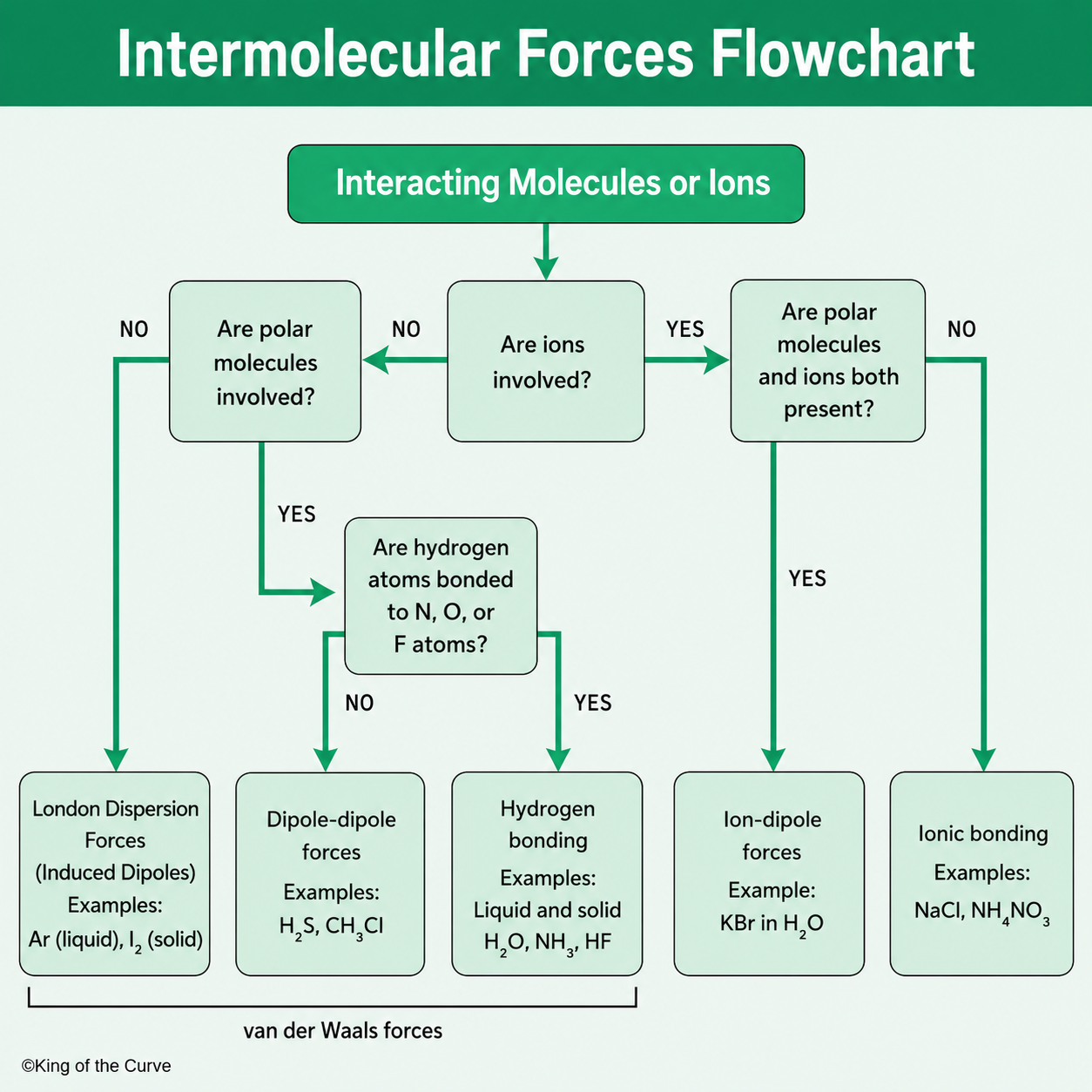
Intermolecular forces are the attractive forces that exist between molecules or ions. These forces are weaker than chemical bonds but play a major role in determining physical properties such as boiling point, melting point, solubility, viscosity, and surface tension. The flowchart shown above helps identify which type of intermolecular force is present based on molecular structure and polarity.
⚛️ Why Intermolecular Forces Matter
Intermolecular forces influence how substances behave in everyday life. For example:
Water forms droplets because of hydrogen bonding.
Oils do not mix with water because of polarity differences.
Ionic compounds dissolve in water due to ion-dipole interactions.
Understanding these forces is essential in chemistry, biology, medicine, and materials science.
🌫️ London Dispersion Forces
London dispersion forces are the weakest intermolecular forces and occur in all molecules, especially nonpolar molecules. They result from temporary fluctuations in electron distribution that create temporary dipoles.
Examples include:
Argon (Ar)
Iodine (I₂)
Even though they are weak individually, dispersion forces can become significant in large molecules.
🔄 Dipole-Dipole Forces
Dipole-dipole forces occur between polar molecules. In these interactions, the positive end of one molecule attracts the negative end of another molecule.
Examples:
H₂S
CH₃Cl
These forces are generally stronger than London dispersion forces because the molecules possess permanent dipoles.
💧 Hydrogen Bonding
Hydrogen bonding is a particularly strong type of dipole-dipole interaction. It occurs when hydrogen is bonded directly to nitrogen (N), oxygen (O), or fluorine (F).
Common examples:
Water (H₂O)
Ammonia (NH₃)
Hydrogen fluoride (HF)
Hydrogen bonding explains why water has unusually high boiling and melting points compared to similar molecules.
⚡ Ion-Dipole and Ionic Forces
Ion-dipole forces occur between ions and polar molecules. These interactions are important in dissolving ionic compounds in water.
Example:
KBr dissolved in H₂O
Ionic bonding, on the other hand, occurs between oppositely charged ions and is much stronger than typical intermolecular forces.
Examples:
NaCl
NH₄NO₃
📊 Simple Table of Intermolecular Forces
| Force Type | Occurs Between | Relative Strength | Examples |
|---|---|---|---|
| London Dispersion | Nonpolar molecules | Weakest | Ar, I2 |
| Dipole-Dipole | Polar molecules | Moderate | H2S, CH3Cl |
| Hydrogen Bonding | H bonded to N, O, or F | Strong | H2O, NH3, HF |
| Ion-Dipole | Ions and polar molecules | Very Strong | KBr in H2O |
| Ionic Bonding | Positive and negative ions | Strongest | NaCl, NH4NO3 |
🧠 Using the Flowchart Effectively
The intermolecular forces flowchart provides a step-by-step method to determine the dominant force in a substance. By asking questions about polarity, ion presence, and hydrogen bonding, students can quickly identify the correct interaction type. This approach simplifies complex chemistry concepts and improves understanding of molecular behavior.

Frequently Asked Questions (FAQs)
-
Aim for 4-6 focused hours, ensuring you incorporate breaks to avoid burnout.
-
Practice mindfulness techniques, take practice exams under realistic conditions, and maintain a balanced lifestyle.
-
Set short-term goals, seek support from mentors, and reward yourself for small achievements.
-
Regular exercise improves focus, reduces stress, and enhances overall mental clarity.
-
KOTC offers personalized learning tools, gamification features, and adaptive question banks to help students stay on track without burnout.