
🧪 Common Functional Groups: The Building Blocks of Biochemistry and MCAT Success
Understanding functional groups is one of the most important skills for students studying biology, biochemistry, and organic chemistry. These small chemical structures determine how molecules behave, react, and interact within living organisms.
🔍 Why Functional Groups Matter
Functional groups are specific arrangements of atoms that give molecules characteristic properties and functions. Instead of memorizing thousands of molecules, students can learn a handful of functional groups and predict how molecules will behave. This approach simplifies organic chemistry and biochemistry significantly. On the MCAT, identifying functional groups often helps students answer questions about polarity, acidity, solubility, and biological activity.
💧 The Hydroxyl Group: Increasing Water Solubility
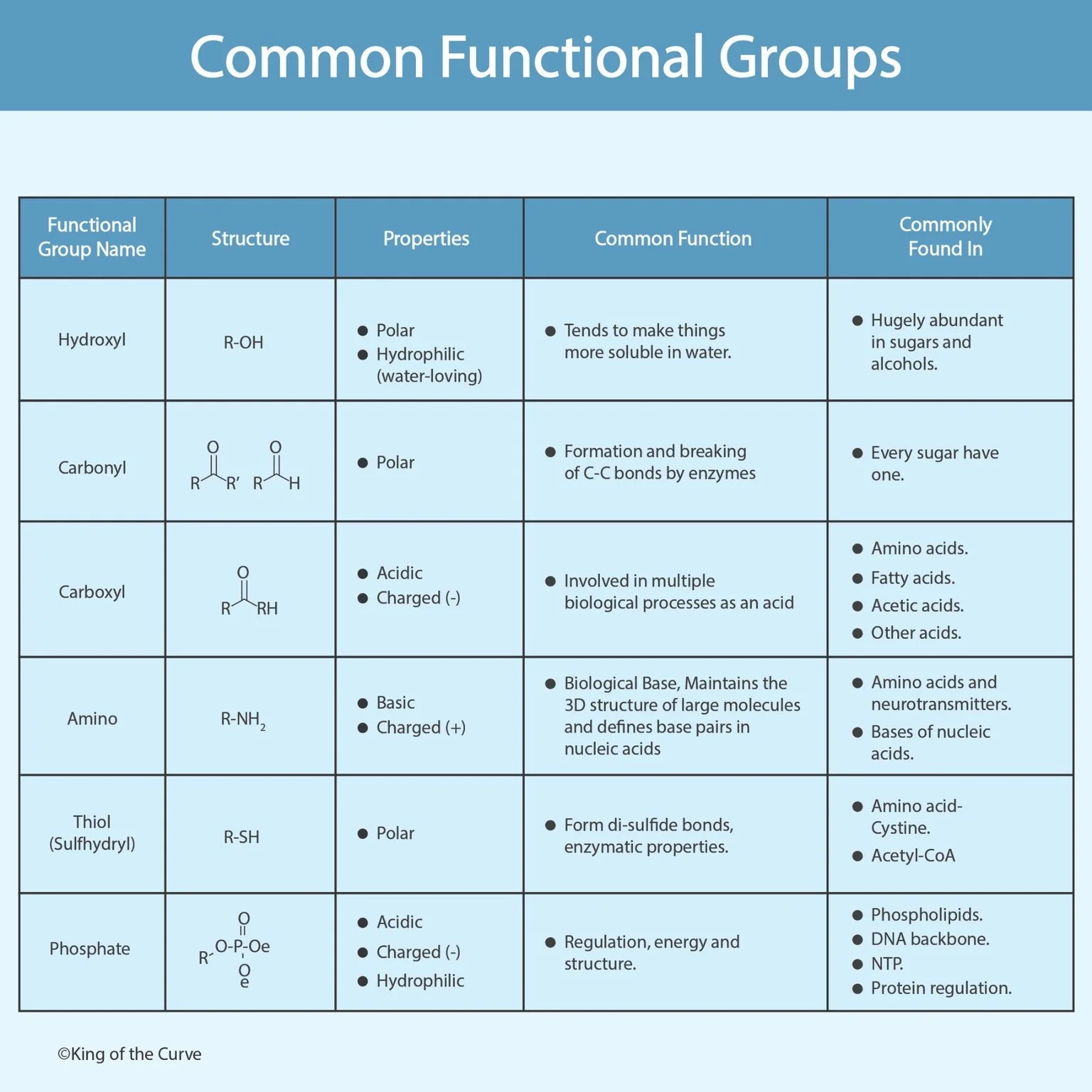
The hydroxyl group (-OH) is highly polar and helps molecules interact with water through hydrogen bonding. This property makes compounds containing hydroxyl groups more soluble in aqueous environments. Hydroxyl groups are commonly found in sugars and alcohols, making them essential components of biological systems. Understanding hydroxyl groups is especially useful when studying carbohydrates and cellular metabolism.
⚡ The Carbonyl Group: A Hub for Biological Reactions
Carbonyl groups (C=O) are present in aldehydes and ketones and play a major role in energy metabolism. Many biological reactions involve the formation or breaking of bonds around carbonyl-containing molecules. Sugars such as glucose and fructose contain carbonyl groups, which influence their structure and reactivity. MCAT passages frequently test the ability to distinguish between different carbonyl-containing compounds.
📊 Quick Reference Table: Common Functional Groups
| Functional Group | Key Property | Biological Role | Common Examples |
|---|---|---|---|
| 💧 Hydroxyl (-OH) | Polar, Hydrophilic | Increases water solubility | Sugars, Alcohols |
| ⚡ Carbonyl (C=O) | Polar, Reactive | Participates in metabolic reactions | Glucose, Fructose |
| 🧬 Carboxyl (-COOH) | Acidic | Donates protons in biological systems | Fatty Acids, Amino Acids |
| 🧪 Amino (-NH₂) | Basic | Accepts protons and forms proteins | Amino Acids, Neurotransmitters |
| 🔗 Thiol (-SH) | Sulfur-containing | Forms disulfide bonds | Cysteine, Coenzyme A |
| 🔋 Phosphate (-PO₄²⁻) | Negatively Charged | Energy transfer and signaling | ATP, DNA, RNA |
🧬 Carboxyl and Amino Groups: Foundations of Amino Acids
Carboxyl (-COOH) and amino (-NH₂) groups are essential because they form the backbone of amino acids. Carboxyl groups are acidic and often carry a negative charge, while amino groups are basic and frequently carry a positive charge. Together, these groups allow amino acids to form proteins and participate in countless biological processes. Understanding their acid-base behavior is a high-yield topic for standardized exams.
🔗 Thiol Groups and Protein Stability
Thiol groups (-SH) contain sulfur and are best known for forming disulfide bonds between cysteine residues in proteins. These bonds help stabilize the three-dimensional structure of proteins and contribute to proper biological function. Thiol groups are also found in important molecules such as Coenzyme A, which plays a key role in metabolism. Their unique chemistry makes them highly relevant in biochemistry and molecular biology.
🔋 Phosphate Groups and Cellular Energy
Phosphate groups are among the most important functional groups in biology because they are involved in energy transfer, signaling, and molecular structure. ATP, often called the cell’s energy currency, relies on phosphate bonds to store and release energy. Phosphate groups are also essential components of DNA, RNA, and phospholipid membranes. Their negative charge and hydrophilic nature influence many cellular processes.
🎯 Functional Groups on the MCAT and Beyond
Functional groups appear throughout MCAT Biology, Biochemistry, and Organic Chemistry sections. Rather than memorizing reactions individually, students who recognize functional groups can predict molecular behavior and solve problems more efficiently. This pattern-recognition approach is exactly why King of the Curve emphasizes visual learning and concept mastery. Building confidence with functional groups creates a strong foundation for advanced science topics and future healthcare studies.

Frequently Asked Questions (FAQs)
-
Aim for 4-6 focused hours, ensuring you incorporate breaks to avoid burnout.
-
Practice mindfulness techniques, take practice exams under realistic conditions, and maintain a balanced lifestyle.
-
Set short-term goals, seek support from mentors, and reward yourself for small achievements.
-
Regular exercise improves focus, reduces stress, and enhances overall mental clarity.
-
KOTC offers personalized learning tools, gamification features, and adaptive question banks to help students stay on track without burnout.