
🎵 Intensity and Amplitude of Sound Explained
Sound is something we experience every day—from soft whispers to loud music. But what actually determines how loud or quiet a sound is? The answer lies in amplitude and intensity.
🔊 What is Amplitude?
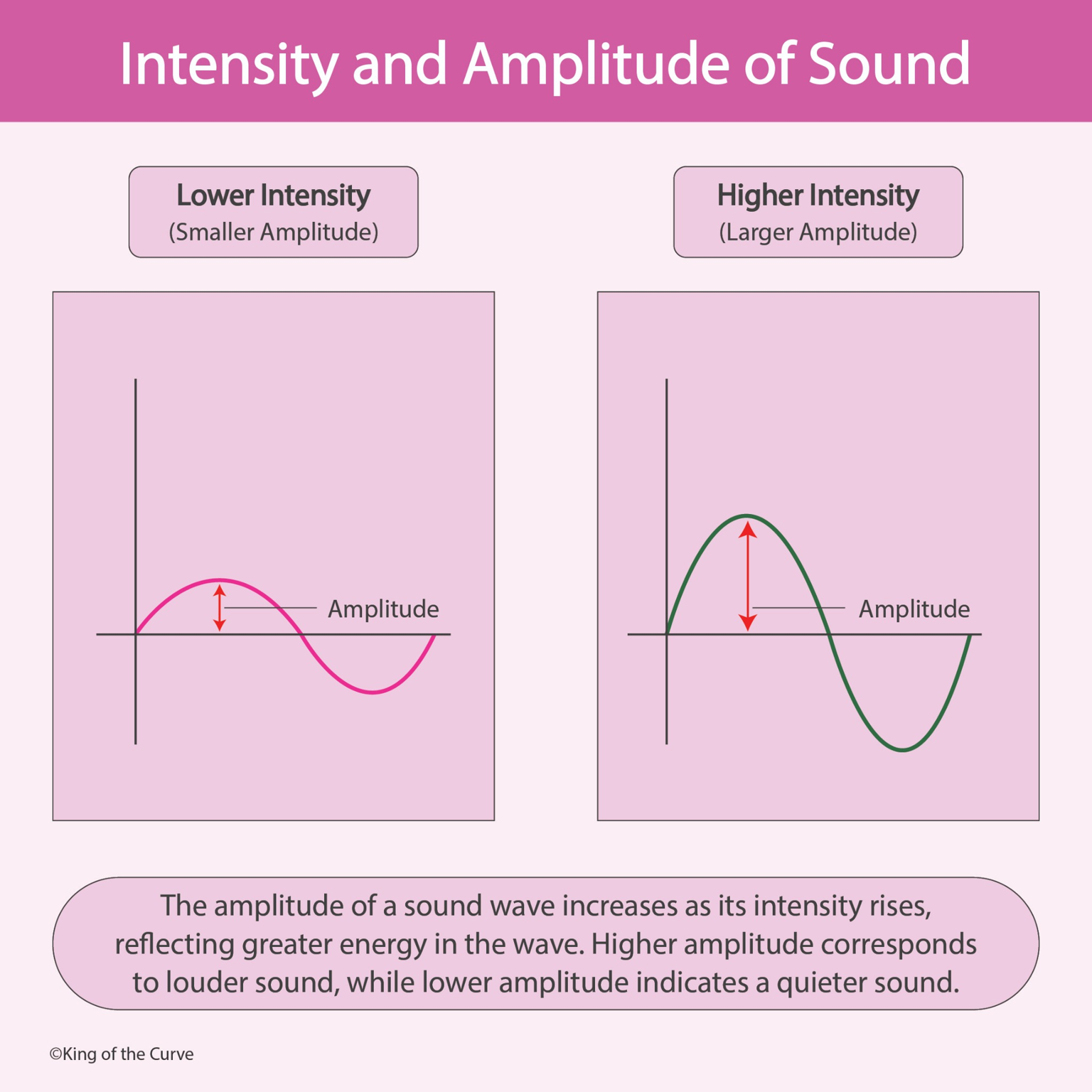
Amplitude refers to the height of a sound wave from its rest position.
Higher amplitude = taller wave
Lower amplitude = shorter wave
In your diagram:
The left wave shows smaller amplitude
The right wave shows larger amplitude
⚡ What is Sound Intensity?
Sound intensity is the amount of energy a sound wave carries per unit area.
Higher intensity = more energy
Lower intensity = less energy
Intensity is directly related to how powerful the sound wave is.
🔗 Relationship Between Amplitude and Intensity
Amplitude and intensity are closely connected:
Higher amplitude → higher intensity → louder sound
Lower amplitude → lower intensity → quieter sound
In fact, intensity is proportional to the square of the amplitude, meaning small increases in amplitude can significantly increase loudness.
🧠 Additional Insight
Sound waves travel through a medium by vibrating particles. When amplitude increases, these vibrations become stronger, transferring more energy from one particle to another. This is why louder sounds feel more “powerful” and can even cause physical vibrations, like a bass speaker shaking a surface.
Another important point is that human perception of loudness is not linear. Doubling the amplitude does not simply double how loud we perceive the sound—it can feel much louder. This is why sound levels are often measured in decibels (dB), which use a logarithmic scale to better represent how we actually hear sound.
🔉 Loud vs Quiet Sounds
📉 Lower Intensity (Smaller Amplitude)
Less energy in the wave
Quieter sound
Smaller vibrations
📈 Higher Intensity (Larger Amplitude)
More energy in the wave
Louder sound
Larger vibrations
📊 Comparison Table
| Feature | Lower Intensity (Small Amplitude) |
Higher Intensity (Large Amplitude) |
|---|---|---|
| Wave Height | Small | Large |
| Energy | Low | High |
| Loudness | Quiet | Loud |
| Particle Vibration | Weak | Strong |
| Real-Life Example | Whisper | Loud music / speaker |
🧠 Why This Matters
Understanding amplitude and intensity helps in:
Audio engineering 🎧
Medical imaging (ultrasound) 🏥
Noise control 🔇
Physics problem-solving 📘
✅ Key Takeaways
Amplitude determines the loudness of sound
Intensity measures the energy carried by the wave
Bigger waves = louder sounds
Smaller waves = quieter sounds

Frequently Asked Questions (FAQs)
-
Aim for 4-6 focused hours, ensuring you incorporate breaks to avoid burnout.
-
Practice mindfulness techniques, take practice exams under realistic conditions, and maintain a balanced lifestyle.
-
Set short-term goals, seek support from mentors, and reward yourself for small achievements.
-
Regular exercise improves focus, reduces stress, and enhances overall mental clarity.
-
KOTC offers personalized learning tools, gamification features, and adaptive question banks to help students stay on track without burnout.