
🧲 Inclined Plane Free Body Diagram Explained
Understanding forces on an inclined plane is a core concept in physics. A free body diagram (FBD) helps you visualize all the forces acting on an object, making problem-solving much clearer and more intuitive.
📐 What is an Inclined Plane?
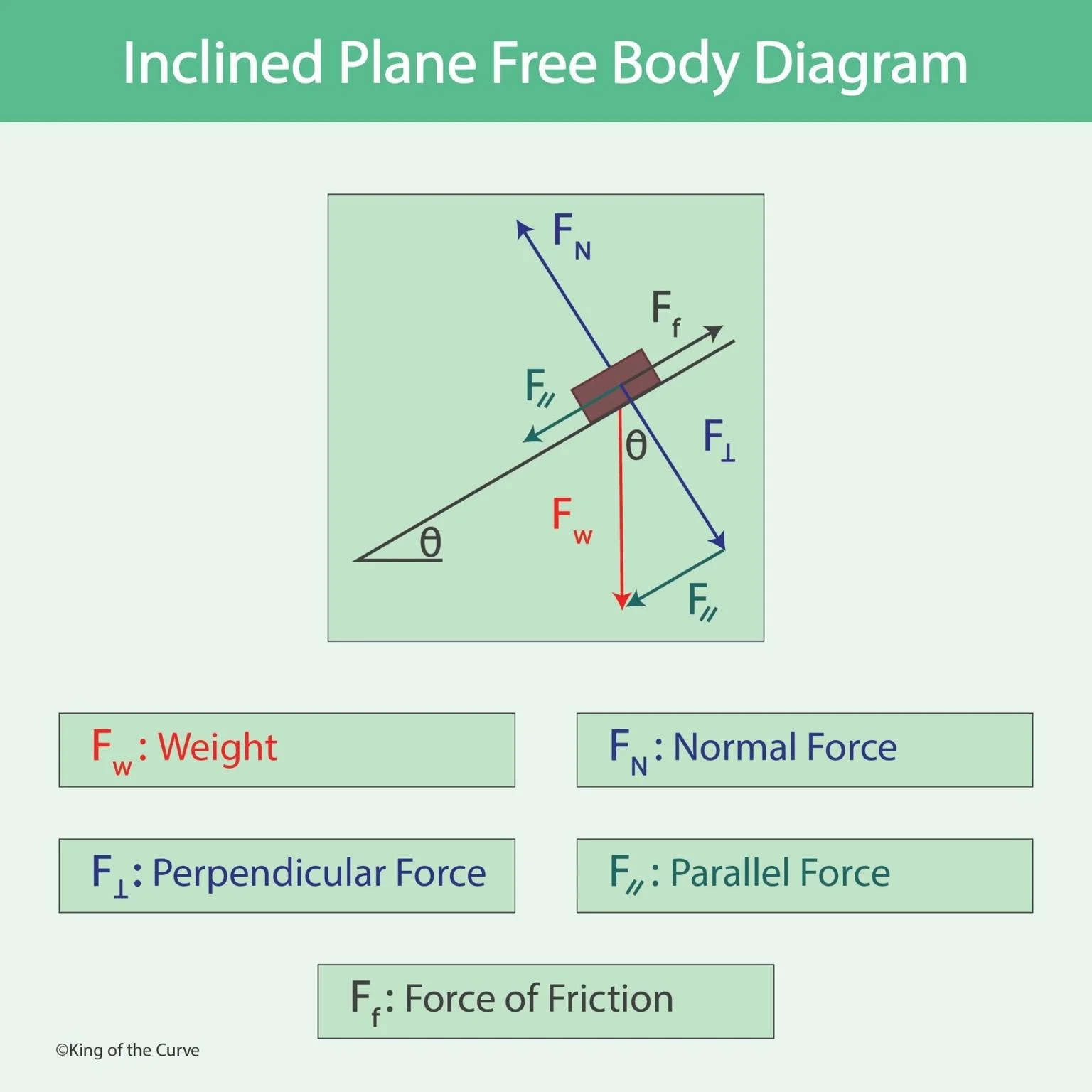
An inclined plane is a flat surface tilted at an angle (θ) relative to the horizontal. When an object is placed on it, gravity still acts straight down, but its effects are split into components along and perpendicular to the plane.
⚙️ Forces Acting on the Object
🔴 1. Weight (Fₓ or Fw)
Acts vertically downward
Formula: F = mg
Represents gravitational pull
🔵 2. Normal Force (Fₙ)
Acts perpendicular to the surface
Supports the object against the plane
Changes with angle θ
🟢 3. Parallel Force (F∥)
Acts down the slope
Causes motion along the plane
Formula: F∥ = mg sinθ
🟣 4. Perpendicular Force (F⊥)
Acts into the surface
Helps determine the normal force
Formula: F⊥ = mg cosθ
⚫ 5. Frictional Force (Ff)
Opposes motion
Acts up the slope if object tends to slide down
Formula: Ff = μFₙ
🔄 How the Forces Work Together
On an inclined plane:
Gravity pulls the object downward
The parallel component (F∥) tries to move it down
Friction (Ff) resists that motion
Normal force (Fₙ) balances the perpendicular component
📊 Outcomes:
F∥ > Ff → Object slides down
F∥ = Ff → Object is in equilibrium
F∥ < Ff → Object remains at rest
🧠 Why Free Body Diagrams Matter
Free body diagrams help you:
Break complex problems into simple forces
Visualize directions clearly
Apply Newton’s laws effectively
Avoid common mistakes in calculations
✅ Key Takeaways
Resolve weight into parallel and perpendicular components
Friction always opposes motion
Normal force is perpendicular, not vertical
Angle (θ) plays a crucial role in all force calculations

Frequently Asked Questions (FAQs)
-
Aim for 4-6 focused hours, ensuring you incorporate breaks to avoid burnout.
-
Practice mindfulness techniques, take practice exams under realistic conditions, and maintain a balanced lifestyle.
-
Set short-term goals, seek support from mentors, and reward yourself for small achievements.
-
Regular exercise improves focus, reduces stress, and enhances overall mental clarity.
-
KOTC offers personalized learning tools, gamification features, and adaptive question banks to help students stay on track without burnout.