
🧠 Ion Transport in the Proximal Tubule
The proximal convoluted tubule (PCT) plays a crucial role in kidney function by reabsorbing essential substances from the filtrate and maintaining acid–base balance. It is responsible for reclaiming a large proportion of filtered sodium (Na⁺), bicarbonate (HCO₃⁻), glucose, amino acids, and phosphate, ensuring that valuable molecules are not lost in urine.
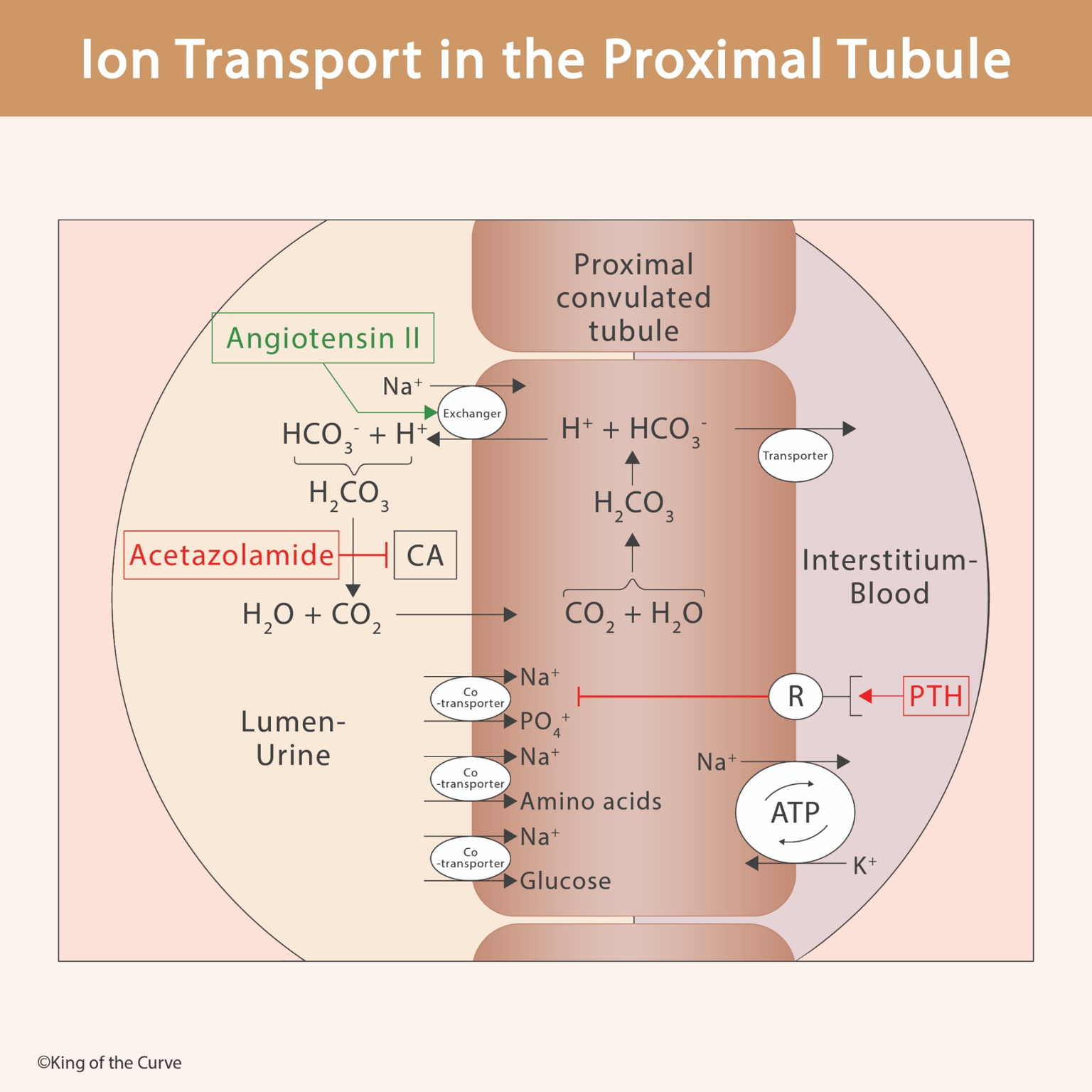
⚙️ Key Mechanisms of Ion Transport
🔋 Sodium (Na⁺) Reabsorption
Sodium reabsorption is the driving force behind many processes in the PCT.
Na⁺ enters the tubular cell via the Na⁺/H⁺ exchanger
It is then pumped into the blood via the Na⁺/K⁺ ATPase
This creates a gradient that allows other substances to be reabsorbed
⚖️ Bicarbonate (HCO₃⁻) Reabsorption
Bicarbonate reabsorption is essential for maintaining blood pH.
H⁺ is secreted into the lumen and combines with HCO₃⁻ → forms H₂CO₃
Carbonic anhydrase (CA) converts H₂CO₃ into CO₂ + H₂O
CO₂ diffuses into the cell and reforms H₂CO₃
This eventually regenerates HCO₃⁻, which is transported into the blood
👉 Clinical Note:
💊 Acetazolamide inhibits carbonic anhydrase, reducing bicarbonate reabsorption and increasing urine alkalinity.
🍽️ Co-Transport of Nutrients
The PCT reabsorbs essential nutrients through Na⁺-dependent co-transporters:
Glucose via SGLT transporters
Amino acids via specific carriers
Phosphate (PO₄³⁻) via Na⁺-phosphate co-transporters
🧬 Hormonal Regulation
🔺 Angiotensin II
Enhances Na⁺ reabsorption via the Na⁺/H⁺ exchanger
Promotes fluid retention and increases blood pressure
🧪 Parathyroid Hormone (PTH)
Inhibits phosphate reabsorption
Leads to increased phosphate excretion in urine
🔄 Basolateral Transport
On the blood-facing side:
Na⁺/K⁺ ATPase maintains the sodium gradient
Other transporters move bicarbonate and nutrients into circulation
📊 Summary Table
| Process | Transport Mechanism | Function |
|---|---|---|
| Sodium reabsorption | Na+/H+ exchanger + Na+/K+ ATPase | Drives reabsorption of many solutes |
| Bicarbonate reabsorption | Carbonic anhydrase system | Maintains acid–base balance |
| Glucose uptake | Na+-glucose co-transporter | Prevents energy loss |
| Amino acid uptake | Na+-dependent transporters | Conserves nutrients |
| Phosphate regulation | Na+-phosphate co-transporter inhibited by PTH | Controls phosphate levels |
⚠️ Why the Proximal Tubule Matters
The proximal tubule is responsible for reabsorbing ~65–70% of filtered sodium and water, making it the most important segment for bulk reabsorption. Any dysfunction here can lead to significant imbalances, including:
Metabolic acidosis
Glucosuria
Aminoaciduria
Electrolyte disturbances
Understanding ion transport in the PCT is essential for interpreting renal physiology, pharmacology, and disease states.

Frequently Asked Questions (FAQs)
-
Aim for 4-6 focused hours, ensuring you incorporate breaks to avoid burnout.
-
Practice mindfulness techniques, take practice exams under realistic conditions, and maintain a balanced lifestyle.
-
Set short-term goals, seek support from mentors, and reward yourself for small achievements.
-
Regular exercise improves focus, reduces stress, and enhances overall mental clarity.
-
KOTC offers personalized learning tools, gamification features, and adaptive question banks to help students stay on track without burnout.