
🌡️ Impact of Temperature on Reaction Rate
Temperature plays a crucial role in determining how fast a chemical reaction occurs. Whether in biological systems, industrial processes, or everyday chemistry, increasing temperature generally leads to a faster reaction rate. But why does this happen?
⚙️ The Basics: Kinetic Energy and Collisions
Chemical reactions occur when particles collide with enough energy to break bonds and form new ones. This required minimum energy is known as activation energy.
At low temperatures, particles move slowly
At high temperatures, particles move faster
Faster movement means:
More frequent collisions
More energetic collisions
📈 Maxwell-Boltzmann Distribution Explained
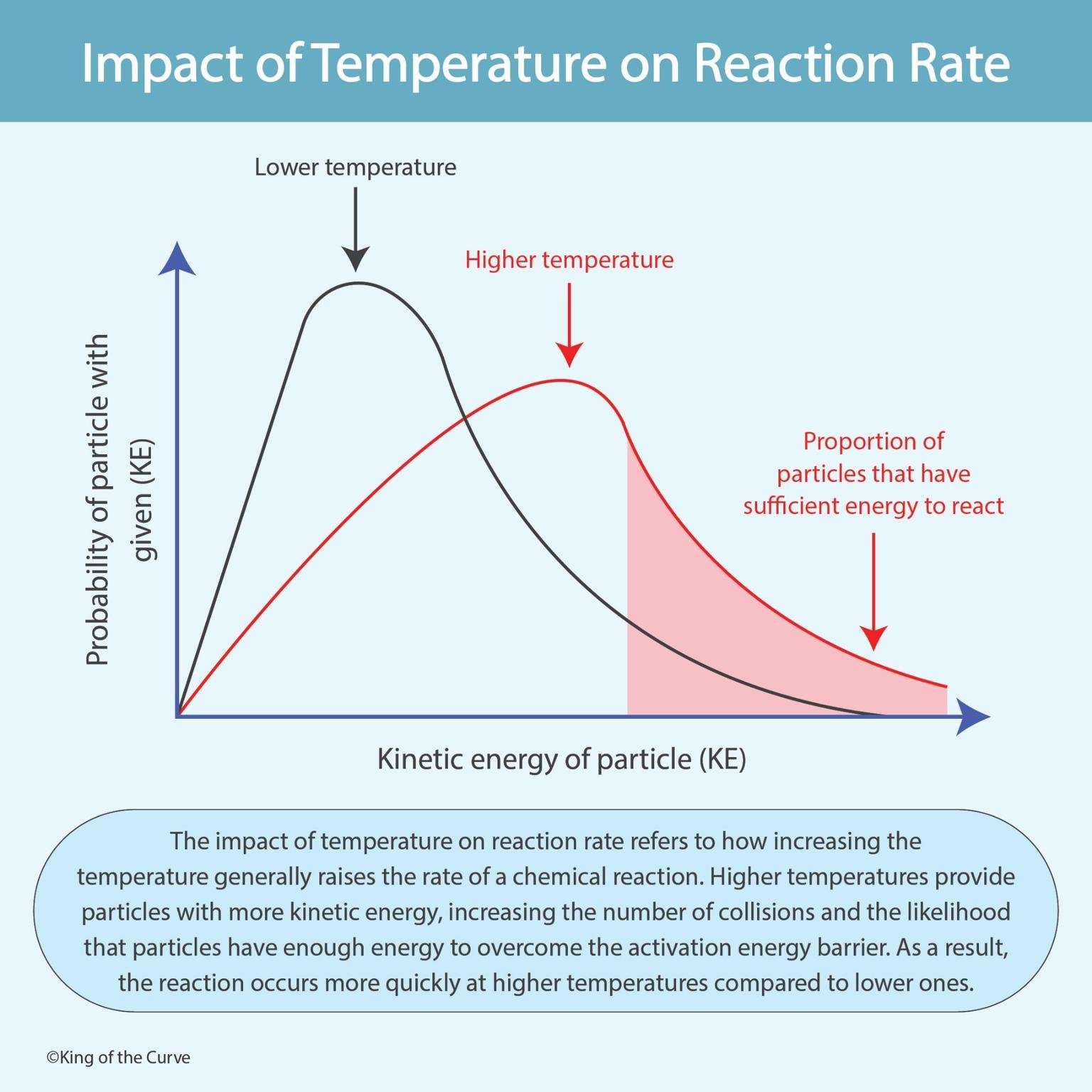
The graph in your image represents a Maxwell-Boltzmann distribution, showing the spread of particle energies.
🔵 Lower Temperature Curve
Narrow and peaked
Most particles have low kinetic energy
Few particles exceed activation energy
➡️ Slower reaction rate
🔴 Higher Temperature Curve
Broader and shifted to the right
More particles have higher kinetic energy
Larger proportion exceeds activation energy
➡️ Faster reaction rate
🔥 Why Higher Temperature Increases Reaction Rate
When temperature increases:
Average kinetic energy rises
Particles move faster
Collision frequency increases
More particles overcome activation energy
👉 The shaded region in the graph shows the proportion of particles capable of reacting, which is significantly larger at higher temperatures.
🌍 Temperature and Reaction Efficiency
Temperature doesn’t just affect speed—it also influences reaction efficiency. At optimal temperatures, reactions proceed not only faster but also more completely, yielding higher product output. This is particularly important in industrial chemistry, where controlling temperature can maximize production while minimizing waste.
However, efficiency must be balanced with stability. Excessively high temperatures can lead to decomposition of reactants or products, reducing overall yield. This is why many processes operate within a carefully controlled temperature range.
🧬 Biological Perspective
In living systems, temperature has a profound effect on enzyme-catalyzed reactions. Enzymes increase reaction rates by lowering activation energy, but they are sensitive to temperature changes.
Moderate temperature increases → faster enzyme activity
Extremely high temperatures → enzyme denaturation
Low temperatures → reduced metabolic activity
This explains why the human body maintains a stable internal temperature for optimal biochemical function.
📊 Summary Table
| Temperature Level | Particle Speed | Collision Frequency | Particles Exceeding Activation Energy | Reaction Rate |
|---|---|---|---|---|
| Low Temperature | Slow | Low | Very Few | Slow |
| Moderate Temperature | Moderate | Moderate | Some | Moderate |
| High Temperature | Fast | High | Many | Fast |
🧪 Real-World Examples
Cooking food faster at higher heat
Enzyme activity increasing with temperature (up to an optimum point)
Industrial reactions optimized by temperature control
⚠️ Important Note
While increasing temperature speeds up reactions, extremely high temperatures can:
Denature enzymes (in biological systems)
Cause unwanted side reactions
Increase safety risks
🧠 Key Takeaways
Reaction rate depends on particle energy and collisions
Higher temperature → more particles exceed activation energy
Maxwell-Boltzmann curves shift right with increasing temperature
Result: faster and more efficient reactions

Frequently Asked Questions (FAQs)
-
Aim for 4-6 focused hours, ensuring you incorporate breaks to avoid burnout.
-
Practice mindfulness techniques, take practice exams under realistic conditions, and maintain a balanced lifestyle.
-
Set short-term goals, seek support from mentors, and reward yourself for small achievements.
-
Regular exercise improves focus, reduces stress, and enhances overall mental clarity.
-
KOTC offers personalized learning tools, gamification features, and adaptive question banks to help students stay on track without burnout.