
⚡ Electrical and Mechanical Activity in GI Smooth Muscle
The gastrointestinal (GI) tract relies on a coordinated interaction between electrical signals and muscle contractions to move food efficiently. Understanding this relationship helps explain how digestion and motility occur in the body.
🔌 Electrical Activity in GI Smooth Muscle
GI smooth muscle exhibits a unique type of electrical behavior known as slow waves.
🔹 What are Slow Waves?
Slow waves are rhythmic fluctuations in membrane potential.
They are generated by specialized cells called Interstitial Cells of Cajal (ICC).
These waves do not cause contraction directly but set the stage for it.
⚡ Action Potentials (Spikes)
When slow waves reach a certain threshold, action potentials (spikes) occur.
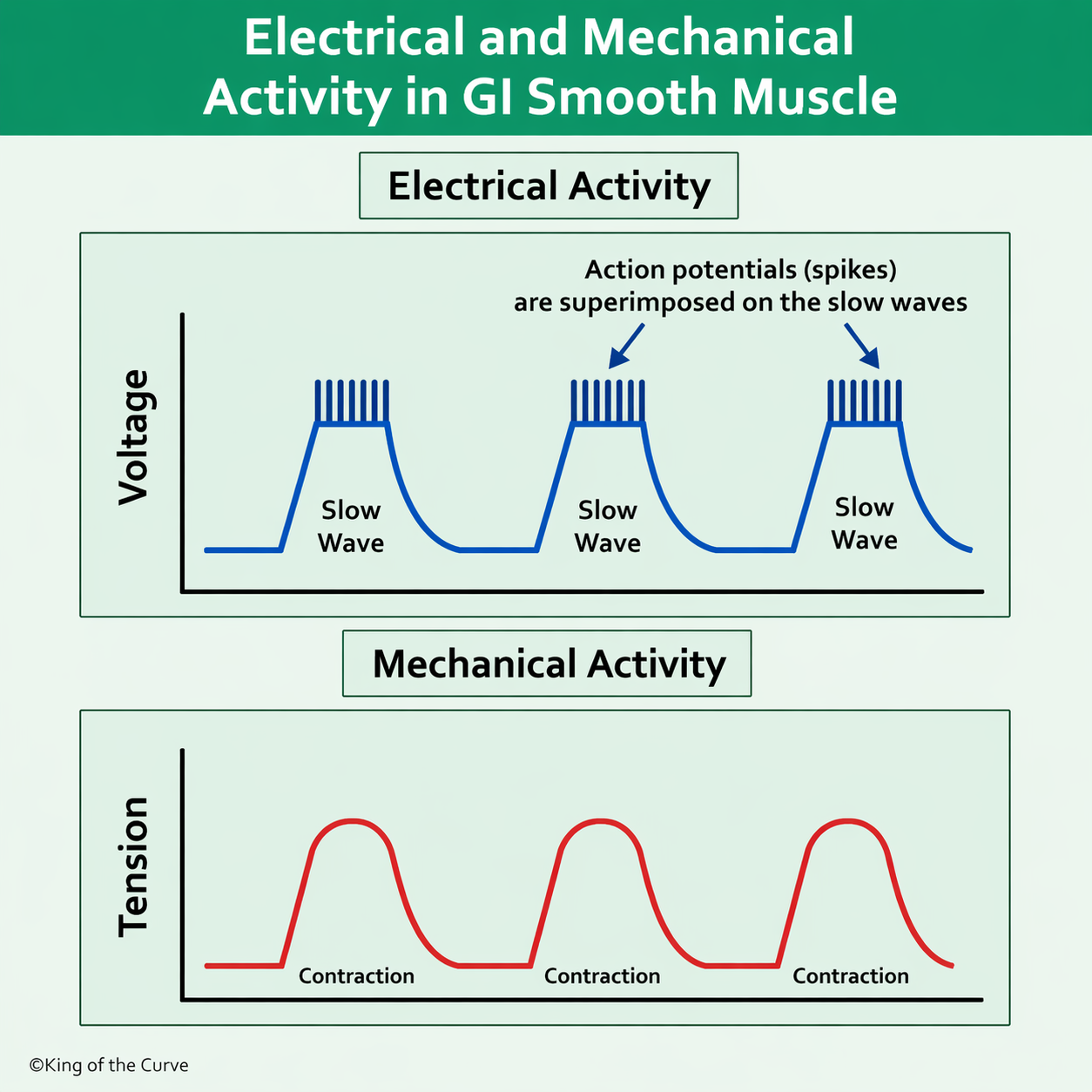
These spikes are superimposed on the slow waves, as shown in the diagram.
The greater the number of spikes, the stronger the contraction.
👉 Key Insight:
Slow waves determine timing, while spikes determine strength.
⚙️ Mechanical Activity (Contraction)
Mechanical activity refers to the actual contraction of smooth muscle, which helps propel food through the digestive tract.
🔹 How Contraction Occurs
Contraction happens only when action potentials are present.
Calcium ions (Ca²⁺) enter the muscle cells during spikes.
This triggers muscle shortening and contraction.
🔄 Pattern of Contraction
Contractions follow the rhythm of slow waves.
Each contraction corresponds to a burst of electrical spikes.
👉 Key Insight:
No spikes = No contraction, even if slow waves are present.
🔗 Relationship Between Electrical and Mechanical Activity
| 🔍 Feature | ⚡ Electrical Activity | ⚙️ Mechanical Activity |
|---|---|---|
| Main Function | Generates signals | Produces movement |
| Trigger | Slow waves + spikes | Action potentials |
| Output | Voltage changes | Muscle contraction |
| Role | Controls timing | Controls force |
🧠 Why This Matters
This coordinated system is essential for:
Peristalsis (wave-like movement of food)
Mixing of digestive contents
Proper functioning of the stomach and intestines
Disruptions in this system can lead to:
Gastroparesis
Irritable bowel syndrome (IBS)
Motility disorders
✅ Summary
GI smooth muscle activity depends on both electrical and mechanical processes.
Slow waves set the rhythm.
Action potentials (spikes) trigger contractions.
Mechanical contractions occur only when spikes are present.

Frequently Asked Questions (FAQs)
-
Aim for 4-6 focused hours, ensuring you incorporate breaks to avoid burnout.
-
Practice mindfulness techniques, take practice exams under realistic conditions, and maintain a balanced lifestyle.
-
Set short-term goals, seek support from mentors, and reward yourself for small achievements.
-
Regular exercise improves focus, reduces stress, and enhances overall mental clarity.
-
KOTC offers personalized learning tools, gamification features, and adaptive question banks to help students stay on track without burnout.