
⚡ Electric Field Lines Surrounding Point Charges
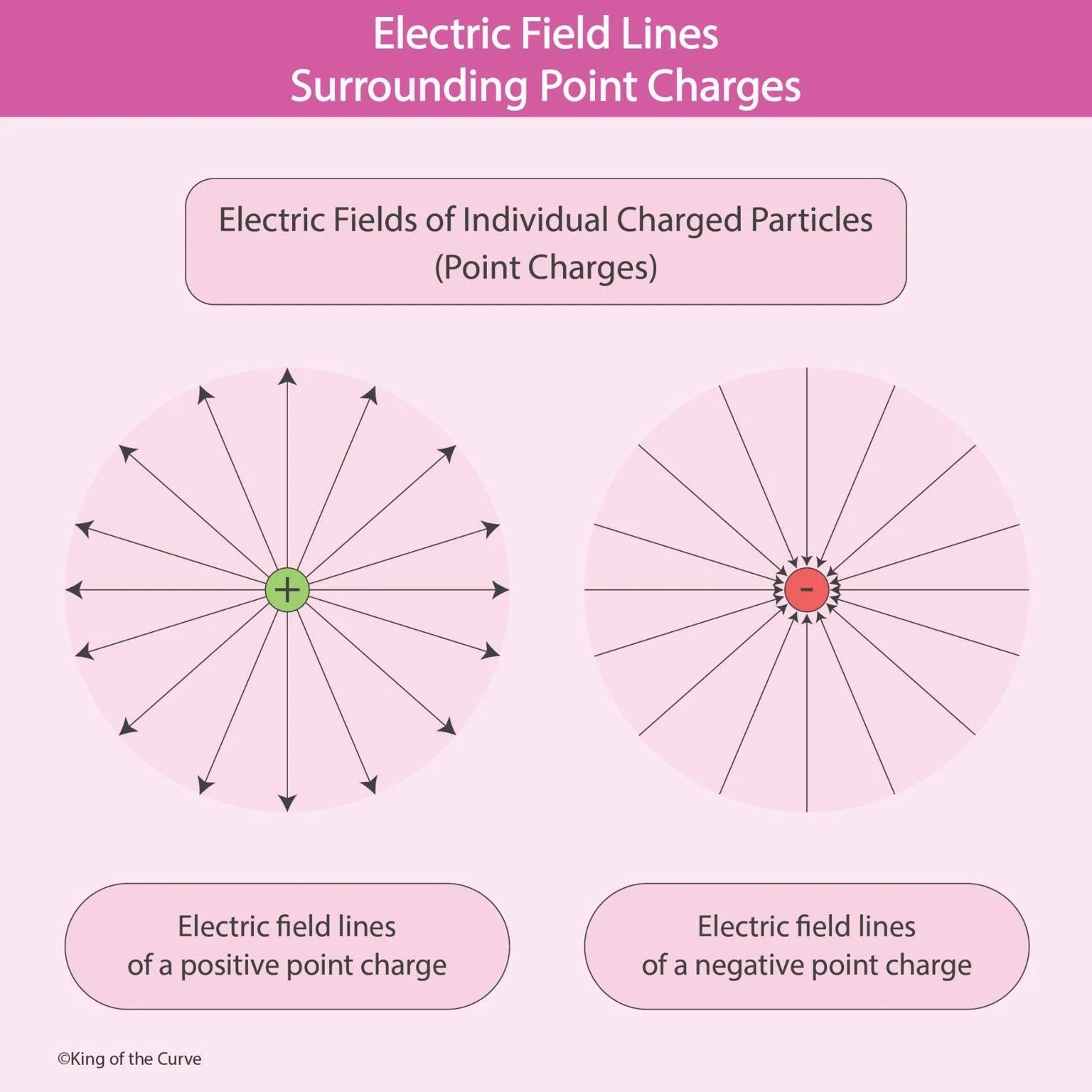
Electric field lines help us visualize invisible electric forces around charged particles. This diagram clearly shows how fields behave around positive (+) and negative (−) point charges.
📘 What Are Electric Field Lines?
Electric field lines are imaginary lines that represent:
Direction of the electric force
Strength of the electric field
Interaction between charges
👉 A positive test charge moves along these lines.
➕ Electric Field Around a Positive Charge
Field lines radiate outward
Indicates repulsion
Strength is highest near the charge
👉 Field direction: Away from the charge
➖ Electric Field Around a Negative Charge
Field lines point inward
Indicates attraction
Strongest near the center
👉 Field direction: Toward the charge
📊 Comparison Table: Positive vs Negative Charges
| Feature | ➕ Positive Charge | ➖ Negative Charge |
|---|---|---|
| Field Line Direction | Outward from the charge | Inward toward the charge |
| Interaction with Test Charge | Repels positive charges | Attracts positive charges |
| Field Line Start/End | Starts from the charge | Ends at the charge |
| Electric Field Strength | Strong near charge, weak far away | Strong near charge, weak far away |
| Visual Representation | Arrows pointing outward | Arrows pointing inward |
📏 Key Rules of Electric Field Lines
Field lines never cross ❌
More lines = stronger field 📈
Lines go from positive → negative ➡️
Always show the path of a positive test charge
🌍 Real-World Applications
Electric field concepts are used in:
⚡ Capacitors and circuits
🖨️ Printers and photocopiers
🧲 Particle accelerators
🎨 Electrostatic painting
🧠 Quick Summary
➕ Positive charges → field lines go outward
➖ Negative charges → field lines go inward
Field lines show direction + strength of electric forces

Frequently Asked Questions (FAQs)
-
Aim for 4-6 focused hours, ensuring you incorporate breaks to avoid burnout.
-
Practice mindfulness techniques, take practice exams under realistic conditions, and maintain a balanced lifestyle.
-
Set short-term goals, seek support from mentors, and reward yourself for small achievements.
-
Regular exercise improves focus, reduces stress, and enhances overall mental clarity.
-
KOTC offers personalized learning tools, gamification features, and adaptive question banks to help students stay on track without burnout.