
🚀 What Is Escape Velocity?
Escape velocity is the minimum speed an object must reach to completely overcome the gravitational pull of a planet or star without requiring additional propulsion. Once an object reaches this critical velocity, gravity continues to slow it down, but it will never fall back to the celestial body. This concept plays a central role in astrophysics, satellite launches, and space exploration, making it a valuable topic for students preparing for the MCAT and other science exams.
🌍 Why Does Escape Velocity Exist?
Every object with mass exerts a gravitational force that attracts other objects toward it. The larger the mass of a planet or star, the stronger its gravitational pull. To escape this attraction, an object must possess enough kinetic energy to counteract the planet's gravitational potential energy. Escape velocity represents the exact speed at which these energy values balance, allowing the object to leave the gravitational field permanently.
📐 Understanding the Escape Velocity Formula
Escape velocity is calculated using the equation:
Vₑₛc = √(2GM/R)
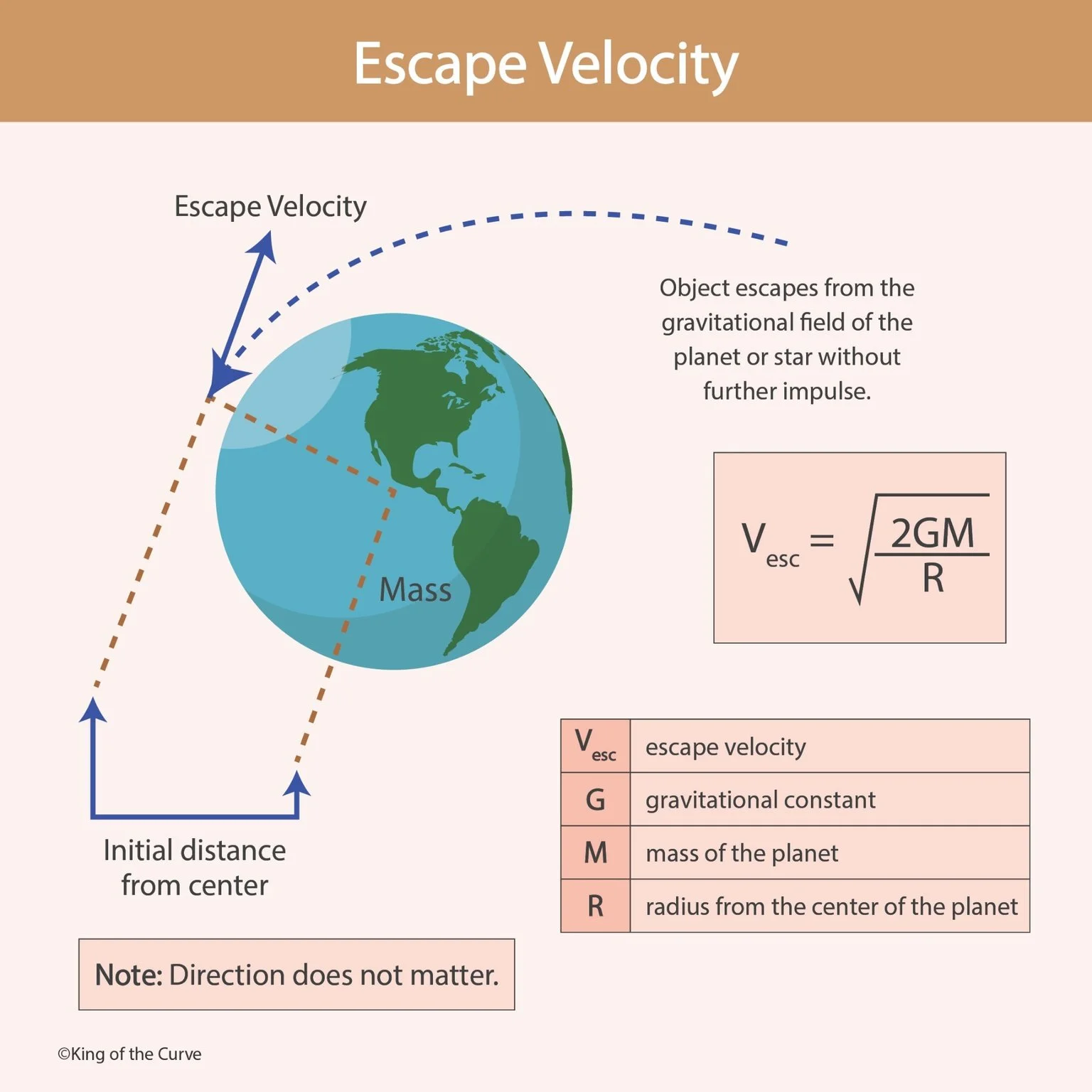
In this equation, G is the universal gravitational constant, M is the mass of the planet or celestial body, and R is the distance from the planet's center to the object's starting position. The formula shows that escape velocity depends only on the planet's mass and radius—not on the object's own mass.
🌎 Breaking Down the KOTC Illustration
The King of the Curve illustration demonstrates an object launching away from Earth. The dashed trajectory represents the object's path as it escapes Earth's gravitational field. The diagram also highlights that the object's initial distance from the planet's center is important because escape velocity depends on the radius measured from the center of the planet, not simply from the surface. The accompanying equation and variable definitions help students connect the visual with the mathematical relationship.
🛰️ Real-World Applications
Escape velocity is fundamental to modern space exploration. Rockets launching satellites, lunar missions, and interplanetary spacecraft must achieve sufficient velocity to escape Earth's gravitational influence. For Earth, the escape velocity is approximately 11.2 km/s (25,000 mph). Different planets have different escape velocities because each has a unique mass and radius. Understanding this concept helps explain why launching from larger planets requires much more energy.
📋 Variables in the Escape Velocity Formula
| Variable | Meaning | SI Unit |
|---|---|---|
| Vesc | Escape velocity | meters per second (m/s) |
| G | Universal gravitational constant | N·m²/kg² |
| M | Mass of the planet or celestial body | kilograms (kg) |
| R | Distance from the planet's center | meters (m) |
🎯 How the MCAT Tests Escape Velocity
The MCAT typically tests escape velocity through conceptual questions rather than lengthy calculations. Students may be asked how escape velocity changes if a planet becomes more massive or if its radius increases. Remember that increasing mass increases escape velocity, while increasing radius decreases it. Understanding these relationships allows you to quickly interpret graphs, experimental passages, and astronomy-based scenarios.
❌ Common Misconceptions
A common misconception is that heavier objects require a greater escape velocity than lighter ones. In reality, the object's mass does not appear in the escape velocity equation, meaning all objects require the same escape speed when launched from the same location on a planet, assuming air resistance is ignored. Another misconception is that escape velocity depends on launch direction. As highlighted in the KOTC illustration, the required speed depends only on energy, not on the direction of travel.
🚀 Master Physics with King of the Curve
Physics concepts like escape velocity become much easier to understand through visual learning. King of the Curve's exclusive science illustrations simplify complex equations into memorable diagrams that improve long-term retention. Explore this illustration and 1,000+ additional science visuals at mcat.kingofthecurve.org, and strengthen your preparation with adaptive question banks, daily challenges, gamified learning, and comprehensive MCAT study resources designed to help you succeed.

Frequently Asked Questions (FAQs)
-
Aim for 4-6 focused hours, ensuring you incorporate breaks to avoid burnout.
-
Practice mindfulness techniques, take practice exams under realistic conditions, and maintain a balanced lifestyle.
-
Set short-term goals, seek support from mentors, and reward yourself for small achievements.
-
Regular exercise improves focus, reduces stress, and enhances overall mental clarity.
-
KOTC offers personalized learning tools, gamification features, and adaptive question banks to help students stay on track without burnout.