
🧪 What Is the Power Formula?
Power is one of the most fundamental concepts in physics because it measures how quickly work is done. Instead of focusing only on the amount of work performed, power tells us the rate at which energy is transferred or work is completed. On the MCAT, understanding the Power Formula helps students solve problems involving mechanical systems, motors, and biological movement. The basic definition of power is Power = Work ÷ Time, making it an essential equation for both conceptual and calculation-based questions.
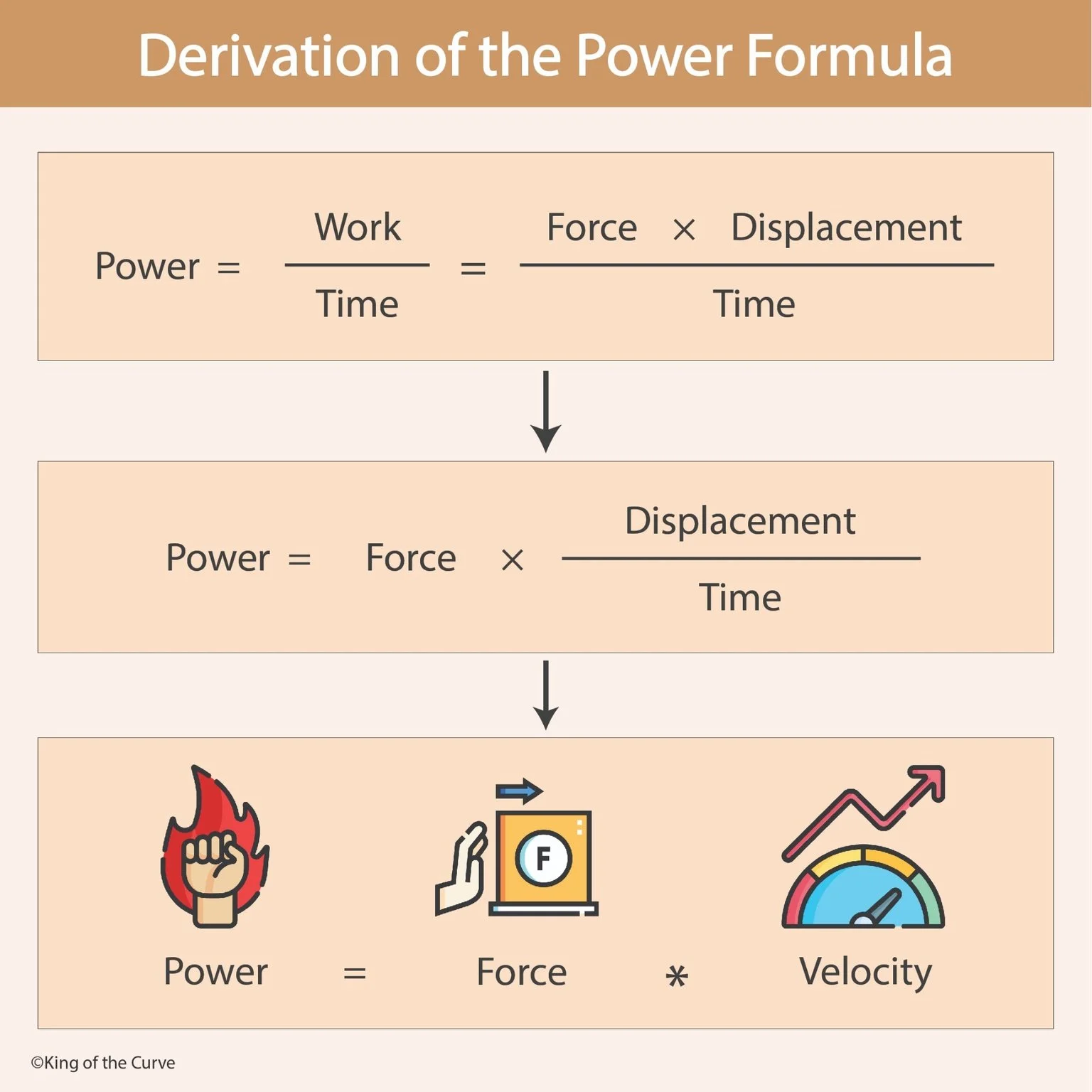
⚙️ Starting with the Definition of Power
The derivation begins with the standard definition of power:
Power = Work / Time
Since work is defined as Force × Displacement, we can substitute this into the equation. This gives us:
Power = (Force × Displacement) / Time
This substitution connects two important physics concepts and sets the foundation for deriving one of the most commonly used formulas in mechanics.
📐 Deriving the Formula Step by Step
The next step is to recognize that displacement divided by time equals velocity. Mathematically,
Velocity = Displacement / Time
Replacing displacement divided by time with velocity simplifies the equation into:
Power = Force × Velocity
This elegant relationship shows that power depends not only on how much force is applied but also on how quickly an object moves while that force is being exerted.
🚗 A Real-World Example
Imagine two people pushing identical shopping carts with the same amount of force. If one person pushes the cart faster across the store, they are producing more power because the cart is moving at a greater velocity. Even though the force remains the same, increasing velocity increases power output. This principle also explains why high-performance engines are designed to produce both significant force and high speeds.
🩺 Applications in Medicine and Biology
The Power Formula extends beyond physics and into medicine. The human heart generates power by applying force to pump blood through the circulatory system. Muscles also produce power whenever they contract to move bones and joints. Understanding this equation helps students connect biomechanics with physiology, making it especially valuable for MCAT passages that integrate physics and biology.
📋 Key Variables in the Power Formula
| Variable | Meaning | SI Unit |
|---|---|---|
| P | Power | Watt (W) |
| F | Force | Newton (N) |
| v | Velocity | meters per second (m/s) |
🎯 How the MCAT Tests Power
Rather than simply asking students to memorize equations, the MCAT often embeds the Power Formula within experimental passages or real-life scenarios. You may be asked how power changes if force doubles while velocity stays constant, or what happens when an object moves faster under the same applied force. Recognizing the relationship Power = Force × Velocity allows you to solve these questions quickly and confidently.
❌ Common Mistakes to Avoid
A frequent mistake is confusing power with work or energy. Work measures the total energy transferred, whereas power measures how rapidly that transfer occurs. Another common error is forgetting that the equation Power = Force × Velocity only applies when the force acts in the same direction as the object's motion. Paying attention to vector directions can help avoid incorrect answers on physics exams.
🚀 Master Physics with King of the Curve
Physics becomes much easier when complex derivations are presented visually. King of the Curve's exclusive science illustrations break down topics like the Power Formula into clear, step-by-step diagrams that improve understanding and long-term retention. Explore this illustration along with 1,000+ visual study resources at mcat.kingofthecurve.org, and strengthen your preparation with adaptive question banks, daily challenges, gamified learning, and comprehensive MCAT study tools designed to help you succeed.

Frequently Asked Questions (FAQs)
-
Aim for 4-6 focused hours, ensuring you incorporate breaks to avoid burnout.
-
Practice mindfulness techniques, take practice exams under realistic conditions, and maintain a balanced lifestyle.
-
Set short-term goals, seek support from mentors, and reward yourself for small achievements.
-
Regular exercise improves focus, reduces stress, and enhances overall mental clarity.
-
KOTC offers personalized learning tools, gamification features, and adaptive question banks to help students stay on track without burnout.