
⚡ Electrophilic Addition Reactions Explained
Electrophilic addition reactions are among the most important reaction types in organic chemistry because they explain how alkenes and alkynes transform into more complex molecules. These reactions occur when an electron-rich carbon-carbon double bond attacks an electrophile, resulting in the addition of atoms across the double bond.
🧪 What Is an Electrophilic Addition Reaction?
An electrophilic addition reaction occurs when a molecule containing a π bond reacts with an electrophile. The double bond is rich in electrons, making it attractive to positively charged or electron-deficient species. As the electrophile approaches, the π bond breaks and forms a new sigma bond. This process converts an unsaturated molecule into a more saturated product while creating important reaction intermediates.
🔬 Step 1: Electrophile Attacks the Double Bond
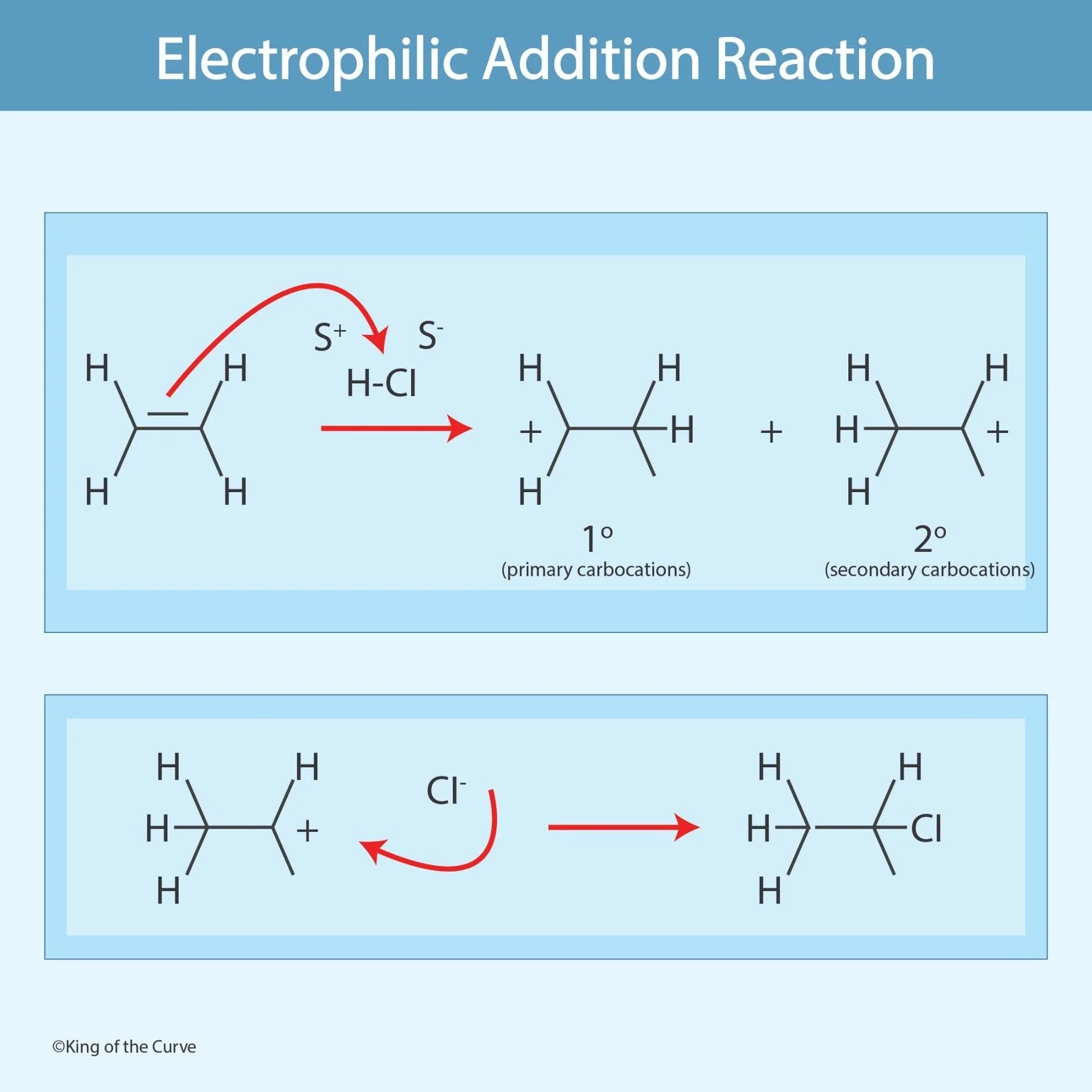
In the reaction shown, the alkene reacts with HCl. The hydrogen atom acts as the electrophile because the H–Cl bond is polarized, giving hydrogen a partial positive charge. Electrons from the double bond attack the hydrogen, breaking the H–Cl bond and generating a carbocation intermediate. This step is often the rate-determining step because carbocation formation requires significant energy.
📊 Key Features of Electrophilic Addition Reactions
| Reaction Order | Rate Law | Effect of Doubling [A] | Concentration vs Time | Units of k |
|---|---|---|---|---|
| Zero Order | Rate = k[A]⁰ | No Change | Linear Decrease | M·s⁻¹ |
| First Order | Rate = k[A] | Rate Doubles | Exponential Decay | s⁻¹ |
| Second Order | Rate = k[A]² | Rate Quadruples | Curved Decay | M⁻¹·s⁻¹ |
⚖️ Carbocation Stability Matters
Once the carbocation forms, its stability determines which reaction pathway is favored. The image compares primary (1°) and secondary (2°) carbocations, demonstrating that secondary carbocations are generally more stable. This stability arises from alkyl groups donating electron density and helping disperse positive charge. As a result, reactions tend to proceed through the most stable carbocation available.
🧲 Step 2: Nucleophilic Attack
After the carbocation is formed, the chloride ion (Cl⁻) acts as a nucleophile. The negatively charged chloride is attracted to the positively charged carbocation and forms a new carbon-chlorine bond. This completes the addition reaction and produces the final alkyl halide product. The nucleophilic attack step is usually rapid because of the strong electrostatic attraction between opposite charges.
📈 Understanding Markovnikov's Rule
Electrophilic addition reactions often follow Markovnikov's Rule, which predicts where the hydrogen atom and nucleophile will attach. The hydrogen typically bonds to the carbon already containing more hydrogens, while the halide attaches to the more substituted carbon. This arrangement usually produces the more stable carbocation intermediate during the reaction. Understanding this rule is critical for predicting products on standardized exams.
🎯 MCAT and Organic Chemistry Applications
The MCAT frequently tests electrophilic addition through reaction mechanisms, product prediction, and carbocation stability questions. Students are often asked to identify intermediates, determine the major product, or explain why one pathway is favored over another. Mastering electrophilic addition provides a foundation for understanding hydration, hydrohalogenation, halogenation, and many other alkene reactions. Recognizing carbocation stability patterns can significantly improve problem-solving speed.

Frequently Asked Questions (FAQs)
-
Aim for 4-6 focused hours, ensuring you incorporate breaks to avoid burnout.
-
Practice mindfulness techniques, take practice exams under realistic conditions, and maintain a balanced lifestyle.
-
Set short-term goals, seek support from mentors, and reward yourself for small achievements.
-
Regular exercise improves focus, reduces stress, and enhances overall mental clarity.
-
KOTC offers personalized learning tools, gamification features, and adaptive question banks to help students stay on track without burnout.