
⚗️ Chemical Reaction Rate Laws Explained
Chemical reaction rate laws are among the most important concepts in chemistry because they explain how reaction speed depends on reactant concentration. Whether you're studying for the MCAT, DAT, AP Chemistry, or a college chemistry course, understanding reaction orders can simplify complex kinetics problems.
🧪 What Are Reaction Rate Laws?
A rate law mathematically relates the rate of a reaction to the concentration of reactants. The exponent attached to a reactant concentration determines the reaction order with respect to that reactant. Different reaction orders respond differently when concentrations change, making it essential to identify the correct relationship. Rate laws help chemists understand reaction mechanisms and predict how quickly products will form under various conditions.
🔹 Zero-Order Reactions
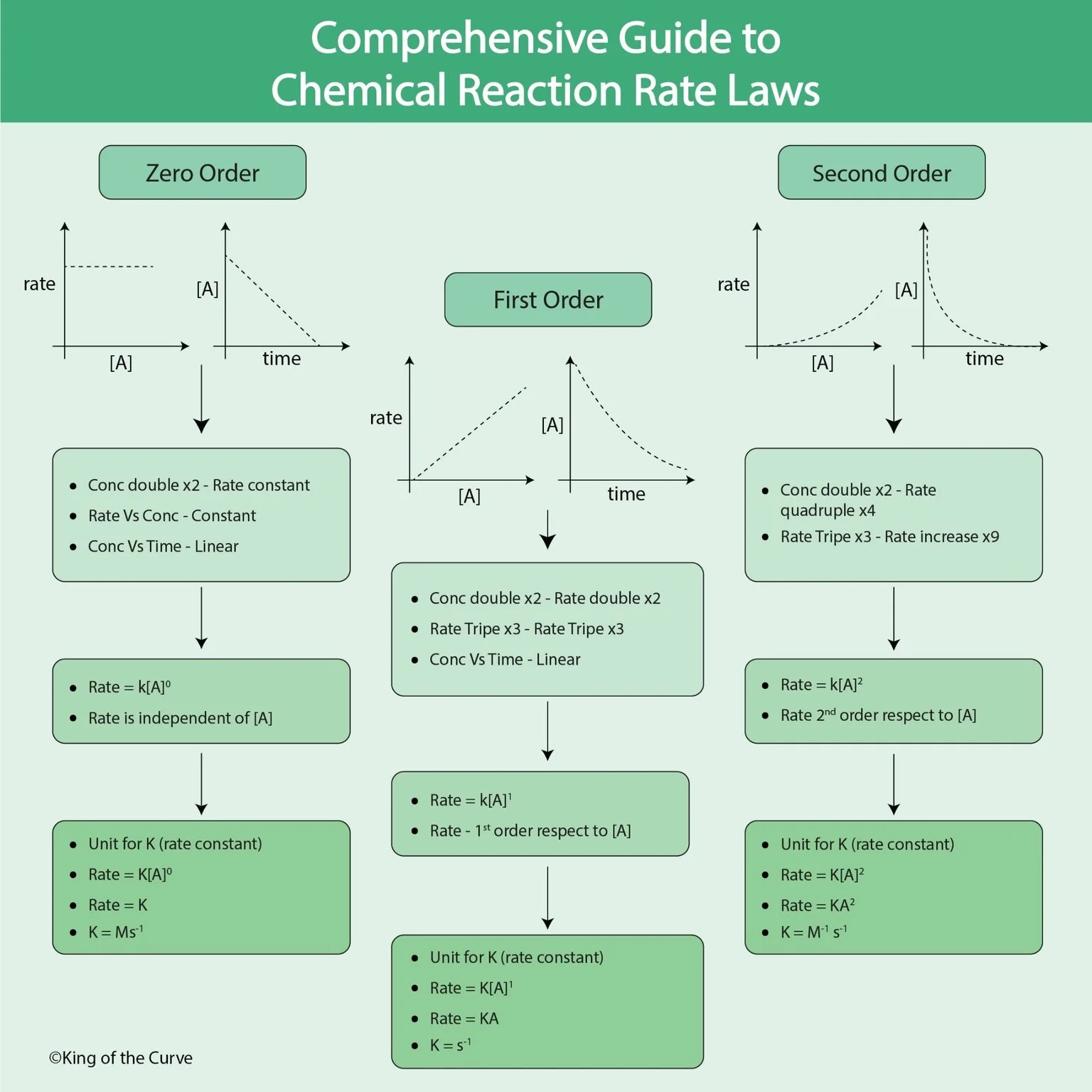
In a zero-order reaction, the reaction rate remains constant regardless of the concentration of the reactant. This means doubling or tripling the concentration has no effect on how quickly the reaction proceeds. The rate law is written as Rate = k[A]⁰, which simplifies to Rate = k. Zero-order reactions often occur when a catalyst or enzyme becomes saturated and can no longer increase the reaction rate.
📊 Comparison of Common Reaction Orders
| Reaction Order | Rate Law | Effect of Doubling [A] | Concentration vs Time | Units of k |
|---|---|---|---|---|
| Zero Order | Rate = k[A]⁰ | No Change | Linear Decrease | M·s⁻¹ |
| First Order | Rate = k[A] | Rate Doubles | Exponential Decay | s⁻¹ |
| Second Order | Rate = k[A]² | Rate Quadruples | Curved Decay | M⁻¹·s⁻¹ |
📈 First-Order Reactions
First-order reactions are directly proportional to reactant concentration. If the concentration doubles, the reaction rate doubles as well. The rate law is written as Rate = k[A]¹, often shortened to Rate = k[A]. Many radioactive decay processes and biological reactions follow first-order kinetics, making this one of the most commonly tested reaction orders on standardized exams.
🚀 Second-Order Reactions
Second-order reactions exhibit an even stronger dependence on concentration. The rate law is Rate = k[A]², meaning that doubling the concentration causes the reaction rate to increase fourfold. Likewise, tripling the concentration results in a ninefold increase in reaction rate. Because of this squared relationship, second-order reactions are highly sensitive to concentration changes and often appear in advanced kinetics problems.
📉 Understanding the Graphs
The visual demonstrates how reaction order affects both rate-versus-concentration and concentration-versus-time graphs. Zero-order reactions show a constant rate and a linear decrease in concentration over time. First-order reactions display a linear relationship between rate and concentration but an exponential decay in concentration. Second-order reactions produce curved graphs that reflect their stronger concentration dependence and more complex kinetic behavior.
🎯 MCAT and Exam Applications
Reaction kinetics is a high-yield topic on the MCAT and other science exams because it combines chemistry, mathematics, and critical thinking. Students are often asked to determine reaction order from experimental data or predict how changing concentrations will affect reaction speed. Recognizing the characteristic patterns of zero, first, and second-order reactions can save valuable time during exams. Memorizing the rate laws and units of the rate constant is especially helpful for solving calculation-based questions.

Frequently Asked Questions (FAQs)
-
Aim for 4-6 focused hours, ensuring you incorporate breaks to avoid burnout.
-
Practice mindfulness techniques, take practice exams under realistic conditions, and maintain a balanced lifestyle.
-
Set short-term goals, seek support from mentors, and reward yourself for small achievements.
-
Regular exercise improves focus, reduces stress, and enhances overall mental clarity.
-
KOTC offers personalized learning tools, gamification features, and adaptive question banks to help students stay on track without burnout.