
🧬 Digestion and Absorption of Carbohydrates
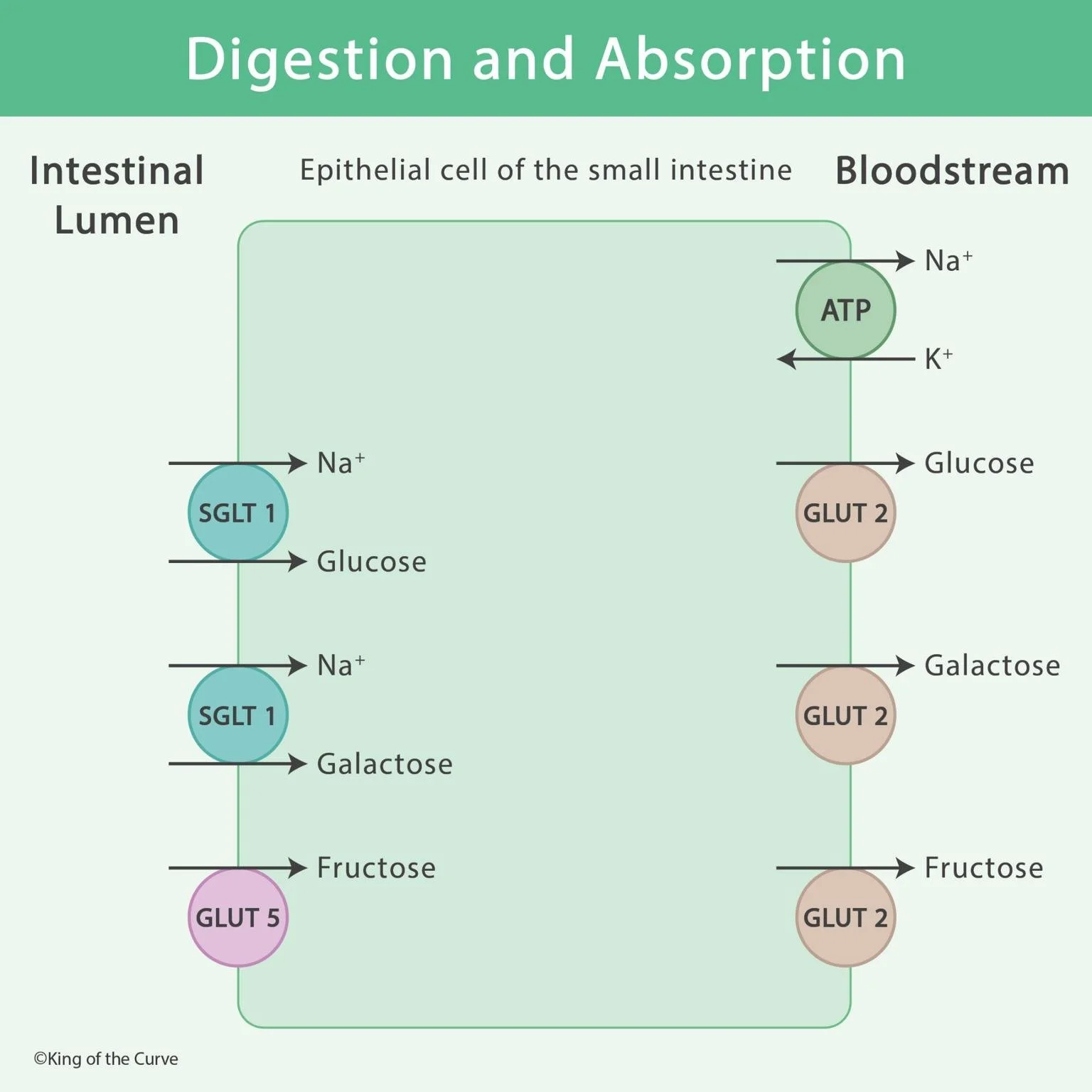
Carbohydrate absorption in the small intestine is a highly coordinated process involving specialized transporters located on the epithelial cells lining the intestinal wall. These cells act as a bridge between the intestinal lumen (where digestion occurs) and the bloodstream (where nutrients are delivered). The diagram highlights how glucose, galactose, and fructose are absorbed through distinct yet interconnected mechanisms.
🔄 Role of the Intestinal Epithelium
The epithelial cells of the small intestine are equipped with transport proteins on both their apical (lumen-facing) and basolateral (blood-facing) surfaces. These transporters allow monosaccharides to move from the intestinal lumen into the bloodstream.
Apical side (lumen side): Entry of sugars into the cell
Basolateral side (bloodstream side): Exit of sugars into circulation
This directional movement ensures that nutrients are absorbed efficiently and delivered to the body.
⚡ Sodium-Dependent Glucose Transport (SGLT-1)
Glucose and galactose are absorbed via the SGLT-1 (Sodium-Glucose Linked Transporter 1) located on the apical membrane.
It uses secondary active transport, meaning it depends on the sodium gradient
Sodium (Na⁺) moves into the cell along its gradient
Glucose or galactose is co-transported with sodium into the cell
This mechanism is highly efficient and ensures that even low concentrations of glucose can be absorbed effectively.
🍬 Fructose Absorption via GLUT-5
Fructose follows a different pathway compared to glucose and galactose.
It is absorbed through GLUT-5, a facilitated diffusion transporter
This process does not require sodium or energy (ATP)
It relies on concentration gradients
Because it uses passive transport, fructose absorption can be slower and more limited compared to glucose.
🚪 Transport into the Bloodstream (GLUT-2)
Once inside the epithelial cell, all three monosaccharides—glucose, galactose, and fructose—exit into the bloodstream through GLUT-2 transporters located on the basolateral membrane.
GLUT-2 allows facilitated diffusion of sugars
It is non-specific and transports all three monosaccharides
This step ensures nutrients reach circulation for energy use or storage
🔋 Role of Na⁺/K⁺ ATPase Pump
The entire absorption process is driven by the Na⁺/K⁺ ATPase pump on the basolateral side.
It uses ATP to pump Na⁺ out of the cell and K⁺ into the cell
This maintains a low intracellular sodium concentration
The sodium gradient created powers SGLT-1 activity
Without this pump, glucose and galactose absorption would not occur efficiently.
📊 Summary Table
| Sugar | Apical Transporter | Mechanism | Basolateral Transporter |
|---|---|---|---|
| Glucose | SGLT-1 | Secondary active (Na+ dependent) | GLUT-2 |
| Galactose | SGLT-1 | Secondary active (Na+ dependent) | GLUT-2 |
| Fructose | GLUT-5 | Facilitated diffusion | GLUT-2 |
🧠 Clinical Insight
Disruptions in these transport systems can lead to clinical conditions. For example, SGLT-1 defects can cause glucose-galactose malabsorption, while fructose intolerance arises from issues in fructose metabolism. Additionally, oral rehydration therapy (ORT) leverages the sodium-glucose co-transport mechanism to enhance water absorption in patients with diarrhea.
🩺 Key Takeaway
Carbohydrate absorption in the small intestine depends on a combination of active and passive transport mechanisms, driven by sodium gradients and specialized transport proteins. The coordination between SGLT-1, GLUT-5, GLUT-2, and the Na⁺/K⁺ ATPase pump ensures efficient nutrient uptake and energy supply for the body.

Frequently Asked Questions (FAQs)
-
Aim for 4-6 focused hours, ensuring you incorporate breaks to avoid burnout.
-
Practice mindfulness techniques, take practice exams under realistic conditions, and maintain a balanced lifestyle.
-
Set short-term goals, seek support from mentors, and reward yourself for small achievements.
-
Regular exercise improves focus, reduces stress, and enhances overall mental clarity.
-
KOTC offers personalized learning tools, gamification features, and adaptive question banks to help students stay on track without burnout.