
🧪 What Is the Continuity Equation?
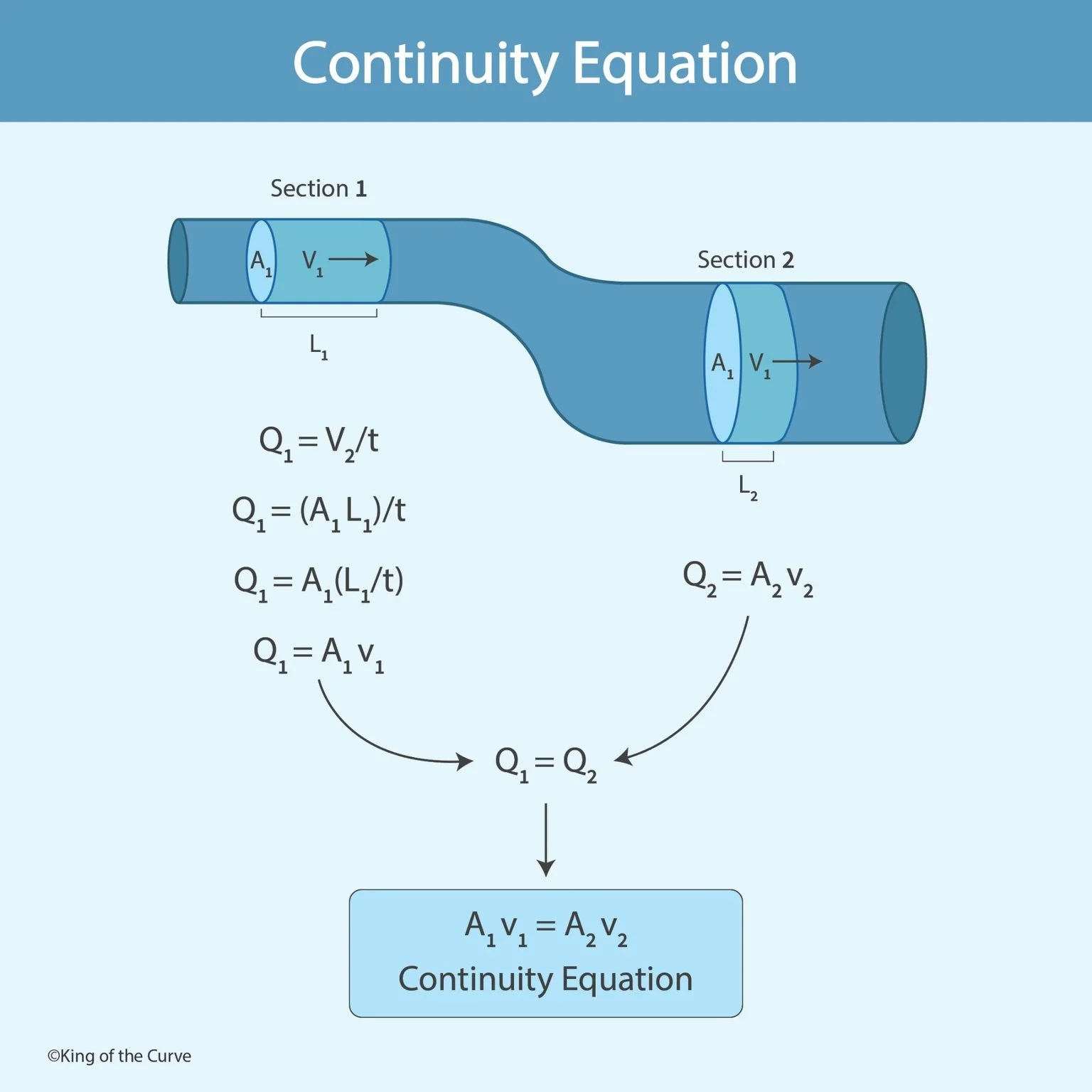
The Continuity Equation is one of the most important concepts in fluid dynamics and is frequently tested on the MCAT. It explains that for an incompressible fluid, the amount of fluid flowing through a system remains constant, even if the diameter of the pipe or blood vessel changes. This relationship is expressed as A₁V₁ = A₂V₂, where A represents cross-sectional area and V represents fluid velocity. Understanding this equation helps students visualize how fluids behave in both physical and biological systems.
⚖️ The Principle of Conservation of Mass
The Continuity Equation is derived from the law of conservation of mass, which states that matter cannot be created or destroyed within a closed system. As fluid moves through a pipe, every unit entering one end must exit the other. Because the flow rate remains constant, any change in the pipe's cross-sectional area must be balanced by an opposite change in fluid velocity. This simple yet powerful principle forms the basis of many fluid mechanics problems.
📊 Breaking Down the Formula
The equation A₁V₁ = A₂V₂ shows the relationship between a fluid's cross-sectional area and its velocity. If the pipe narrows, the area decreases and the fluid must move faster to maintain the same flow rate. Conversely, if the pipe widens, the fluid slows down because it has more space to travel. Keeping this inverse relationship in mind makes solving MCAT physics questions much easier.
🚰 A Simple Everyday Example
One of the easiest ways to understand the Continuity Equation is by thinking about a garden hose. When you partially cover the hose opening with your thumb, the opening becomes smaller, causing the water to spray farther and faster. Although the velocity increases, the total amount of water flowing through the hose each second remains unchanged. This familiar example perfectly illustrates how fluid speed changes while flow rate stays constant.
🩺 Why It Matters in Medicine
The Continuity Equation plays an important role in medicine, particularly in understanding blood circulation. When arteries become narrowed by plaque buildup, blood travels faster through the restricted area because the vessel's cross-sectional area decreases. This principle is also used in Doppler ultrasound, intravenous fluid administration, respiratory physiology, and many medical devices that rely on controlled fluid flow.
📋 Area and Velocity Relationship
| Cross-Sectional Area | Fluid Velocity | Explanation |
|---|---|---|
| Large | Slow | More space allows fluid to move at a lower speed while maintaining flow rate. |
| Medium | Moderate | Velocity adjusts based on the available area. |
| Small | Fast | A narrower passage forces the fluid to move faster to conserve flow rate. |
🎯 How the MCAT Tests This Concept
Rather than asking students to simply memorize the Continuity Equation, the MCAT typically presents it through passage-based questions involving blood vessels, water pipes, or biomedical systems. Students are expected to recognize that when the cross-sectional area decreases, fluid velocity increases. The Continuity Equation is also commonly tested alongside Bernoulli's Equation, making it valuable to understand how both principles work together.
❌ Common Mistakes to Avoid
Many students mistakenly think that both velocity and flow rate change together. In reality, the flow rate remains constant, while the velocity changes depending on the pipe's cross-sectional area. Another common mistake is forgetting that the area of a circular pipe depends on the square of its radius (A = πr²). Even a small decrease in radius results in a much larger decrease in area, leading to a significant increase in fluid velocity.
🚀 Master Fluid Dynamics with King of the Curve
Learning complex physics concepts becomes much easier with visual learning. King of the Curve's proprietary science illustrations simplify topics like the Continuity Equation into memorable diagrams that improve long-term retention. Explore this illustration and 1,000+ additional science visuals at mcat.kingofthecurve.org, and strengthen your preparation with adaptive practice questions, daily challenges, gamified learning, and comprehensive MCAT study resources designed to help you succeed.

Frequently Asked Questions (FAQs)
-
Aim for 4-6 focused hours, ensuring you incorporate breaks to avoid burnout.
-
Practice mindfulness techniques, take practice exams under realistic conditions, and maintain a balanced lifestyle.
-
Set short-term goals, seek support from mentors, and reward yourself for small achievements.
-
Regular exercise improves focus, reduces stress, and enhances overall mental clarity.
-
KOTC offers personalized learning tools, gamification features, and adaptive question banks to help students stay on track without burnout.