
🌊 Laminar vs Turbulent Flow
Fluid flow is a fundamental concept in physics, engineering, and medicine. Whether studying blood circulation, water moving through pipes, or airflow over an aircraft wing, understanding the difference between laminar flow and turbulent flow is essential. These two flow patterns behave very differently and have important real-world applications.
🧭 What Is Fluid Flow?
Fluid flow refers to the movement of liquids or gases from one location to another. Depending on factors such as velocity, viscosity, and the dimensions of the flow channel, fluids may exhibit either laminar or turbulent behavior.
➡️ What Is Laminar Flow?
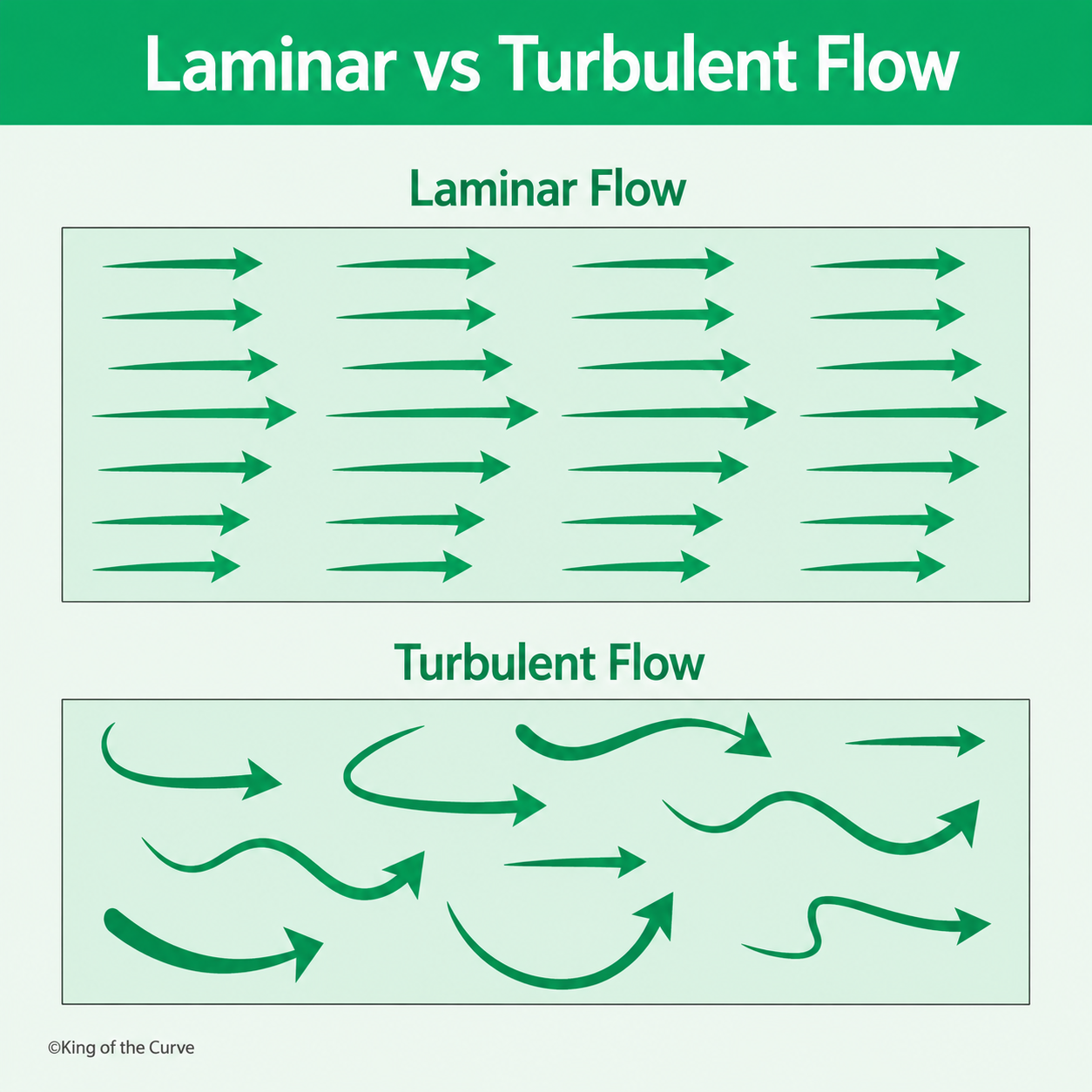
Laminar flow is characterized by smooth, orderly movement of fluid particles in parallel layers. The fluid travels in straight paths with minimal mixing between adjacent layers.
🔹 Characteristics of Laminar Flow
Smooth and predictable motion
Fluid layers move parallel to one another
Minimal mixing between layers
Lower energy loss due to friction
Typically occurs at lower velocities
🩺 Examples of Laminar Flow
Blood flow in small capillaries
Slow-moving water in narrow tubes
Intravenous fluid delivery systems
Microfluidic devices used in laboratories
🌪️ What Is Turbulent Flow?
Turbulent flow is characterized by chaotic, irregular motion. Fluid particles move in swirling patterns known as eddies, causing significant mixing throughout the fluid.
🔹 Characteristics of Turbulent Flow
Chaotic and unpredictable movement
Formation of eddies and vortices
Significant mixing of fluid particles
Greater energy loss due to friction
Usually occurs at higher velocities
🚗 Examples of Turbulent Flow
Rapids in rivers
Airflow behind moving vehicles
Blood flow through narrowed arteries
Water flowing rapidly through large pipes
⚖️ Laminar Flow vs Turbulent Flow
| Feature | Laminar Flow | Turbulent Flow |
|---|---|---|
| Flow Pattern | Smooth and orderly | Chaotic and irregular |
| Mixing | Minimal | Extensive |
| Velocity | Lower | Higher |
| Energy Loss | Low | High |
| Predictability | High | Low |
| Reynolds Number | Less than 2000 | Greater than 4000 |
📏 Reynolds Number and Flow Type
The Reynolds number (Re) is a dimensionless value used to predict whether flow will be laminar or turbulent.
Re = ρvD / μ
Where:
ρ = Fluid density
v = Fluid velocity
D = Diameter of the pipe or vessel
μ = Dynamic viscosity
📊 Reynolds Number Guidelines
Re < 2000: Laminar flow
Re 2000–4000: Transitional flow
Re > 4000: Turbulent flow
❤️ Clinical Importance in Medicine
Understanding flow patterns is especially important in medicine.
🩺 Laminar Blood Flow
Normal blood flow in healthy vessels is generally laminar, allowing efficient circulation and minimal resistance.
🚨 Turbulent Blood Flow
Turbulence can occur when:
Blood velocity increases significantly
Arteries become narrowed (stenosis)
Heart valve abnormalities are present
Turbulent blood flow may produce heart murmurs or vascular bruits, which can be detected during physical examination.
⚙️ Engineering Applications
Engineers often design systems to either minimize or encourage turbulence depending on the application.
✅ When Laminar Flow Is Preferred
Medical devices
Chemical analysis systems
Precision manufacturing
Cleanroom environments
🔄 When Turbulent Flow Is Useful
Industrial mixing processes
Heat exchangers
Combustion systems
Wastewater treatment
🎯 Why Understanding Flow Matters
The distinction between laminar and turbulent flow affects:
Energy efficiency
Heat transfer rates
Pressure losses
Medical diagnoses
Industrial process design
By understanding these flow patterns, scientists, engineers, and healthcare professionals can optimize system performance and improve outcomes.
🏁 Final Thoughts
Laminar and turbulent flows represent two fundamentally different fluid behaviors. Laminar flow is smooth, organized, and efficient, while turbulent flow is chaotic, highly mixed, and associated with greater energy losses. Recognizing the characteristics of each flow type is essential for understanding fluid dynamics in both natural and engineered systems.

Frequently Asked Questions (FAQs)
-
Aim for 4-6 focused hours, ensuring you incorporate breaks to avoid burnout.
-
Practice mindfulness techniques, take practice exams under realistic conditions, and maintain a balanced lifestyle.
-
Set short-term goals, seek support from mentors, and reward yourself for small achievements.
-
Regular exercise improves focus, reduces stress, and enhances overall mental clarity.
-
KOTC offers personalized learning tools, gamification features, and adaptive question banks to help students stay on track without burnout.