
⚗️ Common Mechanisms in Organic Chemistry
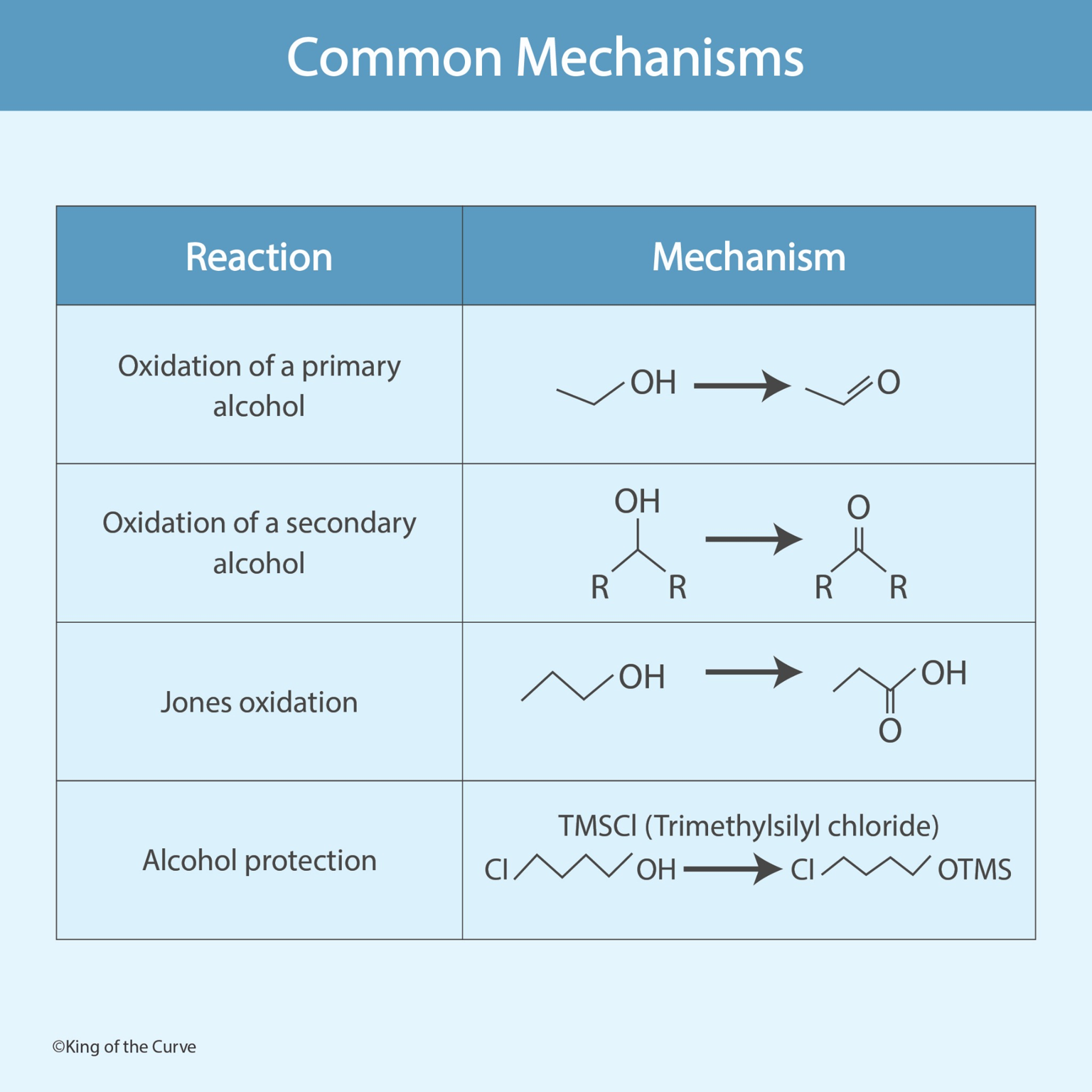
Organic chemistry reactions often follow predictable patterns known as reaction mechanisms. Understanding these mechanisms helps students recognize how molecules transform during synthesis and how different reagents influence chemical behavior. The infographic above highlights several widely used oxidation and protection reactions involving alcohols.
🧪 Oxidation of Primary Alcohols
Primary alcohols can undergo oxidation to form aldehydes and, under stronger conditions, carboxylic acids. Mild oxidizing agents stop the reaction at the aldehyde stage, while stronger oxidants continue oxidation further.
This type of reaction is important in both industrial and biological chemistry. For example, ethanol oxidation in the body eventually forms acetic acid through sequential oxidation steps.
🔬 Oxidation of Secondary Alcohols
Secondary alcohols are commonly oxidized into ketones. Unlike primary alcohols, secondary alcohols do not usually oxidize further without breaking carbon-carbon bonds.
These reactions are highly useful in pharmaceutical and synthetic chemistry because ketones are stable intermediates used in many organic transformations.
⚠️ Jones Oxidation
Jones oxidation uses chromic acid (CrO₃ in sulfuric acid) as a powerful oxidizing agent. It strongly oxidizes primary alcohols directly into carboxylic acids.
Because the reagent is highly reactive, it is often used when complete oxidation is desired. However, chemists must handle chromium reagents carefully due to toxicity and environmental concerns.
🛡️ Alcohol Protection Using TMSCl
In multi-step synthesis, alcohol groups sometimes need protection to prevent unwanted reactions. Trimethylsilyl chloride (TMSCl) converts alcohols into silyl ethers, temporarily protecting the hydroxyl group.
Protecting groups are extremely important in organic synthesis because they allow chemists to selectively react one functional group while leaving another unchanged.
📊 Common Organic Reaction Mechanisms Table
| Reaction | Transformation | Typical Reagent |
|---|---|---|
| Primary Alcohol Oxidation | Alcohol → Aldehyde | PCC |
| Secondary Alcohol Oxidation | Alcohol → Ketone | CrO₃ / PCC |
| Jones Oxidation | Primary Alcohol → Carboxylic Acid | CrO₃, H₂SO₄ |
| Alcohol Protection | Alcohol → Silyl Ether | TMSCl |
⚡ Importance of Oxidation Reactions in Organic Chemistry
Oxidation reactions are among the most important transformations in organic chemistry because they help convert simple alcohols into more reactive functional groups such as aldehydes, ketones, and carboxylic acids. These products serve as key intermediates in the synthesis of pharmaceuticals, polymers, fragrances, and biological molecules. By controlling the strength of the oxidizing agent, chemists can selectively stop a reaction at a desired stage.
Understanding oxidation mechanisms also improves problem-solving skills in reaction prediction. Students frequently encounter oxidation questions in exams where they must identify reagents, predict products, or determine whether a primary or secondary alcohol is present. Recognizing these patterns makes complex synthesis pathways much easier to analyze and understand.
🧬 Role of Protecting Groups in Multi-Step Synthesis
Protecting groups such as TMS (trimethylsilyl) ethers are essential in advanced organic synthesis because many molecules contain multiple reactive functional groups. Without protection, unwanted side reactions may occur, reducing product yield or creating impurities. Converting alcohols into protected silyl ethers allows chemists to perform selective reactions elsewhere in the molecule safely.
After the desired transformations are complete, the protecting group can be removed under controlled conditions to regenerate the original alcohol. This strategy is widely used in medicinal chemistry, peptide synthesis, and natural product synthesis, where precise control over molecular reactivity is critical for successful chemical design.

Frequently Asked Questions (FAQs)
-
Aim for 4-6 focused hours, ensuring you incorporate breaks to avoid burnout.
-
Practice mindfulness techniques, take practice exams under realistic conditions, and maintain a balanced lifestyle.
-
Set short-term goals, seek support from mentors, and reward yourself for small achievements.
-
Regular exercise improves focus, reduces stress, and enhances overall mental clarity.
-
KOTC offers personalized learning tools, gamification features, and adaptive question banks to help students stay on track without burnout.