
🪑 Chair Conformations in Cyclohexane
Chair conformations are the most stable three-dimensional arrangements of cyclohexane rings. In organic chemistry, cyclohexane does not remain flat because a planar structure would create excessive angle strain and torsional strain. Instead, the molecule adopts a puckered “chair” shape that minimizes these destabilizing forces and allows bond angles to remain close to the ideal tetrahedral angle of 109.5°.
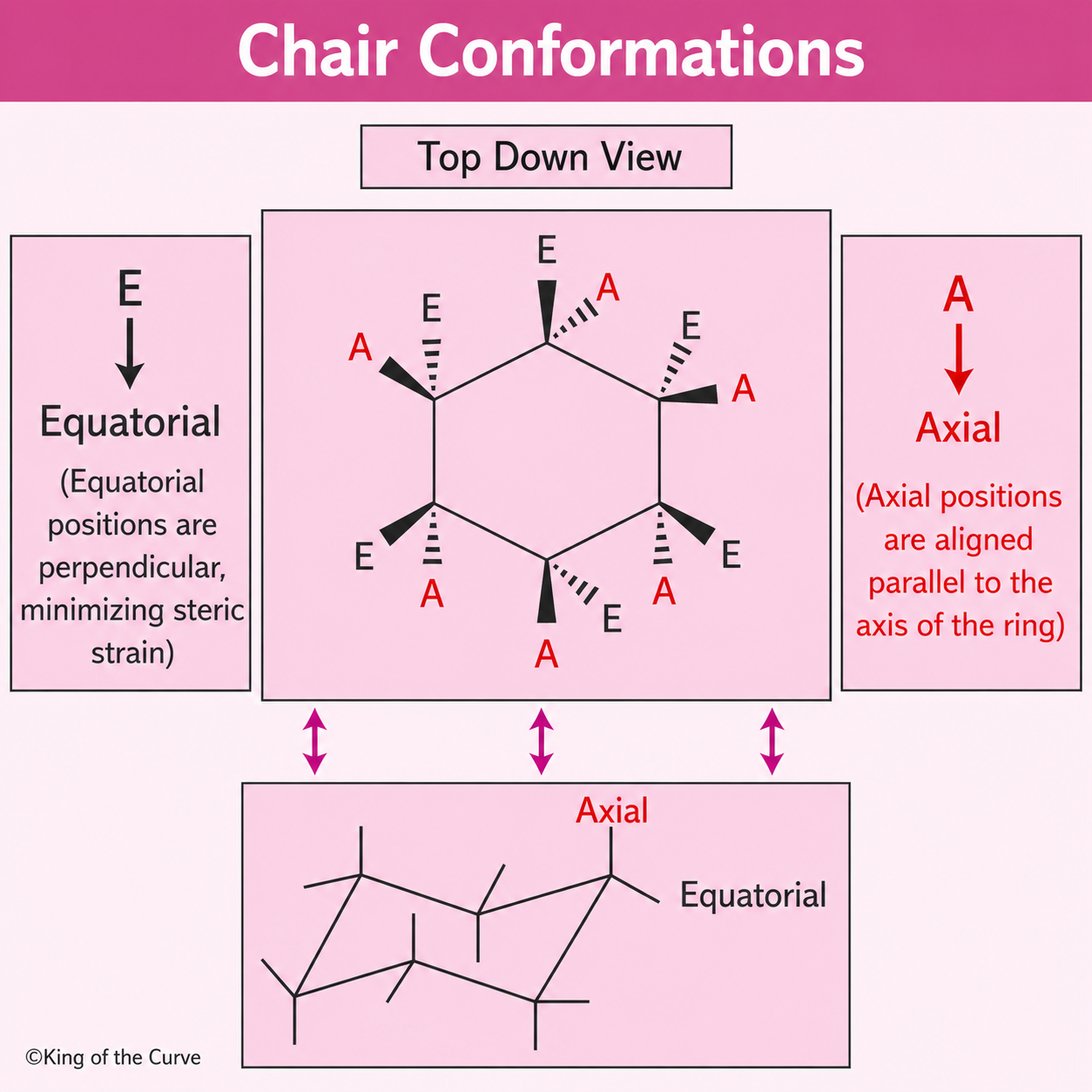
🔬 What Is a Chair Conformation?
A chair conformation is the lowest-energy structure of cyclohexane. In this arrangement:
Carbon atoms alternate above and below the plane
Bond angles remain nearly tetrahedral
Eclipsing interactions are minimized
This makes the chair form more stable than other cyclohexane conformations such as the boat or twist-boat forms.
📍 Axial Positions
Axial positions are oriented vertically relative to the ring. These bonds point either straight up or straight down and are parallel to the axis of the ring.
Characteristics of axial positions:
Alternate upward and downward around the ring
Can create steric hindrance with nearby substituents
Often less stable for bulky groups
Large substituents in axial positions experience 1,3-diaxial interactions, which increase steric strain.
↔️ Equatorial Positions
Equatorial positions extend outward around the perimeter of the ring. These bonds are roughly parallel to the ring plane.
Characteristics of equatorial positions:
More spacious arrangement
Reduced steric strain
Preferred position for bulky substituents
Because equatorial substituents experience fewer repulsive interactions, cyclohexane conformations with bulky groups in equatorial positions are generally more stable.
🔄 Ring Flipping
Cyclohexane can undergo a process called ring flipping, where axial substituents become equatorial and vice versa.
During a ring flip:
Axial → Equatorial
Equatorial → Axial
However:
Upward/downward orientation remains unchanged
The molecule rapidly interconverts between forms at room temperature
The more stable conformation is usually the one placing larger groups in equatorial positions.
📊 Axial vs Equatorial Positions
| Feature | Axial Position | Equatorial Position |
|---|---|---|
| Orientation | Vertical | Outward / sideways |
| Steric Strain | Higher | Lower |
| Stability for Bulky Groups | Less stable | More stable |
| Parallel to Ring Axis | Yes | No |
| Preferred by Large Substituents | No | Yes |
⚗️ Importance in Organic Chemistry
Chair conformations help chemists predict:
Molecular stability
Reaction outcomes
Steric interactions
Conformational preferences
Many biological molecules and pharmaceutical compounds contain cyclohexane rings, making chair conformations highly relevant in medicinal chemistry and biochemistry.
🧠 Conclusion
Chair conformations provide cyclohexane with its most stable three-dimensional structure by minimizing strain. The distinction between axial and equatorial positions plays a major role in determining molecular stability and substituent behavior. Understanding these conformations is fundamental in organic chemistry and helps explain the physical and chemical properties of cyclic compounds.

Frequently Asked Questions (FAQs)
-
Aim for 4-6 focused hours, ensuring you incorporate breaks to avoid burnout.
-
Practice mindfulness techniques, take practice exams under realistic conditions, and maintain a balanced lifestyle.
-
Set short-term goals, seek support from mentors, and reward yourself for small achievements.
-
Regular exercise improves focus, reduces stress, and enhances overall mental clarity.
-
KOTC offers personalized learning tools, gamification features, and adaptive question banks to help students stay on track without burnout.