
⚖️ Common Ion Effect Explained: A High-Yield MCAT Chemistry Concept
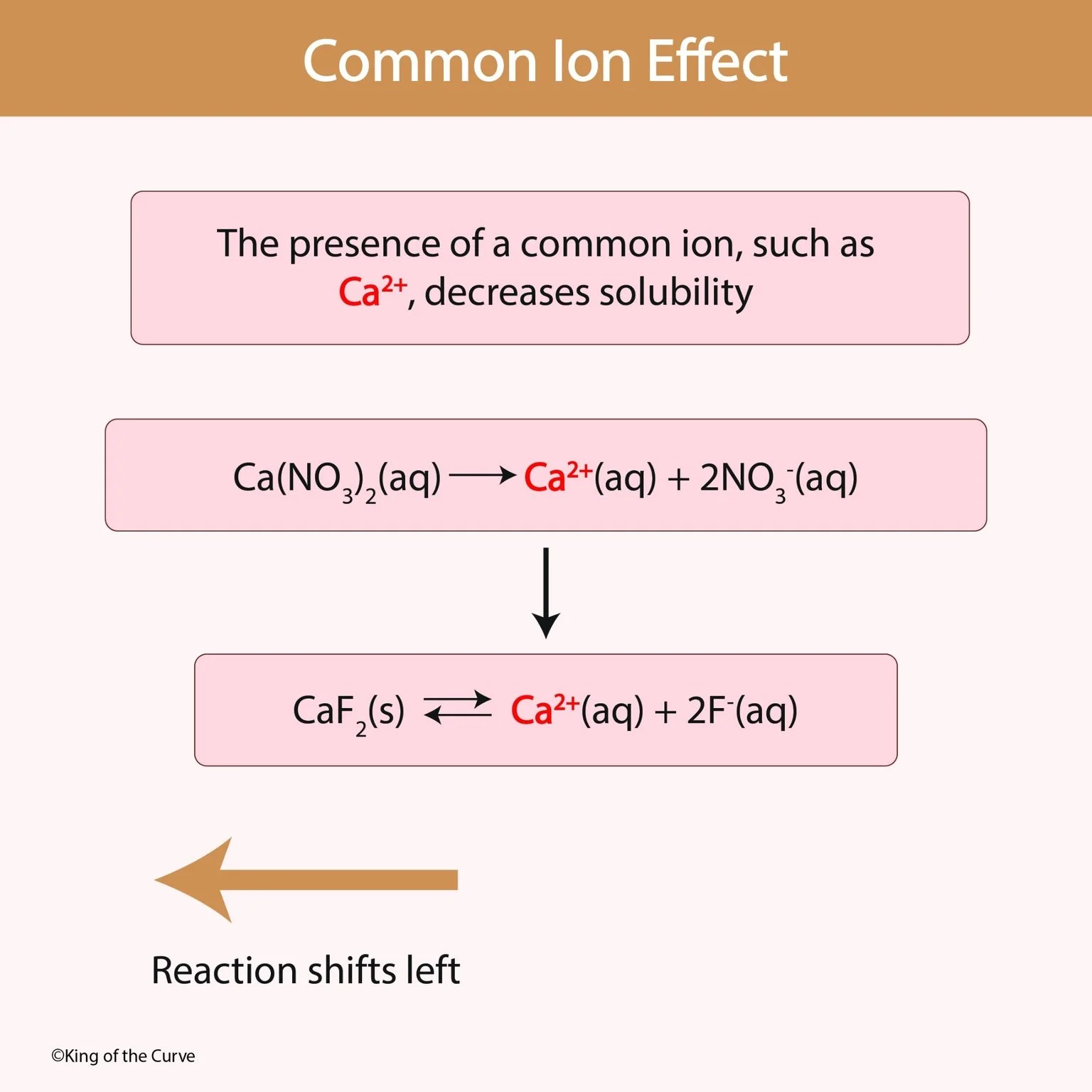
The Common Ion Effect is one of the most important equilibrium concepts tested in general chemistry and frequently appears in MCAT, DAT, and undergraduate chemistry courses. It describes what happens when an ion already present in a chemical equilibrium is added to the solution. As shown in the King of the Curve visual, introducing additional calcium ions (Ca²⁺) causes a shift in equilibrium that decreases the solubility of calcium fluoride. Understanding this principle helps students predict how chemical systems respond to changes in concentration.
🧪 What Is the Common Ion Effect?
The Common Ion Effect occurs when a solution contains an ion that is shared by a dissolved compound and an equilibrium reaction. According to Le Châtelier's Principle, adding more of a product causes the equilibrium to shift in the opposite direction to reduce that disturbance. In solubility equilibria, this often results in less of a solid dissolving into solution. As a result, compounds become less soluble when one of their constituent ions is already abundant in the surrounding environment.
🔬 Calcium Nitrate Introduces a Common Ion
In the diagram, calcium nitrate dissolves completely in water:
Ca(NO₃)₂(aq) → Ca²⁺(aq) + 2NO₃⁻(aq)
This reaction significantly increases the concentration of calcium ions in solution. Since calcium ions are also present in the calcium fluoride equilibrium, they become the "common ion." The introduction of additional Ca²⁺ creates an imbalance that the equilibrium system must correct. This sets the stage for a shift in the calcium fluoride dissolution reaction.
📊 Common Ion Effect at a Glance
| Step | Process | Result |
|---|---|---|
| 1️⃣ | Calcium nitrate dissolves | Increases Ca²⁺ concentration |
| 2️⃣ | Ca²⁺ enters solution | Common ion is introduced |
| 3️⃣ | Equilibrium responds | System shifts left |
| 4️⃣ | Calcium fluoride dissolves less | Solubility decreases |
| 5️⃣ | More solid remains undissolved | Precipitation is favored |
↔️ How Equilibrium Shifts Left
Calcium fluoride exists in equilibrium with its dissolved ions:
CaF₂(s) ⇌ Ca²⁺(aq) + 2F⁻(aq)
When extra Ca²⁺ ions are added, the equilibrium contains more product than before. To counteract this change, the reaction shifts toward the reactant side. This means dissolved ions combine to form more solid calcium fluoride. The result is a decrease in the amount of CaF₂ that remains dissolved in solution.
📉 Why Solubility Decreases
Solubility refers to the maximum amount of a substance that can dissolve under specific conditions. When a common ion is introduced, the equilibrium favors formation of the solid rather than dissolution. Consequently, less of the ionic compound can dissolve before equilibrium is reached. This phenomenon is routinely observed in laboratory settings and is a common topic in chemistry calculations involving Ksp and solubility equilibria.
🧠 MCAT and Exam Applications
The MCAT frequently tests the Common Ion Effect through equilibrium passages, solubility questions, and laboratory scenarios. Students may be asked to predict whether solubility increases or decreases after adding a particular salt. Rather than memorizing individual examples, it is more effective to identify the common ion and apply Le Châtelier's Principle. This strategy allows students to solve unfamiliar problems quickly and accurately during the exam.
🎯 Common Mistakes Students Make
One of the most common misconceptions is assuming that adding any ion decreases solubility. In reality, only the addition of a common ion shifts the equilibrium in this way. Another mistake is forgetting that spectator ions, such as nitrate (NO₃⁻) in this example, generally do not affect the dissolution equilibrium. Focusing on the ions directly involved in the equilibrium reaction helps avoid unnecessary confusion and calculation errors.

Frequently Asked Questions (FAQs)
-
Aim for 4-6 focused hours, ensuring you incorporate breaks to avoid burnout.
-
Practice mindfulness techniques, take practice exams under realistic conditions, and maintain a balanced lifestyle.
-
Set short-term goals, seek support from mentors, and reward yourself for small achievements.
-
Regular exercise improves focus, reduces stress, and enhances overall mental clarity.
-
KOTC offers personalized learning tools, gamification features, and adaptive question banks to help students stay on track without burnout.