
🧲 Common Free Body Diagram Forces Explained
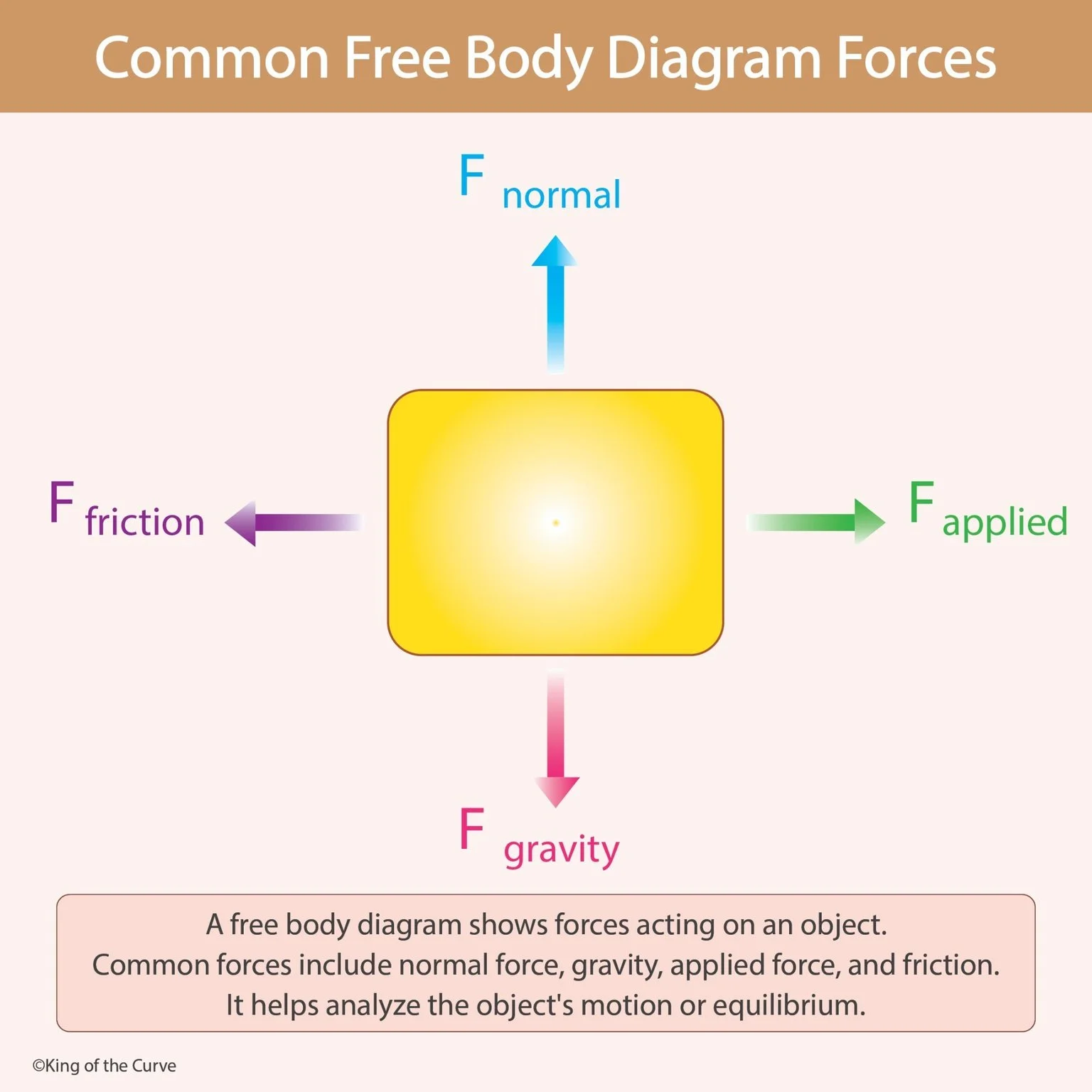
A free body diagram (FBD) is one of the most useful tools in physics and engineering for understanding how forces act on an object. It simplifies a situation by isolating the object and showing every external force acting on it. These diagrams help students and engineers visualize motion, balance, and interactions between surfaces.
⚙️ Why Free Body Diagrams Matter
Free body diagrams are essential because they form the foundation for solving mechanics problems. Whether an object is moving, accelerating, or staying still, forces are always involved. By drawing an FBD, you can clearly identify which forces are present and determine how they combine to influence the object’s motion or equilibrium.
⬆️ Normal Force (F normal)
The normal force is the support force exerted by a surface on an object resting against it. For example, when a block sits on a table, the table pushes upward on the block. This upward push is the normal force, and it always acts perpendicular to the surface.
⬇️ Gravitational Force (F gravity)
Gravity is one of the most constant forces in nature. It pulls objects downward toward the center of the Earth. This force is also called weight and is calculated as F = mg, where m is mass and g is gravitational acceleration.
➡️ Applied Force (F applied)
An applied force is any force exerted on an object by an external source. This could be a push, pull, or tension from a rope. For example, if a person pushes a box across the floor, the push is an applied force.
⬅️ Friction Force (F friction)
Friction is a resisting force that acts opposite the direction of motion or attempted motion. If you push a block to the right, friction pushes back to the left.
📊 Common Forces in a Free Body Diagram
| Force Type | Symbol | Direction | Example |
|---|---|---|---|
| Normal Force | F normal | Upward, perpendicular to surface | Table supporting a book |
| Gravitational Force | F gravity | Downward toward Earth | Weight of an object |
| Applied Force | F applied | In direction of push/pull | Person pushing a box |
| Friction Force | F friction | Opposite motion direction | Box sliding on the floor |
⚖️ Balanced vs Unbalanced Forces
Free body diagrams help determine whether forces are balanced. If all forces cancel out, the net force is zero and the object remains in equilibrium. If forces do not cancel, the object accelerates according to Newton’s Second Law: F net = ma.
🎯 Mastering Free Body Diagrams
Learning the four common forces—normal force, gravity, applied force, and friction—makes it much easier to solve physics problems. Free body diagrams provide a clear roadmap for analyzing motion, understanding equilibrium, and applying Newton’s laws in real-world scenarios.

Frequently Asked Questions (FAQs)
-
Aim for 4-6 focused hours, ensuring you incorporate breaks to avoid burnout.
-
Practice mindfulness techniques, take practice exams under realistic conditions, and maintain a balanced lifestyle.
-
Set short-term goals, seek support from mentors, and reward yourself for small achievements.
-
Regular exercise improves focus, reduces stress, and enhances overall mental clarity.
-
KOTC offers personalized learning tools, gamification features, and adaptive question banks to help students stay on track without burnout.