
🌸 Celiac Trunk and Its Branches
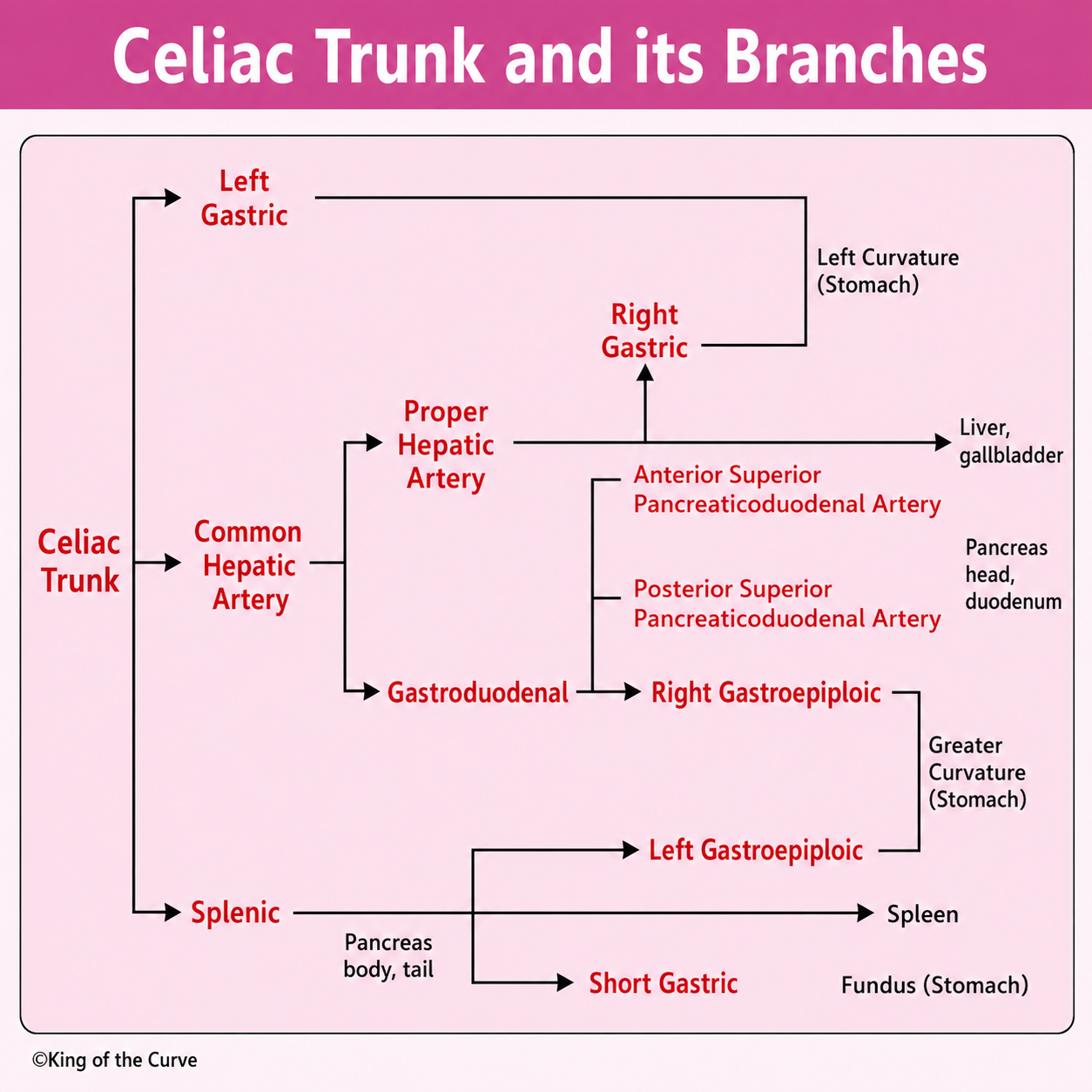
The celiac trunk is the first major branch of the abdominal aorta that supplies blood to the upper abdominal organs derived from the embryonic foregut. It is a short but vital artery that rapidly divides into three primary branches: the left gastric artery, splenic artery, and common hepatic artery. These vessels ensure oxygen-rich blood reaches the stomach, liver, spleen, pancreas, and portions of the duodenum.
🩺 What Is the Celiac Trunk?
The celiac trunk arises from the abdominal aorta just below the diaphragm around the T12 vertebral level. Although only a few centimeters long, it immediately branches into arteries that supply several major digestive organs.
The three classical branches are:
Left Gastric Artery
Splenic Artery
Common Hepatic Artery
These branches form extensive arterial networks around the stomach and abdominal organs.
🍽️ Left Gastric Artery
The left gastric artery is usually the smallest branch of the celiac trunk. It travels toward the lesser curvature of the stomach and supplies:
Lesser curvature of the stomach
Lower esophagus
It anastomoses with the right gastric artery, creating a continuous blood supply along the stomach’s lesser curvature.
🧠 Splenic Artery
The splenic artery is typically the largest and most tortuous branch. It courses along the superior border of the pancreas toward the spleen.
It supplies:
Spleen
Pancreatic body and tail
Fundus of the stomach
Important branches:
Left gastroepiploic artery
Short gastric arteries
These vessels help supply the greater curvature and fundus of the stomach.
🫀 Common Hepatic Artery
The common hepatic artery travels toward the liver and gives rise to multiple clinically important branches.
Major branches include:
Proper hepatic artery
Gastroduodenal artery
Right gastric artery
The proper hepatic artery ultimately supplies the liver and gallbladder.
⚕️ Gastroduodenal and Pancreaticoduodenal Arteries
The gastroduodenal artery descends behind the duodenum and gives rise to:
Anterior superior pancreaticoduodenal artery
Posterior superior pancreaticoduodenal artery
Right gastroepiploic artery
These vessels supply:
Head of the pancreas
Duodenum
Greater curvature of the stomach
This arterial network forms important collateral circulation with branches from the superior mesenteric artery.
📊 Major Branches of the Celiac Trunk
| Branch | Main Supply |
|---|---|
| Left Gastric Artery | Lesser curvature of stomach, lower esophagus |
| Splenic Artery | Spleen, pancreas, stomach fundus |
| Common Hepatic Artery | Liver, gallbladder, stomach, pancreas |
| Right Gastroepiploic Artery | Greater curvature of stomach |
| Short Gastric Arteries | Fundus of stomach |
| Pancreaticoduodenal Arteries | Pancreas head and duodenum |
🧬 Clinical Significance
Knowledge of the celiac trunk is extremely important in:
Abdominal surgeries
Liver transplantation
Pancreatic surgery
Gastric resections
Angiography and interventional radiology
Blockage or compression of the celiac trunk can lead to abdominal pain and ischemia. Variations in branching patterns are also common and clinically significant during surgical planning.
📚 Conclusion
The celiac trunk is a short but essential artery that supplies multiple upper abdominal organs through its three primary branches: the left gastric, splenic, and common hepatic arteries. Its extensive arterial network supports the stomach, liver, spleen, pancreas, and duodenum. Understanding these branches is fundamental in anatomy and clinical medicine.

Frequently Asked Questions (FAQs)
-
Aim for 4-6 focused hours, ensuring you incorporate breaks to avoid burnout.
-
Practice mindfulness techniques, take practice exams under realistic conditions, and maintain a balanced lifestyle.
-
Set short-term goals, seek support from mentors, and reward yourself for small achievements.
-
Regular exercise improves focus, reduces stress, and enhances overall mental clarity.
-
KOTC offers personalized learning tools, gamification features, and adaptive question banks to help students stay on track without burnout.